
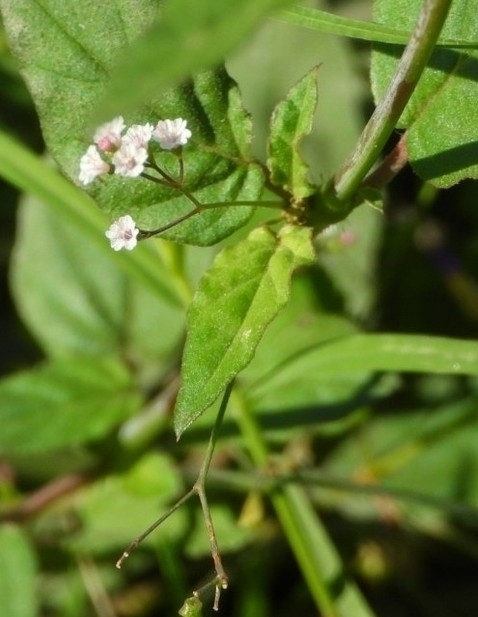
Erect spiderling (Boerhavia erecta) is a fast-growing annual herb native to the warm regions of the Americas and tropical Africa. It belongs to the Nyctaginaceae family and reaches heights between 20-80 cm (8-31 in).
The plant colonizes disturbed soils, sandy fields, and roadsides across tropical and subtropical zones. Its sticky, club-shaped fruits attach easily to passing animals, spreading seeds across wide distances.
Key Facts
- Family: Four o’clock family (Nyctaginaceae)
- Height: 20-80 cm (8-31 in) upright habit
- Lifecycle: Annual or short-lived perennial herb
- Native Range: Americas, tropical and southern Africa
- Fruit Type: Glandular, sticky anthocarp measuring 3-4 mm
Where Erect Spiderling Grows and Spread Pattern
Erect spiderling thrives in disturbed, open ground with full sun exposure across tropical and warm temperate biomes. It functions as an opportunistic pioneer weed rather than a cultivated garden plant.
You will frequently encounter it along gravel paths, sandy fields, rail lines, and bare urban spots. Its taproot penetrates compacted ground rapidly after spring rains, allowing it to complete its lifecycle in under 60 days.
How to Identify Boerhavia erecta
Erect spiderling is a branching herb reaching 20-80 cm (8-31 in) tall with reddish, smooth or sparsely hairy stems. The plant maintains a distinct upright habit, unlike spreading low-growing relatives in its genus.
Key botanical characteristics help distinguish this species in the field:
- Leaves: Opposite pairs measuring 2-6 cm (0.8-2.4 in) long, oval to lance-shaped with pale, whitish undersides often edged in red.
- Flowers: Small, bell-shaped blooms measuring 1-2 mm, ranging from pale pink to white, grouped in loose terminal clusters.
- Stems: Slender, erect, reddish-green, and hairless near the base with sticky brown nodal rings.
- Fruit: Club-shaped anthocarps measuring 3-4 mm long, marked by 5 distinct smooth ribs and sticky glands.
Native Habitat and Global Distribution
Erect spiderling originates in the tropical Americas and sub-Saharan Africa, where it occupies sandy washes, river banks, and scrublands. It now persists as a naturalized weed across Asia, Australia, and Pacific island groups.
The species grows at elevations from sea level up to 1,200 m (3,900 ft). It prefers temperatures between 20-35 °C (68-95 °F) and annual rainfall between 400-1,500 mm (16-59 in).
Ecology and Seed Dispersal of Erect Spiderling
Erect spiderling relies primarily on epizoochory for long-distance seed transport via small adhesive glands on its fruit. The sticky coating clings to animal fur, bird feathers, machinery, and clothing.
Small solitary bees and flies pollinate the tiny blossoms during morning hours. Seed production is prolific, with a single plant producing over 2,000 seeds per growing cycle in warm climates.
Weed Status and Environmental Impact
Erect spiderling holds a classification of agricultural and ruderal weed in over 40 countries across Asia and the Americas. It competes with crops such as maize, sugarcane, cotton, and peanuts for soil nitrogen and moisture.
Control methods in agricultural settings include:
- Shallow cultivation before seeds mature to interrupt the 45-day seed-to-flower cycle.
- Mulching bare crop rows to prevent seed germination in sunny spots.
- Manual hand-pulling before sticky seed pods form in mid-summer.
Traditional Boerhavia erecta Medicinal Uses and Benefits
Erect spiderling was traditionally used in West African, Caribbean, and Indian folk medicine to treat fever, jaundice, and internal inflammation. Indigenous populations boiled whole plant extracts into herbal teas and poultices.
In rural regions of Nigeria and Brazil, young shoots were occasionally cooked as pot herbs during dry seasons. Modern phytochemical screening has isolated punarnavine alkaloids and flavonoids from root tissues, though raw consumption requires caution due to potential nitrate accumulation.
Similar Species and Distinguishing Features
Erect spiderling is frequently confused with red spiderling (Boerhavia diffusa), which grows as a trailing, prostrate ground cover rather than an erect herb. Knowing the structural differences helps confirm field identification.
Compare erect spiderling against these related species:
- Boerhavia diffusa (red spiderling): Prostrate, sprawling stems with magenta flowers and glandular-hairy seed pods.
- Boerhavia coccinea (scarlet spiderling): Sticky, hairy stems with bright red-purple flowers and glandular fruit.
- Mirabilis jalapa (four o’clock): Larger shrubby perennial in the same family with tubed flowers measuring 3-5 cm (1.2-2.0 in).
- Acanthocarpus preissii: Rigid coastal perennial with spiky fruit clusters.
Frequently Asked Questions
What is the common name of Boerhavia erecta?
The most widely used common name is erect spiderling. Other recognized regional names include erect boerhavia, smooth hogweed, and hogmeat.
Which plant family does Boerhavia erecta belong to?
Boerhavia erecta belongs to the Nyctaginaceae family, commonly known as the four o'clock family.
What are the traditional medicinal uses of Boerhavia erecta?
Boerhavia erecta was traditionally used in West Africa and India for treating fever, liver discomfort, and inflammation. Extracts contain punarnavine compounds, but consuming raw material carries risks from accumulated nitrates.
What is the difference between Boerhavia erecta L. and Boerhavia diffusa?
Boerhavia erecta grows upright with hairless stems and pale pink to white flowers, whereas red spiderling (Boerhavia diffusa) forms a low prostrate mat with hairy stems and dark magenta blossoms.
Is Boerhavia erecta related to Cydonia vulgaris?
No, erect spiderling is entirely unrelated to quince (Cydonia vulgaris, correctly known as Cydonia oblonga), which is a woody fruit tree in the Rosaceae family.
Information about traditional or historical uses is provided for educational interest only and is not medical advice. Do not use any plant to treat a condition without speaking to a qualified professional.
Sources & Verification
Taxonomy and distribution are checked against the databases below. Care guidance is written for cultivated species only and reviewed by our editor. How We Build Plant Profiles →
