
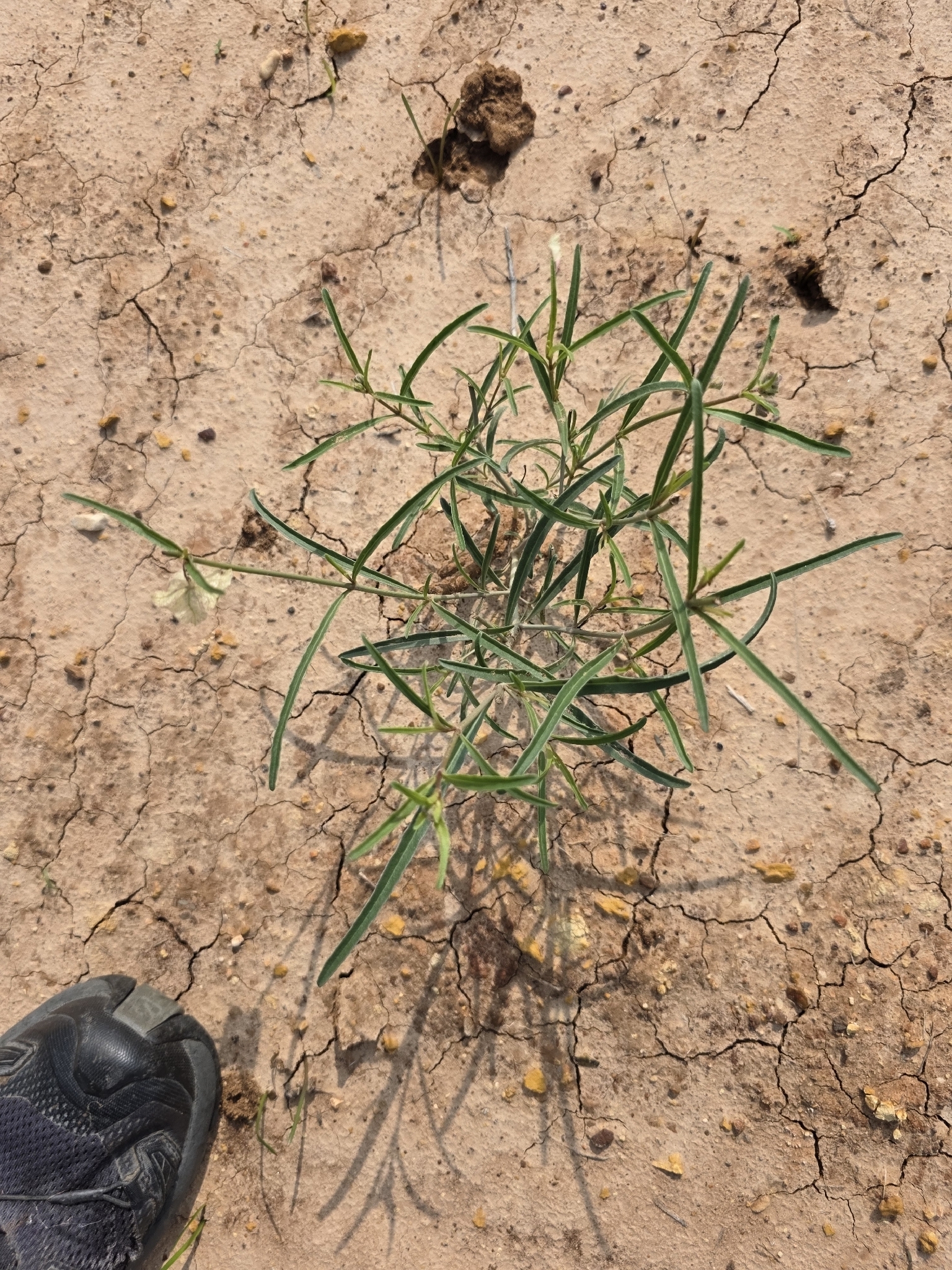
Narrowleaf four o’clock (Mirabilis linearis) is a herbaceous perennial native to dry prairies, barrens, and open woodlands across central and western North America. It produces slender stems with narrow leaves and pale pink to magenta flowers that open late in the day.
Unlike garden species in the four o’clock family, this wild plant thrives in rocky, fast-draining soils with minimal moisture. Its deep taproot allows it to survive severe drought conditions across high plains habitats.
Key Facts
- Plant Type: Herbaceous perennial wildflower
- Native Range: Central and western North America
- Height: 30 to 100 cm (12 to 40 in)
- Bloom Time: Late spring through summer
- Flower Opening: Late afternoon to mid-morning
- Root System: Thick perennial taproot
Where Narrowleaf Four O’Clock Fits in Wild Landscapes
Narrowleaf four o’clock functions as a drought-adapted perennial coloniser in arid grassland ecosystems and exposed rocky slopes. It grows in thin prairie soils where moisture evaporates quickly.
This wild perennial has low water demands and high wind resistance across elevated plains regions. It provides physical ground coverage in native prairie remnants and disturbed hillside communities.
How to Identify Narrowleaf Four O’Clock
Narrowleaf four o’clock is identified by its linear opposite leaves measuring 3 to 10 cm (1.2 to 3.9 in) long and under 6 mm (0.24 in) wide. The plant grows from 30 to 100 cm (12 to 40 in) tall on branched, grey-green stems.
The pink to white funnel-shaped flowers measure 8 to 15 mm (0.3 to 0.6 in) long and open during late afternoon hours. Key identification traits include:
- Stems: Pale green to greyish, highly branched, smooth or slightly hairy near nodes.
- Leaves: Strictly opposite, linear to narrowly lanceolate, attached directly to stems.
- Involucre: Bell-shaped green bract cup enclosing clusters of 3 flowers.
- Fruit: Club-shaped anthocarp 3.5 to 5 mm (0.14 to 0.20 in) long with 5 distinct ribs and a textured surface.
- Taproot: Thick, woody underground root storing moisture for dry spells.
Native Habitat and Range of Mirabilis linearis
Mirabilis linearis ranges across central North America from Saskatchewan south through northern Mexico. It occurs at elevations between 300 and 2,600 m (1,000 and 8,500 ft) above sea level.
It inhabits open grassland prairies, pinyon-juniper woodlands, sandy plains, and gravelly bluffs. The species thrives in neutral to alkaline soils and withstands winter air temperatures down to -30 °C (-22 °F) in northern prairie zones.
Ecology and Night-Blooming Pollination
The flowers of narrowleaf four o’clock open in late afternoon around 4:00 PM to 6:00 PM and stay open overnight before closing by mid-morning. This timing aligns flower availability with nocturnal insect activity.
Sphingid hawkmoths and nocturnal bees visit the blooms to collect nectar. Granivorous birds and small rodents harvest the nutrient-rich seed-like anthocarps during autumn months.
Conservation Status of Narrowleaf Four O’Clock
Narrowleaf four o me holds a global conservation status of G5 (Secure) across its native range. Wild populations remain broad and stable throughout the Great Plains and Intermountain West.
Localized habitat conversion to row-crop agriculture reduces prairie fragments in eastern boundary zones. Invasive non-native annual grasses like cheatgrass (Bromus tectorum) also crowd out native seedlings in sagebrush ecosystems.
Traditional Uses of Mirabilis linearis Roots
Indigenous North American tribes traditionally prepared water decoctions from the thick taproot of narrowleaf four o’clock to manage digestive discomfort. The Zuni people historically ingested root infusions to treat stomachaches and induce emesis.
The fleshy roots contain natural saponins and resinous compounds that provoke strong physical responses. Historical records note that tribal healers handled the root with care due to its potent emetic qualities.
Distinguishing Narrowleaf Four O’Clock from Similar Species
Narrowleaf four o’clock is distinguished from related species by its narrow, thread-like leaves that rarely exceed 6 mm in width. Related plants in the family Nyctaginaceae differ significantly in leaf dimensions and growth form.
Key differences among look-alike species include:
- Mirabilis nyctaginea (Heartleaf four o’clock): Features broad, heart-shaped leaf blades measuring 2 to 10 cm (0.8 to 3.9 in) wide.
- Mirabilis jalapa (Garden four o’clock): Has broad oval leaves, bright multi-coloured flowers up to 5 cm (2 in) long, and a bushy cultivated habit.
- Mirabilis multiflora (Colorado four o’clock): Forms wide mounds up to 1 m (3.3 ft) across with thick triangular leaves and larger purple flowers.
- Welwitschia mirabilis (Welwitschia): An ancient African gymnosperm producing only two continuous strap-like leaves over centuries, completely unrelated despite sharing the species name mirabilis.
Frequently Asked Questions
Is Mirabilis linearis a perennial?
Yes, narrowleaf four o'clock is a deep-rooted herbaceous perennial. Its aboveground stems die back in late autumn, and new growth emerges from the underground taproot each spring.
What is the difference between Mirabilis linearis and Welwitschia mirabilis?
Narrowleaf four o'clock (Mirabilis linearis) is a flowering wildflower native to North America, whereas Welwitschia mirabilis is a long-lived desert gymnosperm endemic to the Namib Desert of Africa. They share the Latin species epithet mirabilis (meaning wonderful) but belong to entirely different plant divisions.
How old is the Welwitschia mirabilis plant?
Individual Welwitschia mirabilis plants in the Namib Desert live between 1,000 and 2,000 years. By comparison, individual wild Mirabilis linearis plants live for several years to a few decades.
Is Mirabilis linearis or Mirabilis jalapa poisonous?
Yes, species within the genus Mirabilis, including Mirabilis jalapa and Mirabilis linearis, contain toxic resins and alkaloids in their roots and seeds. Ingesting these parts causes vomiting, diarrhea, and stomach pain in humans and pets.
When do narrowleaf four o'clock flowers open?
Flowers of narrowleaf four o'clock open in late afternoon between 4:00 PM and 6:00 PM. They remain open through the night to attract nocturnal pollinators and close by mid-morning.
Information about traditional or historical uses is provided for educational interest only and is not medical advice. Do not use any plant to treat a condition without speaking to a qualified professional.
Sources & Verification
Taxonomy and distribution are checked against the databases below. Care guidance is written for cultivated species only and reviewed by our editor. How We Build Plant Profiles →


