
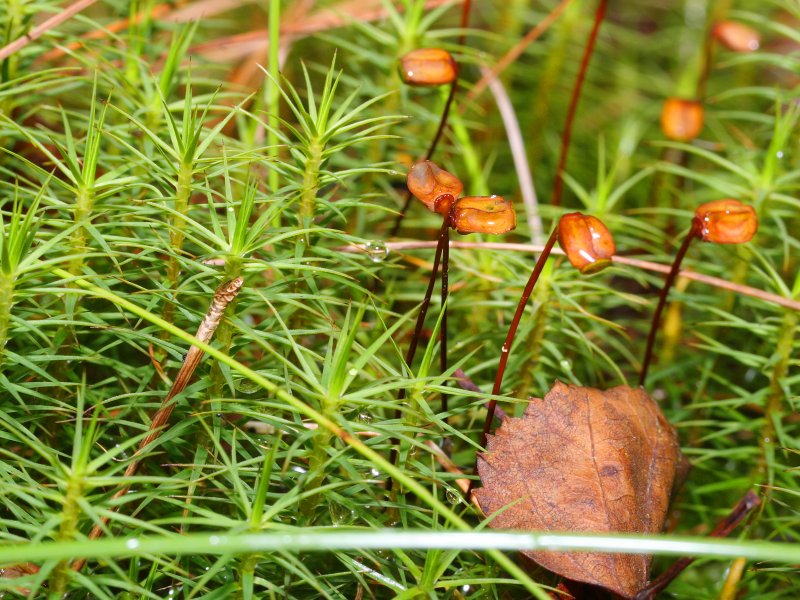
Common haircap moss (Polytrichum commune) is a robust, upright perennial moss native to damp boreal and temperate regions across the globe. It forms dense, dark green colonies in acidic bogs and along forest streams, easily recognised by its exceptional height.
You will find that this species requires permanently wet, acidic soils and high atmospheric humidity to thrive. It fails entirely in dry, alkaline urban environments and does not tolerate prolonged drought.
Key Facts
- Type: Perennial moss
- Height: 5 to 30 cm (2 to 12 in)
- Habitat: Bogs and wet heathland
- Distribution: Northern Hemisphere, Australia, New Zealand
- Soil: Acidic and moisture-retentive
What Is Common Haircap Moss Like
Common haircap moss is a distinctive, ground-covering bryophyte that behaves much like a miniature forest underfoot. It suits damp, shaded woodland gardens or naturalistic bog installations where soil moisture remains constant throughout the year.
- Grows in dense carpets that suppress competing weed species.
- Requires almost no maintenance provided the moisture levels remain high.
- Adapts poorly to indoor cultivation due to extreme humidity demands.
The single most important rule for appreciating this plant in a wild or semi-natural garden is leaving its underlying hydrology undisturbed. Draining the surrounding soil will cause the colony to die back within weeks.
How to Identify Polytrichum commune
Common haircap moss is distinguished by stems that commonly reach 5 to 30 cm (2 to 12 in) in height, making it exceptionally tall for a bryophyte. The individual stems resemble tiny pine trees poking up through the damp peat.
- Leaves are narrow, sharply toothed, and dark green, spreading outward when wet.
- Spore capsules are distinctly four-sided and covered by a hairy, golden cap.
- Stems can occasionally stretch up to 70 cm (27.5 in) in optimal, undisturbed bog conditions.
Botanists classify this species within the family Polytrichaceae. The specific scientific name Polytrichum commune references its common habit of forming large, communal patches across suitable landscapes.
Natural Habitat and Where It Grows
Common haircap moss grows primarily in bogs, wet heathland, and along the margins of forest streams. It prefers acidic substrates with a pH typically ranging between 4.0 and 5.5.
- Thrives in areas experiencing high annual rainfall and atmospheric humidity.
- Frequently colonizes partially open habitats recently disturbed by human activity or livestock.
- Distributed widely across boreal and temperate latitudes in the Northern Hemisphere.
You will also encounter isolated populations in Mexico, several Pacific Islands, New Zealand, and Australia. It is entirely absent from arid or highly alkaline regions.
Ecology and Reproduction
Common haircap moss reproduces primarily through microscopic spores released from its distinctive capsule during the summer months. Water is strictly required for fertilization, as the male gametes must swim to the female organs.
- Spore dispersal occurs when wind shakes the mature, four-sided capsules on their long stalks.
- Colonies also expand asexually through branching underground rhizoids.
- Provides essential micro-habitats for small invertebrates in wetland ecosystems.
Class Polytrichopsida species demonstrate high resilience in disturbed wet soils. They rapidly stabilize bare peat and prevent erosion after minor floods or land slips.
Conservation Status of Common Haircap Moss
Common haircap moss maintains a secure global population and is classified as Least Concern (LC) by the IUCN. Localized declines occur due to wetland drainage and agricultural conversion.
- Widespread distribution across multiple continents buffers the species against regional extinction.
- Peat extraction poses the most significant localized threat to large wild colonies.
- Protected within numerous national parks and nature reserves across its native range.
Wild harvesting for horticultural or craft purposes remains minimal. Conservation efforts focus on preserving intact peat bogs rather than protecting the moss species individually.
Traditional Uses and Medicinal Claims
Common haircap moss was traditionally used in folk remedies and domestic crafts across northern Europe and North America. Indigenous groups and early herbalists utilized various plant parts for specific ailments.
- A strong tea brewed from the boiled stems was traditionally consumed to treat kidney stones and gallstones.
- The fibrous stems were historically bundled together and twisted to make small scrubbing brushes or rope.
- Dried moss was occasionally used as mattress stuffing or insulation in cold climates.
Modern scientific studies do not validate these historical health claims. Consuming preparations made from Polytrichum commune is not recommended due to potential gastrointestinal irritation.
Similar Moss Species and Look-Alikes
Common haircap moss is easily confused with other robust bryophytes that share its damp forest floor habitat. Distinguishing between them requires looking closely at leaf margins and capsule shapes.
- Juniper haircap moss (Polytrichum juniperinum) prefers drier, more exposed acidic soils and has bluish-green leaves with incurved, transparent tips.
- Pigeon wheat moss (Polytrichum formosum) features taller stems and is typically found in shadier, more forested environments rather than open bogs.
- Wavy hair-moss (Atrichum undulatum) has noticeably wavy, untoothed leaves and lacks the characteristic hairy cap on its spore capsule.
Examining the leaf edges with a hand lens reveals the sharp, serrated teeth unique to Polytrichum commune.
Frequently Asked Questions
What is the scientific name for common haircap moss?
The scientific name for common haircap moss is Polytrichum commune.
What family does common haircap moss belong to?
Common haircap moss belongs to the family Polytrichaceae.
What are the traditional medicinal uses of common haircap moss?
Common haircap moss was traditionally used in herbal teas to treat kidney stones, though modern medicine does not support these claims.
Where does common haircap moss naturally grow?
Common haircap moss grows in acidic bogs, wet heathlands, and along forest streams across temperate and boreal regions of the Northern Hemisphere, Australia, and New Zealand.
Can you make tea from common haircap moss?
Historically, people brewed a tea from common haircap moss for medicinal purposes, but consumption is not advised today due to a lack of clinical backing and potential side effects.
Information about traditional or historical uses is provided for educational interest only and is not medical advice. Do not use any plant to treat a condition without speaking to a qualified professional.
Sources & Verification
Taxonomy and distribution are checked against the databases below. Care guidance is written for cultivated species only and reviewed by our editor. How We Build Plant Profiles →