Guide to Plants in the Asteraceae Family
127 plant profiles · Explore the Asteraceae plant family. Learn composite flower traits, growing requirements, and how to identify common daisies, zinnias, and asters.
The family Asteraceae (commonly known as the composite or daisy family) contains over 32,000 accepted species characterized by specialized composite flower heads called pseudanthia. Each visible flower head is actually a tight cluster of dozens or hundreds of individual florets—typically tubular disc florets in the center surrounded by strap-like ray florets on the perimeter—all anchored to a shared receptacle surrounded by green bracts.
Members of this family span diverse growth forms and habitats across every continent except Antarctica. Ornamental garden annuals include garden cosmos (Cosmos bipinnatus) and common zinnia (Zinnia elegans), while coastal and container gardens frequently feature marguerite daisy (Argyranthemum frutescens) or silver-leaved dusty miller (Cineraria maritima). The family also includes native arid shrubs like brittlebush (Encelia farinosa) and chamisa (Ericameria nauseosa), alongside edible tuberous crops like yacon (Smallanthus sonchifolius) and traditional herbs like toothache plant (Acmella oleracea).
When choosing plants from this family, match the species to your region's moisture levels and available space. Most members require at least 6 hours of direct sunlight daily and loose, free-draining soil with a pH between 6.0 and 7.5 to flower reliably throughout their active growing season.
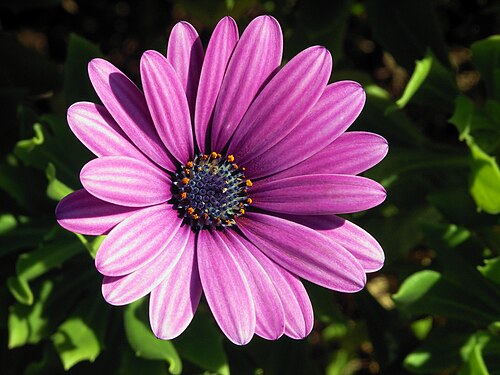
African Daisy
Dimorphotheca ecklonis
☀️ Full Sun 💧 Low
African Lettuce
Launaea taraxacifolia
☀️ Full Sun 💧 Moderate

African Marigold
Tagetes erecta
☀️ Full Sun 💧 Moderate
Alpine Aster
Aster alpinus
☀️ Full Sun 💧 Low

Alpine Blue Sow-Thistle
Cicerbita alpina

Annual Marshelder
Iva annua
☀️ Full Sun 💧 Moderate

Barberton Daisy
Gerbera jamesonii
☀️ Full Sun 💧 Moderate

Bathurst Burr
Xanthium spinosum

Big Sagebrush
Artemisia tridentata
☀️ Full Sun 💧 Low

Billy-Goat Weed
Ageratum conyzoides
☀️ Full Sun 💧 Moderate

Bitter Leaf
Gymnanthemum amygdalinum
☀️ Full Sun 💧 Moderate

Black Salsify
Pseudopodospermum hispanicum
☀️ Full Sun 💧 Moderate

Black-Eyed Susan
Rudbeckia hirta
☀️ Full Sun 💧 Moderate

Blazing Star
Liatris spicata
☀️ Full Sun 💧 Moderate

Brittlebush
Encelia farinosa
☀️ Full Sun 💧 Low

Calico Aster
Symphyotrichum lateriflorum
☀️ Partial Sun 💧 Moderate

Camphor Bush
Tarchonanthus camphoratus
☀️ Full Sun 💧 Low

Canada Goldenrod
Solidago canadensis
☀️ Full Sun 💧 Moderate

Cape Ivy
Senecio angulatus
☀️ Bright Indirect 💧 Low

Cape Marigold
Dimorphotheca sinuata
☀️ Full Sun 💧 Moderate

Capillary Wormwood
Artemisia capillaris
☀️ Full Sun 💧 Low
Cat’s Ear
Hypochaeris radicata
☀️ Full Sun 💧 Low

Chamisa
Ericameria nauseosa
☀️ Full Sun 💧 Low

Chicory
Cichorium intybus
☀️ Full Sun 💧 Moderate
Common Questions
What are the key characteristics of Asteraceae plants?
The primary defining feature of Asteraceae plants is their composite flower structure, where individual disk and ray florets form a single head.
Do Asteraceae family plants need full sun?
Most species in the Asteraceae family require at least 6 hours of direct sunlight daily to support flower development.
Which crops belong to the Asteraceae family?
Edible members of Asteraceae include lettuce, globe artichokes, sunflowers, chicory, and root crops such as yacon (Smallanthus sonchifolius).
How do you identify an Asteraceae flower head?
Identify Asteraceae blooms by turning the flower over to find a cup of overlapping green bracts (involucre) directly beneath the floret disk.