

Big Sagebrush is a silver-grey, evergreen shrub that dominates the arid landscapes of Western North America, particularly the Great Basin. Scientifically known as Artemisia tridentata, it is recognized by its intense aromatic scent and three-toothed leaf tips.
This species relies on a deep taproot that can reach 4 m (13 ft) underground to survive in regions with less than 20 cm (8 in) of annual rainfall. It provides critical habitat for the Greater Sage-Grouse (Centrocercus urophasianus) and functions as the state flower of Nevada.
Key Facts
- Light: Requires full sun for at least 6-8 hours
- Water: Extremely low; drought-tolerant once established
- Soil: Needs deep, well-drained, neutral to alkaline soil
- Hardiness: Survives temperatures down to -40 °C (-40 °F)
- Scent: Strong camphor-like aroma, especially after rain
Where Big Sagebrush Fits in Your Landscape
Big Sagebrush is best suited for xeriscaping, native restoration projects, or large, dry gardens where its silver-grey foliage can provide year-round structure. You should avoid planting it in small containers or humid, high-rainfall climates where the roots will likely rot. It is most effective when used as a background shrub or a windbreak in regions that mimic its native Western North American habitat.
Because it is a large, woody shrub, you must give it plenty of space to breathe. It does not tolerate crowding from moisture-loving plants and will fail in heavy clay soils that retain water. Consider its placement carefully, as the intense aroma can be overwhelming if planted directly under a bedroom window.
Identifying Big Sagebrush in the Wild
The wedge-shaped leaves with three distinct lobes at the tip are the primary way to identify Artemisia tridentata. These leaves are 1-4 cm (0.4-1.5 in) long and covered in fine, silvery hairs that help the plant reflect sunlight and conserve moisture. The foliage remains on the plant year-round, though some leaves may drop during extreme summer droughts.
- Leaf Shape: Narrow base widening to a three-toothed tip.
- Foliage Colour: Silvery-grey or blue-grey due to dense hairs.
- Stem Texture: Older branches have shredded, grey-brown bark.
- Scent: Pungent, sage-like, and spicy when crushed.
Maximum Size and Growth Patterns
Big Sagebrush typically reaches a height of 1-2 m (3-6 ft), though exceptional specimens in deep soil can grow up to 3 m (10 ft). It has a gnarled, woody trunk that can become quite thick with age, giving it the appearance of a miniature tree. The growth rate is moderate, with plants reaching maturity in 10 to 20 years depending on water availability.
The plant develops two types of roots: a deep taproot for accessing groundwater and a shallow lateral system for catching surface rain. This dual system allows it to compete effectively in the arid soils of Utah, Colorado, and Nevada. In the wild, individual shrubs can live for over 100 years if they are not destroyed by fire.
Choosing the Best Site for Artemisia tridentata
You must provide a site with full sun and excellent drainage to successfully grow Big Sagebrush. It is native to states like Colorado, Wyoming, and Oregon, where it thrives in open plains and mountain slopes. The soil should be deep enough to accommodate its taproot; rocky or shallow soils will stunt the plant’s growth and reduce its lifespan.
Avoid low-lying areas where frost or water collects in the winter. While it is extremely cold-hardy, the combination of cold and wet soil is fatal. It prefers neutral to slightly alkaline pH levels, making it a natural fit for the lime-rich soils found across much of the American West.
How to Plant Big Sagebrush Seeds
The most successful way to propagate Big Sagebrush is by sowing seeds in the late autumn to allow for natural cold stratification over winter. You should surface-sow the seeds on well-draining soil, as they require light to germinate. Do not bury them deeply; a very light dusting of sand is sufficient to prevent them from blowing away.
- Sowing Time: October to December for spring germination.
- Germination: Occurs in early spring when soil temperatures rise.
- Success Rate: High in native soils, lower in commercial potting mixes.
- Spacing: Space plants at least 1.5 m (5 ft) apart for mature spread.
Watering and Maintenance Rules
Once established, Big Sagebrush requires zero supplemental irrigation in most Western climates. During the first two years, you may need to water once every 2-3 weeks during the hottest part of the summer to help the root system establish. Overwatering is the most common cause of death, leading to root rot and fungal infections.
You should never fertilize this plant. It is adapted to nutrient-poor soils, and adding nitrogen will cause leggy, weak growth that is prone to breaking. If your soil is particularly heavy, consider planting on a mound or adding grit to the planting hole to improve drainage speed.
Pruning Big Sagebrush Correctly
You should perform minimal pruning, focusing only on removing dead or broken branches in early spring. Big Sagebrush does not sprout easily from old wood, so if you cut back into the thick, leafless branches, that part of the plant will likely die. Always keep your cuts within the leafy, younger growth to ensure the plant can recover.
If the shrub becomes too large for its space, it is better to thin out entire branches rather than shearing the exterior. Shearing creates a dense outer shell that prevents light from reaching the interior, leading to a hollow, woody center. Use clean, sharp bypass pruners to avoid tearing the fibrous bark.
Common Pests and Health Issues
The most frequent problem for Big Sagebrush is root rot caused by overwatering or poor drainage. You will notice the silver leaves turning dull grey or black before the entire branch wilts. There is no cure for advanced root rot, so prevention through site selection is the only effective strategy.
- Sagebrush Galls: Small swellings on stems caused by midges or wasps; usually harmless.
- Sagebrush Defoliator Moth: Larvae can strip leaves in early summer; healthy plants recover.
- Aphids: May cluster on new growth; can be blasted off with a sharp stream of water.
- Powdery Mildew: Occurs in humid climates; improve air circulation to prevent.
Winter Hardiness and Seasonal Changes
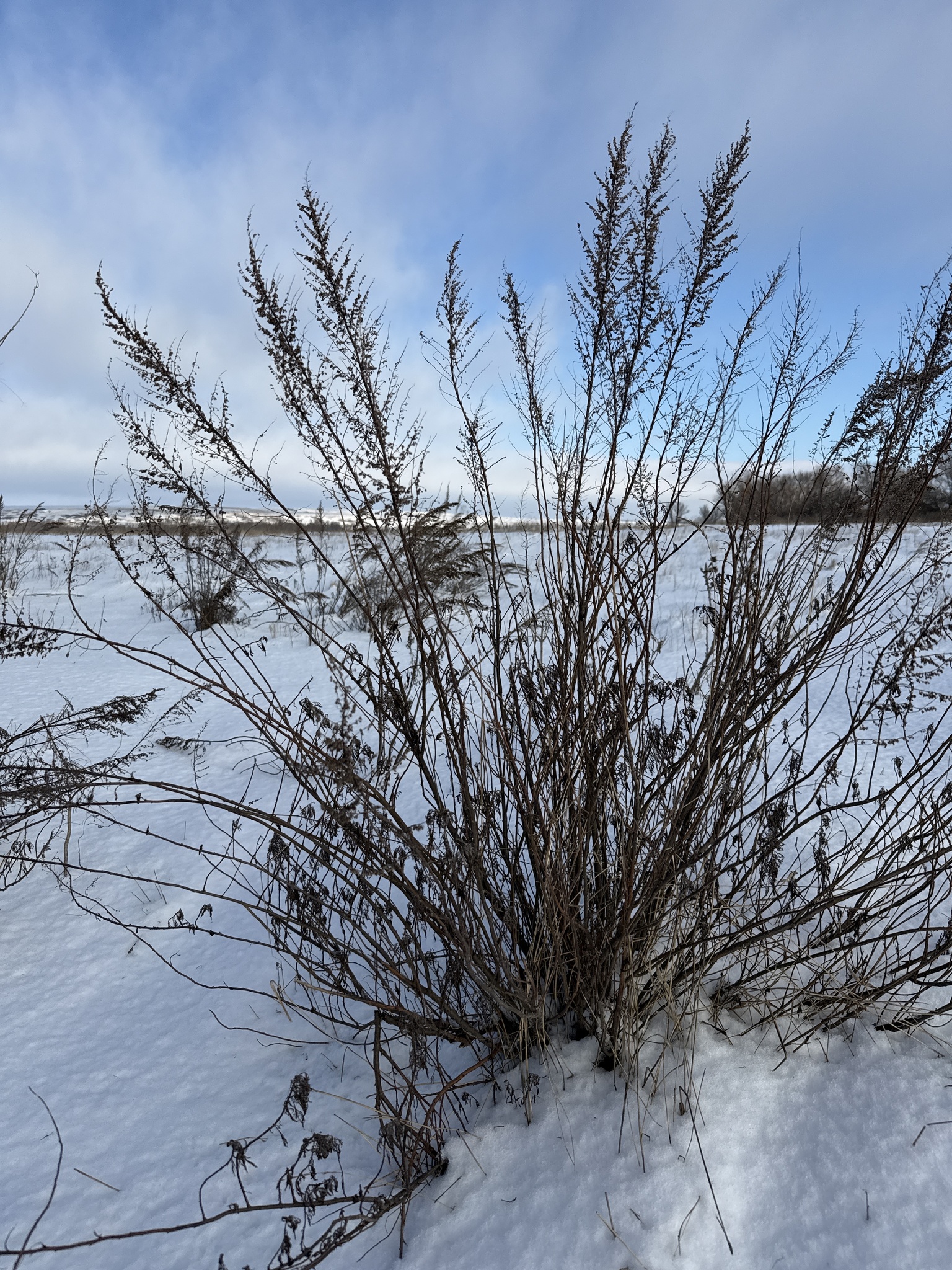
Big Sagebrush is fully hardy in USDA zones 4 through 9 and can withstand temperatures as low as -40 °C (-40 °F). In winter, the plant enters a semi-dormant state, but it retains its leaves. These leaves may take on a slightly darker, more olive-grey hue during the coldest months to protect against UV damage and extreme cold.
Heavy, wet snow can occasionally split the brittle, woody branches of older shrubs. You can prevent this by gently knocking heavy snow accumulation off the plant with a broom. The plant is exceptionally wind-resistant, making it a functional choice for exposed, high-altitude gardens where other shrubs might fail.
Medicinal and Ecological Uses
Big Sagebrush was traditionally used by Indigenous peoples for a variety of medicinal purposes, including teas for digestive issues and poultices for wounds. The leaves contain high concentrations of camphor and other essential oils, which acted as a natural disinfectant. It was also used in ceremonial smudging, though it is distinct from the white sage (Salvia apiana) commonly sold for this purpose.
Ecologically, this plant is a cornerstone species. It provides winter forage for mule deer (Odocoileus hemionus) and nesting sites for various bird species. The seeds are a vital food source for small mammals during the lean winter months, and the dense canopy offers protection from predators in the open desert.
Year-Round Maintenance for Big Sagebrush
| Spring | Prune away any winter-killed branches. Monitor new seedlings for moisture but do not overwater established shrubs. |
|---|---|
| Summer | Stop all watering for established plants. Watch for defoliator moth larvae and spray with water if infestations are heavy. |
| Autumn | Collect seeds from the small yellow flower heads in late autumn. Surface-sow seeds in new locations before the first snow. |
| Winter | Shake off heavy, wet snow to prevent branch breakage. Avoid using de-icing salts near the root zone. |
Common Big Sagebrush Problems and Solutions
| What you see | Likely cause | What to do |
|---|---|---|
| Leaves turning black and wilting | Root rot from excess water | Stop all irrigation immediately and improve soil drainage. |
| Leggy, floppy growth | Too much nitrogen or shade | Move to full sun and stop using fertilizers. |
| Small round bumps on stems | Gall midges | Prune out affected stems if unsightly, otherwise leave alone. |
Subspecies of Artemisia tridentata
- subsp. ‘tridentata’ – the largest variety, found in deep valley soils
- subsp. ‘vaseyana’ – Mountain Big Sagebrush, smaller and more compact
- subsp. ‘wyomingensis’ – Wyoming Big Sagebrush, very drought tolerant
Frequently Asked Questions
Is big sagebrush the same as white sage?
No, Big Sagebrush (Artemisia tridentata) is in the Aster family, while white sage (Salvia apiana) is in the Mint family. They have different leaf shapes, flowers, and chemical profiles.
Is big sagebrush edible?
It is technically edible but extremely bitter and can be toxic in large amounts due to the compound thujone. Historically, it was used in very small quantities for tea or flavoring, but it is not a standard food crop.
Does big sagebrush flower?
Yes, it produces small, inconspicuous yellow flowers in late summer and autumn. The flowers are wind-pollinated and grow in long, narrow clusters at the ends of the branches.
Is big sagebrush invasive?
No, it is a native species in Western North America. However, it can become dominant in overgrazed rangelands because cattle prefer to eat the surrounding grasses, leaving the bitter sagebrush to spread.
Can I grow big sagebrush in a pot?
It is difficult to grow in pots because of its long taproot and sensitivity to drainage. If you try, use a very deep pot with a sandy, cactus-style soil mix and never let it sit in water.
Information about traditional or historical uses is provided for educational interest only and is not medical advice. Do not use any plant to treat a condition without speaking to a qualified professional.
Sources & Verification
Taxonomy and distribution are checked against the databases below. Care guidance is written for cultivated species only and reviewed by our editor. How We Build Plant Profiles →
More in Artemisia

Capillary Wormwood
Artemisia capillaris
☀️ Full Sun 💧 Low

Mugwort
Artemisia vulgaris
☀️ Full Sun 💧 Moderate

Wormwood
Artemisia absinthium
☀️ Full Sun 💧 Low
Southernwood
Artemisia abrotanum
☀️ Full Sun 💧 Low

Tarragon
Artemisia dracunculus
☀️ Full Sun 💧 Low

Chinese Mugwort
Artemisia argyi
☀️ Full Sun 💧 Moderate