
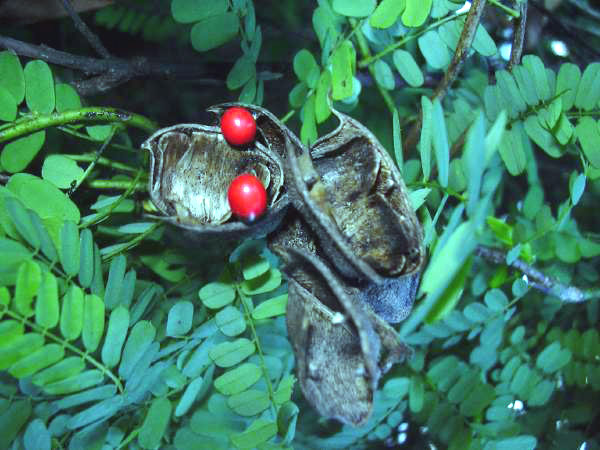
Rosary Pea (Abrus precatorius) is a slender, perennial climbing vine in the bean family that is native to the tropical regions of Asia and Africa. It is most frequently identified by its small, hard seeds which are a bright scarlet red with a distinct black spot at the base.
While the seeds have been used for centuries in jewelry and traditional crafts, they contain abrin, one of the most lethal toxins known to science. In many warm climates, such as Florida and Hawaii, this species has become a problematic invasive weed that smothers native vegetation.
Key Facts
- Toxicity: Seeds contain abrin, which is lethal if chewed
- Identification: Red seeds with a black spot near the hilum
- Growth Habit: Twining vine reaching 3 to 6 m (10 to 20 ft)
- Leaves: Pinnate with 5 to 15 pairs of small leaflets
- Status: Classified as a Category I invasive species in Florida
The Danger of Growing Rosary Pea
Growing Rosary Pea is strongly discouraged in residential gardens due to its extreme toxicity and invasive nature. While some people search for instructions on how to grow it from seed for craft purposes, the plant frequently escapes cultivation and displaces native flora in USDA zones 9 through 11.
If you choose to plant the seeds, they require scarification (nicking the hard outer coat) and soaking in water for 24 hours to trigger germination. However, once established, the vine is difficult to eradicate because it develops a deep, woody taproot and produces hundreds of seeds that remain viable in the soil for several years.
- Germination time: 7 to 21 days at 25 °C (77 °F)
- Root system: Deep, woody taproot that resists hand-pulling
- Spread: Twining stems that can quickly cover a 2 m (6 ft) fence
How to Identify Rosary Pea
You can identify Rosary Pea by its slender, green-to-brown twining stems and its distinctive compound leaves. The leaves are 5 to 13 cm (2 to 5 inches) long and consist of 5 to 15 pairs of oblong leaflets that give the plant a feathery appearance.
The flowers appear in clusters called pseudoracemes, measuring 2 to 7 cm (1 to 3 inches) in length, and range in color from pale violet to pink or white. The most diagnostic feature is the seed pod, which is 2 to 5 cm (0.8 to 2 inches) long, flat, and oblong; it splits open when dry to reveal 3 to 8 glossy red seeds with a black spot.
- Leaflet size: 1 to 2 cm (0.4 to 0.8 inches) long
- Seed size: 5 to 8 mm (0.2 to 0.3 inches) long
- Stem texture: Smooth and herbaceous when young, becoming woody with age
Natural Habitat and Distribution
Rosary Pea thrives in disturbed areas, forest edges, and coastal hammocks across tropical and subtropical regions. Originally native to India and parts of tropical Asia and Africa, it has been introduced to the Caribbean, South America, and the southern United States.
The plant is highly adaptable and can grow in a variety of soil types, including sandy coastal soils and nutrient-poor inland clays. It is frequently found twining around fences, telephone poles, and other shrubs, often becoming the dominant species in neglected agricultural lands or roadsides.
- Preferred elevation: Sea level to 1,200 m (3,900 ft)
- Light requirements: Full sun to partial shade
- Moisture: Drought-tolerant once established but prefers seasonal rainfall
Ecological Impact and Invasive Behavior
Rosary Pea is a significant threat to native ecosystems because it grows over the canopy of shrubs and small trees, blocking sunlight. This “smothering” effect can eventually kill the host plants, leading to a loss of biodiversity in sensitive habitats like Florida’s pine rocklands.
The plant is also fire-resistant, allowing it to quickly recolonize areas after a bushfire has cleared native competition. Because the seeds are bright and attractive, they are often dispersed by birds, although many avian species have evolved to avoid the toxic seeds or pass them through their digestive tracts without breaking the protective coat.
- Invasive status: Prohibited in Florida and parts of Australia
- Dispersal: Primarily through birds and human movement of seeds
- Fire response: Regrows rapidly from the woody crown after burning
Legal Status and How to Get Rid of Rosary Pea
To get rid of Rosary Pea, you must remove the entire woody root system or use targeted systemic herbicides. Simply cutting the vine at the ground level will not kill the plant, as it will vigorously resprout from the remaining taproot.
In many regions, it is illegal to sell or transport the seeds or the live plant. For large infestations, professional application of herbicides containing triclopyr or glyphosate is often necessary to ensure the root system is completely destroyed and to prevent the further spread of seeds into the soil bank.
- Manual control: Digging out the roots before seed pods mature
- Chemical control: Basal bark treatment or cut-stump herbicide application
- Disposal: Bag all seed pods and dispose of them in household waste; do not compost
Traditional and Spiritual Uses of the Seeds
Historically, the seeds were used as a standard weight for gold in India and across Asia because they are remarkably uniform in mass. Each seed weighs approximately 1 carat (200 mg), making them a convenient tool for jewelers and merchants before modern scales were available.
Spiritually, the seeds have been used in many cultures to create rosaries, necklaces, and charms believed to provide protection or good luck. In some Caribbean traditions, “jumbie beads” are used in rituals to ward off evil spirits. Despite these uses, the practice is dangerous; jewelers have been known to die after accidentally pricking their fingers while threading the seeds.
- Jewelry: Used in necklaces and bracelets (illegal in many countries)
- Weight: Known as the “Ratti” weight in historical Indian commerce
- Instrumentation: Used in traditional percussion instruments like shakers
Understanding Rosary Pea Toxicity
The toxin abrin is at least 75 times more poisonous than ricin and works by inhibiting protein synthesis within the body’s cells. A single seed, if thoroughly chewed and swallowed, contains enough toxin to kill an adult human, though swallowing a whole, unbroken seed often results in no symptoms because the hard coat prevents the toxin’s release.
There is no known antidote for abrin poisoning; treatment is purely supportive, focusing on managing symptoms like severe vomiting, diarrhea, and organ failure. While the seeds are the most dangerous part, the leaves and roots also contain small amounts of glycyrrhizin, which gives them a licorice-like flavor but can still pose a risk if consumed in large quantities.
- Lethal dose: Estimated at 0.1 to 1 microgram per kilogram of body weight
- Onset of symptoms: 1 to 3 days after ingestion
- Contact safety: Generally safe to touch if the seeds are intact, but dangerous if dust enters eyes or wounds
Similar Species and Look-Alikes
Rosary Pea is often confused with the Red Bead Tree (Adenanthera pavonina), which also produces bright red seeds. However, the seeds of the Red Bead Tree are entirely red without the black spot and are much larger and more heart-shaped than those of the vine.
Another look-alike is the Snoutbean (Rhynchosia precatoria), which produces seeds that are also red and black. You can distinguish them by the proportions of color; Snoutbean seeds are typically more black than red, whereas Rosary Pea seeds are mostly red with a small black “eye” at one end.
- Red Bead Tree: A large tree, not a vine; seeds lack the black spot
- Coral Bean (Erythrina herbacea): Seeds are all red and much larger
- Snoutbean: Smaller vine; seeds have a different red-to-black ratio
Frequently Asked Questions
Is rosary pea poisonous to touch?
No, the seeds are generally safe to touch if they are intact and the hard outer shell is not broken. However, if a seed is cracked, the toxic abrin inside can be dangerous if it enters a cut or if you touch your eyes or mouth after handling it.
How to use rosary pea for hair growth?
Traditionally, some cultures used processed seed extracts in oils for hair growth, but this is extremely dangerous and not recommended. Because the seeds are lethally toxic, any home preparation poses a significant risk of accidental poisoning or severe skin irritation.
How to detoxify rosary pea?
Historically, Ayurvedic medicine used boiling the seeds in milk or water for several hours to supposedly reduce toxicity, but this does not make them safe for consumption. Modern science confirms that abrin is heat-stable to a degree, and any attempt to detoxify the seeds at home is unreliable and potentially fatal.
What is the spiritual meaning of rosary pea?
In various cultures, the seeds symbolize protection and are used as talismans to ward off the 'evil eye' or negative spirits. The name 'Rosary Pea' comes from their traditional use in making prayer beads, though this practice has declined due to the risk of poisoning during the bead-making process.
How do you get rid of rosary pea vines?
The most effective way to kill the vine is to dig up the entire woody taproot or apply a herbicide containing triclopyr to the freshly cut stump. Simply pulling the foliage will not work, as the plant will regrow from any root material left in the ground.
Information about traditional or historical uses is provided for educational interest only and is not medical advice. Do not use any plant to treat a condition without speaking to a qualified professional.
Sources & Verification
Taxonomy and distribution are checked against the databases below. Care guidance is written for cultivated species only and reviewed by our editor. How We Build Plant Profiles →