
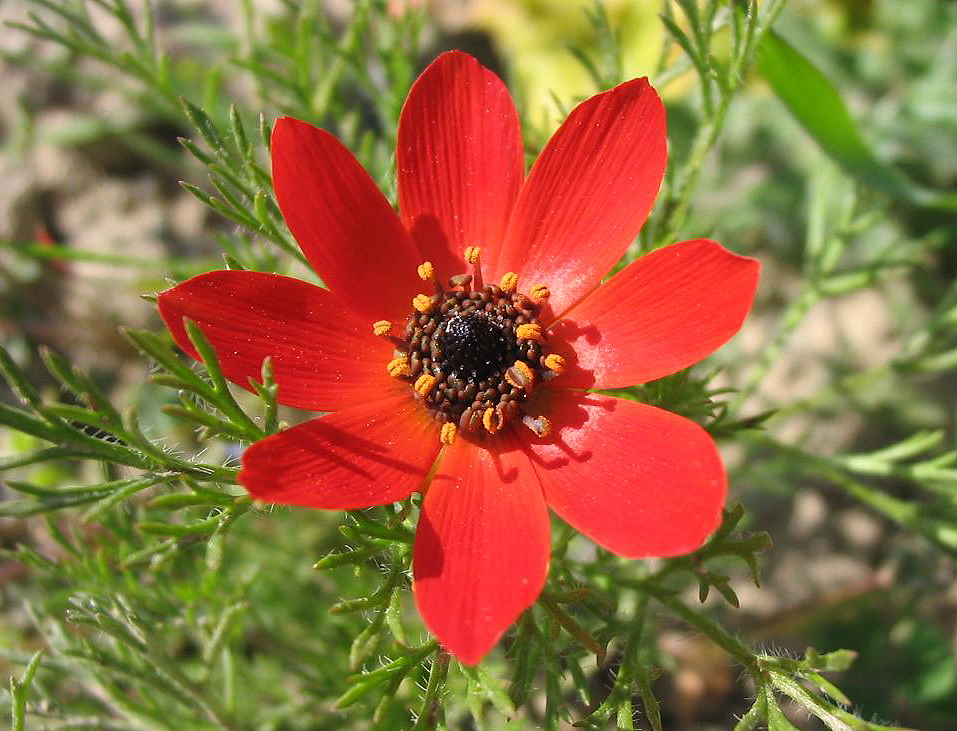
Pheasant’s eye (Adonis annua) is a hardy annual flowering plant native to North Africa, Western Asia, and Southern Europe that produces deep crimson flowers with black basal spots.
All plant tissues contain toxic adonidin glycosides, requiring careful placement away from livestock and pets. Seeds require a 2-month cold stratification period at 4 °C (39 °F) for reliable spring germination.
Key Facts
- Light: Full sun with at least 6 hours direct light
- Soil: Well-drained, alkaline to neutral soil
- Height: 20-50 cm (8-20 in) tall
- Toxicity: Highly toxic to humans, dogs, and horses
- Sowing: Direct sow autumn or early spring
Where Pheasant’s Eye Fits in Your Garden
Pheasant’s eye grows best in sunny cottage gardens, wildflower meadows, and annual borders where loose, well-drained soil prevents root rot.
It completes its life cycle within 12-16 weeks from germination to seed drop. Because it reaches a mature height of 20-50 cm (8-20 in) and a spread of 15-30 cm (6-12 in), it fills mid-border gaps without overpowering neighboring plants.
How to Identify Pheasant’s Eye
Pheasant’s eye produces deep scarlet flowers measuring 1.5-3 cm (0.6-1.2 in) across with 5-8 petals surrounding a prominent black center.
The alternate leaves are feathery and finely divided into linear segments, resembling dill or chamomile, which earned the plant its common alias red chamomile. Stems are upright, branched, and hairless, bearing solitary terminal blooms from May to August. After flowering, the plant forms a cylindrical head of small, green, wrinkled achenes.
Choosing the Best Site and Soil
Pheasant’s eye thrives in full sun with soil pH between 6.5 and 8.0.
Native to limestone slopes and Mediterranean cornfields, this annual requires sharp drainage. Heavy clay holds excessive moisture during winter, causing seeds to rot before spring emergence.
- Sunlight: Minimum 6 hours of direct sunlight per day
- Soil texture: Sandy loam, gravel, or chalky soil
- Drainage: High permeability to prevent waterlogging
- pH range: 6.5 to 8.0 (neutral to moderately alkaline)
How to Sow Pheasant’s Eye Seeds
Sow seeds outdoors in autumn or early spring at a depth of 5 mm (0.2 in) to expose them to natural temperature fluctuations.
Cold stratification improves germination rates, as the hard seed coat breaks down during winter chill at 2-5 °C (35-41 °F).
- Clear weeds and rake soil to a fine tilth in October or March.
- Sow seeds 5 mm (0.2 in) deep and 15 cm (6 in) apart.
- Water lightly with a fine spray to settle the soil.
- Thin seedlings to 20 cm (8 in) spacing once they reach 5 cm (2 in) tall.
Watering and Feeding Pheasant’s Eye
Water newly sown beds to keep soil moist until germination, then supply 2.5 cm (1 in) of water per week during active growth.
Mature plants tolerate brief dry spells due to their Mediterranean heritage. Excess moisture encourages root decay and weak stem growth. Fertilizer is rarely necessary; high nitrogen levels cause leggy foliage and reduce flower production.
Pruning and Maintenance for Pheasant’s Eye
Remove spent flower heads weekly to extend the blooming season by up to 3 weeks.
Snip faded blooms just above a leaf node using sharp shears. If natural reseeding is desired, leave the final flush of summer blossoms to mature into seed heads. Once foliage turns yellow in late summer, cut stems down to soil level.
Managing Pheasant’s Eye Pests and Problems
Slugs and aphids represent the primary pests, while powdery mildew can develop in overcrowded beds with poor air circulation.
Watch for early symptoms to keep plants healthy throughout the growing season.
- Slugs: Handpick at dusk or set beer traps around young seedlings.
- Aphids: Spray clustered insects with a direct stream of water or insecticidal soap.
- Powdery mildew: Space plants 20 cm (8 in) apart and water at the soil base.
- Damping off: Avoid overwatering indoors and ensure sterile seedling media.
Winter Care and Seed Collection
Pheasant’s eye dies after setting seed in late summer and does not survive winter frosts as an active plant.
Collect mature achenes when they turn dry and brown in July or August. Store dried seeds in paper envelopes at 15-18 °C (59-64 °F) until autumn sowing. Self-sown seeds will lie dormant in the topsoil through winter freeze cycles.
How to Maximise Pheasant’s Eye Blooms
Provide full sun and unamended, well-draining soil to maximize the count of bright scarlet blossoms.
Over-fertilizing with nitrogen produces lush green leaves at the expense of floral buds. Ensure spacing allows light to reach lower branches, triggering lateral buds to open sequentially from May through July.
Companion Plants for Pheasant’s Eye
Pair pheasant’s eye with traditional cornfield annuals like corn poppy (Papaver rhoeas) and corn cornflower (Centaurea cyanus) for contrasting blue and red displays.
Combine with low-growing, sun-loving species that share identical light and drainage needs.
- Corn poppy (Papaver rhoeas) – matching annual life cycle and red blooms
- Corn cornflower (Centaurea cyanus) – intense blue petals contrasting scarlet blooms
- Corn marigold (Glebionis segetum) – golden yellow flowers flowering June to August
- Field nigella (Nigella arvensis) – delicate feathery foliage and pale blue flowers
Frequently Asked Questions
What is the meaning of the Adonis annua flower?
In floral symbolism, pheasant's eye represents sorrowful remembrance and painful recollection. The name originates from Greek mythology, where the red flower reportedly sprang from the blood of Adonis.
What does Adonis annua L. stand for?
Adonis annua L. is the formal scientific name assigned by Carl Linnaeus in 1753. The abbreviation L. credits Linnaeus as the botanical authority who first described the species.
Is Adonis annua toxic to dogs and livestock?
Yes, all parts of pheasant's eye contain adonidin, a toxic cardiac glycoside. Ingestion causes severe gastrointestinal irritation, vomiting, irregular heartbeat, and potential cardiac arrest.
How long do Adonis annua seeds take to germinate?
Seeds take 21-42 days to germinate at soil temperatures of 10-15 °C (50-59 °F). Subjecting seeds to 6-8 weeks of cold stratification at 4 °C (39 °F) speeds up seedling emergence.
Are Adonis annua search terms related to corporate financial reports?
No, Adonis annua is strictly a flowering plant species in the buttercup family Ranunculaceae. Queries regarding annual revenue or French directories refer to separate corporate or educational entities.
Information about traditional or historical uses is provided for educational interest only and is not medical advice. Do not use any plant to treat a condition without speaking to a qualified professional.
Sources & Verification
Taxonomy and distribution are checked against the databases below. Care guidance is written for cultivated species only and reviewed by our editor. How We Build Plant Profiles →