
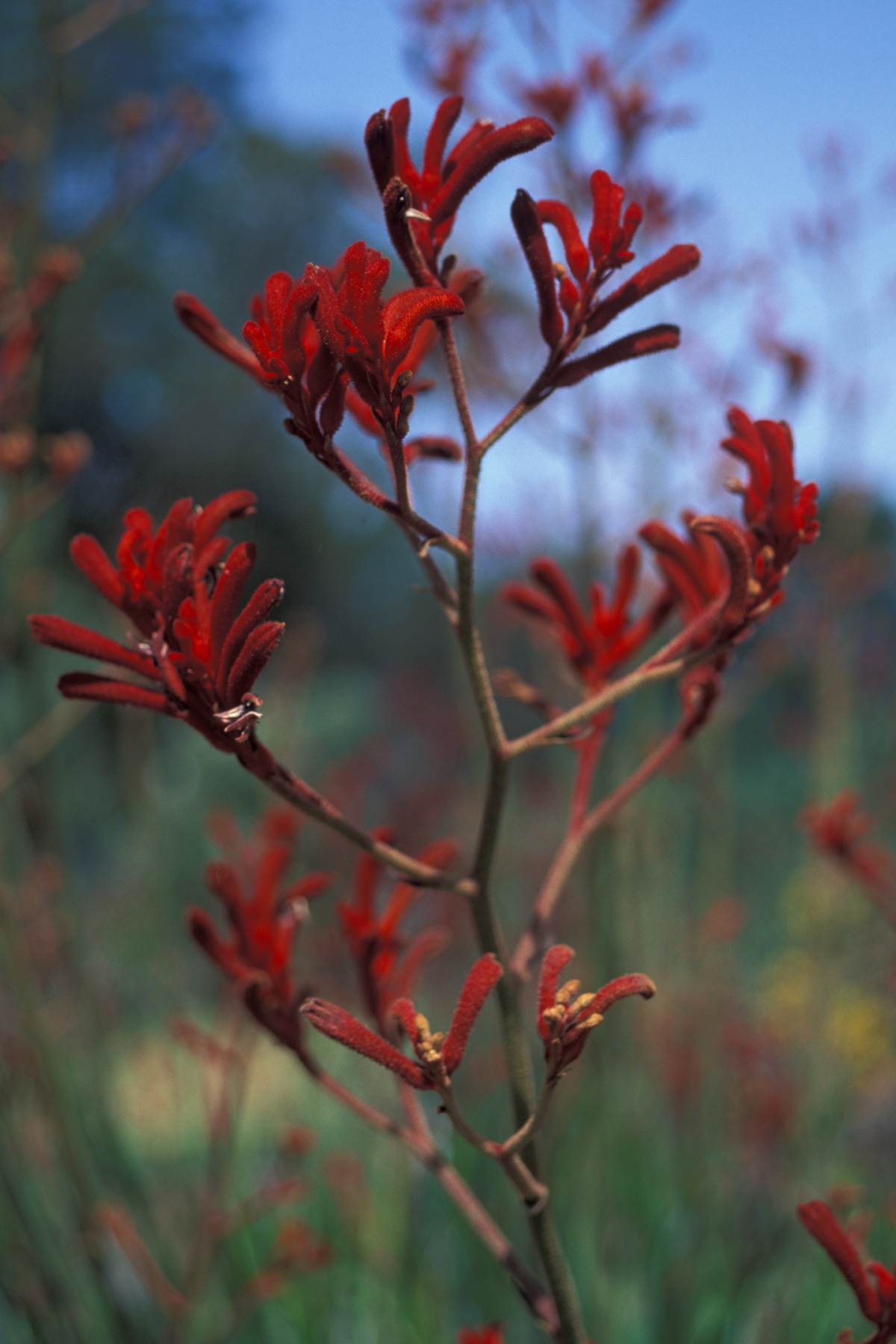
Tall kangaroo paw (Anigozanthos flavidus) is an evergreen, rhizomatous perennial native to Southwest Australia, recognised by its velvety, tubular flower clusters that curve open like claws. Unlike most desert-dwelling members of its genus, it naturally colonises damp road verges and forest margins.
It tolerates heavier soils and wet winter conditions far better than smaller hybrids, but you must keep high-phosphorus fertilisers away from its sensitive root system. Flower stalks regularly reach 2 m (6.6 ft) in sunny garden beds and large patio containers.
Key Facts
- Light: Full sun, minimum 6 hours daily
- Hardiness: USDA Zones 9 to 11; protect below -3 °C (26 °F)
- Water: Moderate during growth; reduce sharply in winter dormancy
- Soil: Sandy loam or well-draining potting mix, pH 5.8–6.8
- Pruning: Cut spent flower stems completely down to ground level
- Toxicity: Non-toxic to dogs, cats, and horses
Growing Kangaroo Paw in Gardens and Pots
Kangaroo paw thrives best outdoors in warm, arid to Mediterranean climates with unrestricted sun exposure. Gardeners in cool-temperate areas or frost-prone regions grow it primarily in outdoor containers that move inside before winter arrives.
Because it forms dense underground rhizomes, it establishes quickly and fills broad spaces without running aggressively. It demands almost no pampering once settled, provided its roots sit in porous, airy media that never stays waterlogged.
Identifying Kangaroo Paw Foliage and Flowers
Kangaroo paw displays strap-like, deep green foliage arranged in flattened fans, topped by branched stems bearing fuzzy, claw-shaped tubular blossoms. Each flower stalk rises 1 to 2 m (3.3 to 6.6 ft) tall, well above the basal clump of leaves.
Individual flowers measure 3 to 4.5 cm (1.2 to 1.8 in) long and are densely coated in branching, velvety hairs. While wild Anigozanthos flavidus produces lime-green or chartreuse-yellow flowers, garden selections also display bronze, amber, and deep crimson shades.
- Foliage: Smooth, sword-like blades 35 to 100 cm (14 to 39 in) long and 1 to 2 cm (0.4 to 0.8 in) wide.
- Stems: Stiff, upright, branched, and covered in fine plumose hairs.
- Floral structure: Tubular corolla splitting into 6 reflexed lobes that resemble an animal’s curved claws.
- Roots: Thick, fleshy, drought-resistant horizontal rhizomes.
Where to Plant Kangaroo Paw for Best Sun and Air
Plant tall kangaroo paw in an open position receiving at least 6 to 8 hours of direct sunlight every day. Shaded conditions cause weak, floppy flower stems, pale petals, and a dramatic spike in ink spot disease.
Ensure your chosen site offers unrestricted air circulation, which prevents moisture from lingering on the hairy stems and foliage. If planting on flat ground in regions with heavy winter rainfall, build a raised bed 20 to 30 cm (8 to 12 in) high to improve base drainage.
Planting Kangaroo Paw in Ground and Containers
Position nursery specimens so the crown sits level with the surrounding soil line, never buried underneath. Sinking the rhizome too deep leads to crown rot within weeks of initial watering.
When growing in pots, choose a sturdy terracotta container at least 30 to 40 cm (12 to 16 in) wide with several base drainage holes. Fill it with a fast-draining potting mixture consisting of equal parts coarse grit, pumice, and low-fertility pine bark substrate.
- Dig the planting hole twice as wide as the nursery rootball, but exactly the same depth.
- Gently tease out any tightly coiled roots circling the bottom of the pot.
- Backfill with native soil mixed with grit, firming down gently to remove large air pockets.
- Apply a 3 cm (1.2 in) layer of coarse gravel mulch around the base, keeping it clear of the leaf fan.
How to Water and Fertilise Kangaroo Paw
Water kangaroo paw thoroughly when the top 5 cm (2 in) of soil feels completely dry during the active spring and summer blooming cycle. Reduce watering to once every two to three weeks through the cooler dormant period.
Feed only with native-plant formulas or slow-release fertilisers with a phosphorus level (P) of under 3 percent. Kangaroo paws have evolved cluster roots designed to forage for minimal nutrients, and standard high-phosphorus garden feeds can induce fatal root toxicity.
Kangaroo Paw Care After Flowering and Pruning
Prune individual flower stems down to ground level as soon as the terminal blossoms fade and dry out. Removing old stalks redirects energy into the subterranean rhizome, stimulating fresh leaf fans for next year.
At the end of summer or early autumn, cut back tired, brown-spotted foliage clumps to 5 to 10 cm (2 to 4 in) above soil level using sterile shears. This radical annual cleanup removes lingering fungal spores, keeps the crown tidy, and triggers a flush of clean, upright leaves the following spring.
Kangaroo Paw Care in Winter and Frost Protection
Kangaroo paw survives short-term cold down to -3 °C (26 °F), but persistent frost will kill foliage and rot exposed rhizomes. In USDA zones 8 and below, move container-grown plants into an unheated glasshouse, conservatory, or bright garage before the first freeze.
Keep overwintering plants nearly dry, watering just enough to stop the root mass from desiccating into dust. Gardeners in the UK and cooler European regions should treat containerised plants as summer bedding accents, shifting them outdoors only after night temperatures stay reliably above 7 °C (45 °F) in May.
Dividing and Growing Kangaroo Paw from Seeds
The most reliable method to multiply tall kangaroo paw is root division in early spring right as active growth resumes. Sow fresh seed indoors at 18 to 22 °C (64 to 72 °F), though germination remains notoriously irregular without smoke-water treatment.
To divide an established clump, lift the entire plant with a garden fork and separate the dense rhizome network using a clean, sharp spade. Each division must retain at least two healthy green fans of leaves and a robust set of fleshy white storage roots before you repot them into gritty compost.
Companion Plants for Kangaroo Paw
Combine kangaroo paw with sun-loving drought-tolerant perennials that share its low-phosphorus and lean soil requirements. Its vertical flower spikes contrast against low, spreading shrubs and structural architectural foliage.
Natural companions from Southern Hemisphere and Mediterranean climates perform best alongside it in mixed borders:
- Silver tussock grass (Poa labillardierei) provides fine-textured silver-blue motion around the flower bases.
- Red bush (Grevillea ‘Peaches and Cream’) supplies continuous warm blooms that attract honeyeaters and bees.
- Coastal rosemary (Westringia fruticosa) contributes tidy grey-green evergreen structure and white flowers.
- Blue chalksticks (Curio ficoides) creates a clean, weed-suppressing succulent groundcover in front of the clumps.
Frequently Asked Questions
What is the difference between kangaroo paw and kangaroo paw fern?
Kangaroo paw is a flowering, sun-loving perennial native to Western Australia, whereas kangaroo paw fern (Zealandia pustulata, formerly Microsorum diversifolium) is an epiphytic woodland fern native to New Zealand and eastern Australia that requires shade and high humidity.
Is kangaroo paw plant poisonous to pets?
No, kangaroo paw is non-toxic to dogs, cats, and horses according to veterinary records. Ingesting large quantities of coarse fibrous foliage can cause mild mechanical stomach upset, but the plant carries no systemic toxins.
Can you grow kangaroo paw indoors as a houseplant?
You can keep kangaroo paw indoors temporarily on a south-facing windowsill, but it rarely thrives long-term as a houseplant due to low light and stale indoor air. It requires full outdoor sun and high airflow to produce flowers and resist fungal diseases.
Why are my kangaroo paw leaves turning black?
Black spots or tips are almost always caused by ink spot disease (Alternaria alternata), a common fungus triggered by wet foliage, stagnant air, or root stress. Trim away infected leaves, maintain dry foliage when watering, and site the plant in full sun.
What colours do kangaroo paw flowers come in?
Wild tall kangaroo paw flowers are chartreuse-yellow to lime-green, but modern hybrid cultivars provide red, orange, pink, purple, and two-tone combinations.
Sources & Verification
Taxonomy and distribution are checked against the databases below. Care guidance is written for cultivated species only and reviewed by our editor. How We Build Plant Profiles →