
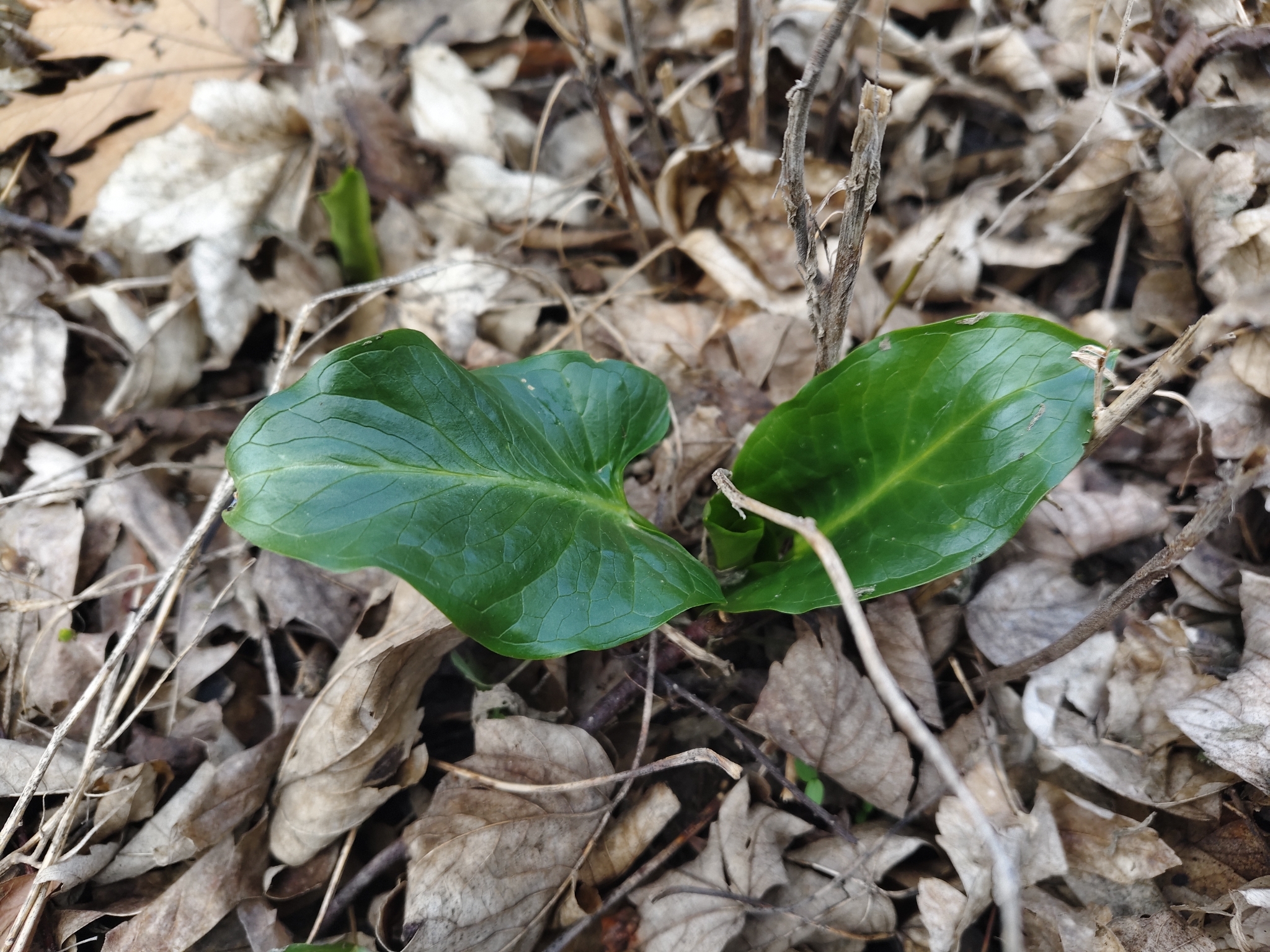
Mountain Arum (Arum cylindraceum) is a tuberous woodland perennial native to central, southern, and eastern Europe as well as Turkey. It features arrow-shaped dark green leaves and a pale yellow-green spathe that encloses a club-like spadix during spring.
Unlike related woodland arums, this species is completely absent from the native flora of the United Kingdom and Scandinavia. All parts of the plant contain microscopic calcium oxalate needles that cause acute oral pain and swelling upon contact.
Key Facts
- Plant Type: Tuberous woodland perennial geophyte
- Native Range: Central, southern, eastern Europe and Turkey
- Mature Height: 30–60 cm (12–24 in)
- Toxicity: Severely toxic to humans and pets
- Bloom Period: April to June
- Foliage: Arrow-shaped, emerging in late autumn
Where Mountain Arum Fits in European Forest Ecosystems
Mountain Arum thrives in humus-rich soils under deciduous tree canopies, particularly within beech, oak, and hornbeam woodlands across Continental Europe. It behaves as a spring ephemeral, completing its main vegetative cycle before upper tree foliage blocks out sunlight in late May.
As a forest geophyte, it relies on underground energy stores during winter. Leaves emerge during mild periods in late autumn or early winter, remaining green throughout cold snaps before dying back in early summer as red berries develop.
How to Identify Arum cylindraceum in the Wild
You can identify Mountain Arum by its horizontal, cylindrical tuber and an upright, pale green spathe surrounding a yellow-to-purple cylindrical spadix appendage. The leaf blades measure 10–25 cm (4–10 in) long and display an unspotted, arrow-shaped (sagittate) outline.
Key visual features to check in spring include:
- Tuber shape: Horizontal and distinctly cylindrical rather than disc-shaped
- Spathe colour: Pale yellow-green, often yellowish on the interior face
- Spadix appendage: Yellowish brown to dull purple, uniform in width along its length
- Foliage: Deep green, arrow-shaped leaves without dark purple spots
- Fruit cluster: Tight spike of 10–30 glossy scarlet berries in August
Native Habitat and European Distribution
Mountain Arum is native to central, eastern, and southern Europe, extending eastward into Anatolian Turkey. Its range includes mountain slopes and foothill forests up to 1,500 m (4,900 ft) elevation in countries like Austria, Italy, Greece, Poland, and Romania.
Despite its broad presence across Continental Europe, key geographic gaps exist. The species is naturally absent from the United Kingdom, Ireland, Scandinavia, Russia, Belarus, Ukraine, the Baltic States, northwestern France, and southern Italy.
Ecological Role and Pollinator Trapping
Mountain Arum reproduces using a specialised floral trap mechanism that temporarily imprisons tiny psychodid midges to achieve cross-pollination. The spathe produces volatile organic compounds that mimic decaying organic matter, drawing insects inside during warm spring evenings.
Once midges crawl into the floral chamber, slipping past downward-pointing sterile hairs, they become trapped overnight. The plant elevates its internal temperature by 2–5 °C (4–9 °F) above ambient air, releasing fragrance and keeping midges active until pollen is shed the following day.
Is Mountain Arum Invasive or Protected?
Mountain Arum is classified as Least Concern (LC) on regional conservation lists and is not an invasive species anywhere within its range. It grows in stable forest populations without spreading aggressively into agricultural pasture or clearings.
In countries like Poland and the Czech Republic, local forest populations receive protection in nature reserves to preserve ancient woodland biodiversity. Because it requires established mycorrhizal soil networks, it rarely colonises disturbed urban land.
Toxicity and Historic Uses of Mountain Arum
All parts of Mountain Arum are strictly toxic to humans, livestock, and domestic pets due to high concentrations of insoluable calcium oxalate crystals and sap toxins. Ingestion triggers instantaneous burning in the mouth, excessive salivation, and vocal cord swelling.
Historical records show that tubers were occasionally harvested during European famine periods for starch extraction, requiring multiple boilings and leaching cycles to degrade oxalates. No modern culinary or health benefits exist, and foraging this species poses severe poisoning risks.
Mountain Arum vs Similar Arum Species
Mountain Arum is distinguished from lords-and-ladies (Arum maculatum) by its elongated cylindrical tuber and uniform, unspotted spathe. While lords-and-ladies frequently features dark spots on its leaves and a purplish club, Mountain Arum maintains a lighter greenish-yellow spathe interior.
It also differs from Italian arum (Arum italicum), which exhibits prominent silver-white leaf veins. Cretan arum (Arum creticum) produces bright yellow, fragrant spathes in Mediterranean scrub, unlike the soft pale green spathe seen on Mountain Arum in mountain forests.
Frequently Asked Questions
Is Arum cylindraceum native to the UK?
No, Mountain Arum is not native to the United Kingdom. Its natural distribution covers mainland Europe from France eastward into Turkey, but excludes the British Isles.
Is Mountain Arum poisonous to dogs and cats?
Yes, Mountain Arum is toxic to dogs, cats, and humans. Ingestion causes immediate burning in the mouth, severe throat swelling, drooling, and vomiting.
Why is it called Mountain Arum?
The common name Mountain Arum refers to its preference for shaded ravines, subalpine woodland margins, and foothill forests up to 1,500 m (4,900 ft) elevation.
Is Arum cylindraceum an invasive species?
No, Mountain Arum is a non-invasive native woodland geophyte in Europe. It forms small, stable colonies in undisturbed forest soils without displacing native flora.
Is Arum cylindraceum related to Arum mountain bikes?
No, Mountain Arum is a wild botanical species in the Araceae family. It shares no connection with commercial mountain bikes or sporting goods that use the name 'Arum'.
Information about traditional or historical uses is provided for educational interest only and is not medical advice. Do not use any plant to treat a condition without speaking to a qualified professional.
Sources & Verification
Taxonomy and distribution are checked against the databases below. Care guidance is written for cultivated species only and reviewed by our editor. How We Build Plant Profiles →

