
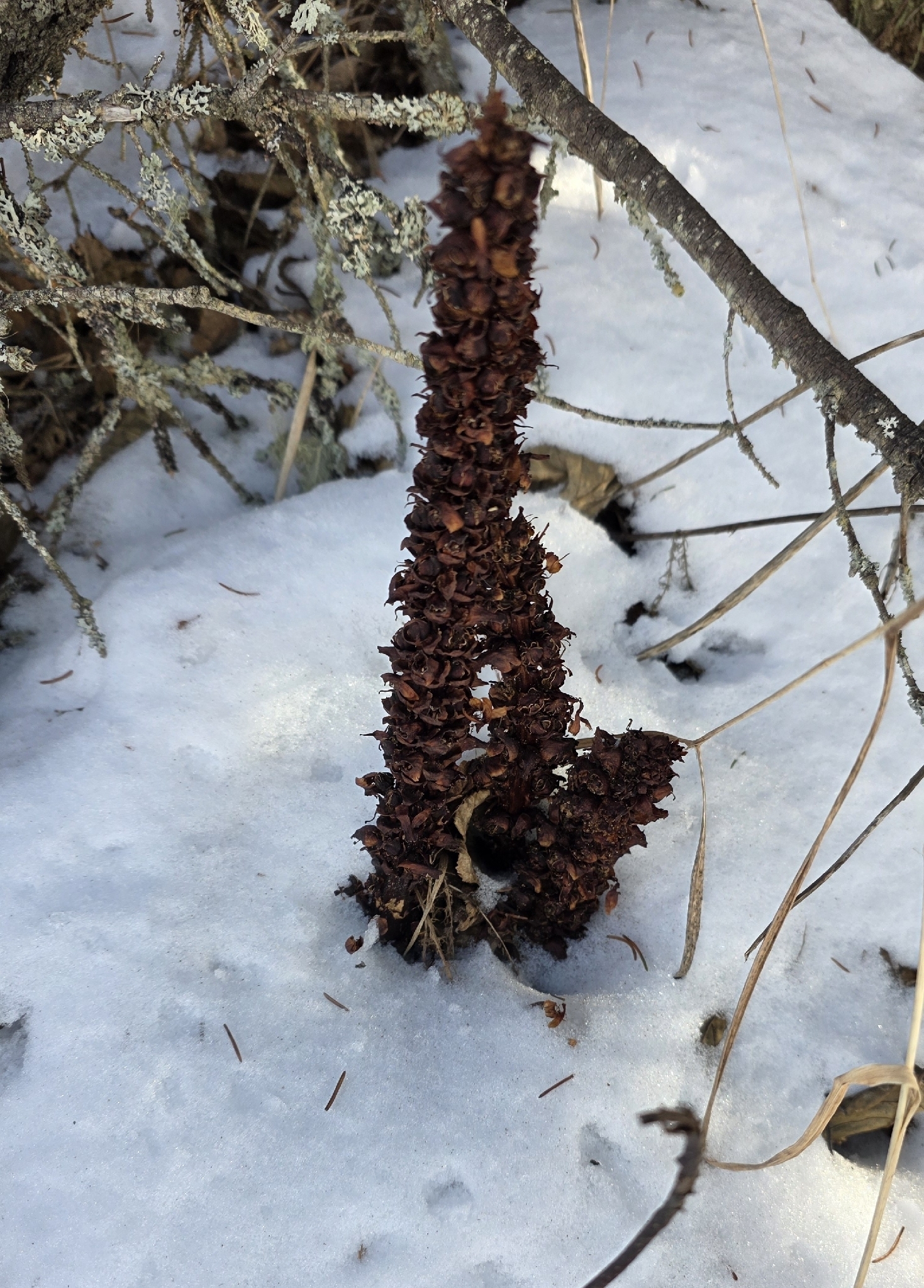
Northern groundcone (Boschniakia rossica) is a perennial holoparasitic plant native to boreal and subarctic regions of North America and East Asia, easily mistaken for an upright pinecone. It produces zero chlorophyll, drawing all its water and carbohydrates directly from the root systems of neighbouring woody shrubs.
Because it depends entirely on established host stands in damp river valleys, it cannot be transplanted or cultivated in a home garden. Field botanists look for its stout, scaly spikes emerging along stream banks beneath thick alder thickets between June and August.
Key Facts
- Plant Type: Herbaceous perennial holoparasite
- Host Species: Primarily alders (Alnus species)
- Height: 10–30 cm (4–12 in) tall
- Native Habitat: Riparian zones and boreal forest floors
- Photosynthesis: Completely absent; lacks green leaves
Finding Northern Groundcone in the Wild
You will spot northern groundcone emerging directly from forest soil within 1–2 m (3–6 ft) of mature alder thickets. Because it lacks green foliage entirely, the plant looks like an upright, fleshy spruce cone or a stout fungal fruiting body thrusting through the leaf litter.
It grows as a solitary spike or in small clumps of three to five stems. The entire organism spends years underground attached to a host root before sending up its flowering structure.
- Look under dense canopies of mountain alder (Alnus alnobetula) or speckled alder (Alnus incana).
- Focus searches along subarctic rivers, damp gravel terraces, and cool forest seepages.
- Watch for dark brown, woody, weathered spikes left over from previous growing seasons.
How to Identify Northern Groundcone
Northern groundcone is distinguished by its 10–30 cm (4–12 in) erect, club-shaped flowering spike densely covered in overlapping scales. It has no green tissue whatsoever, displaying a color palette ranging from dull yellowish-tan to reddish-brown or deep purple.
The leaves are reduced to blunt, triangular, scale-like bracts measuring 6–10 mm (0.24–0.39 in) long. Flowers emerge from the axils of these scales in mid-summer, featuring an irregular, two-lipped corolla that produces thousands of dust-like seeds enclosed within a rounded capsule.
- Stem: Stout, fleshy, unbranched spike arising from a swollen underground tuber (haustorium).
- Leaves: Alternate, sessile, leathery scales tightly pressed against the stem axis.
- Flowers: Tubular, bilabiate, measuring 8–12 mm (0.3–0.5 in) long, tan to purplish.
- Fruit: Bivalved capsule filled with minute, water-dispersed seeds under 0.5 mm in size.
Native Range and Wild Habitat
Northern groundcone thrives across the subarctic circumboreal belt, occurring in Alaska, northwestern Canada, Siberia, northern China, and Japan. In coastal North America, its southern boundary stops sharply at Prince of Wales Island in southeastern Alaska, south of which it is replaced by related taxa.
The plant requires cold, moisture-retentive soils at low to mid elevations between sea level and 1,200 m (3,900 ft). It is closely tied to riparian corridors where seasonal flooding and high water tables maintain the saturated substrate favored by its hosts.
It does not colonize dry uplands or open tundra where large woody shrubs are absent. Snow cover provides vital insulation during sub-zero continental winters, shielding the shallow underground haustorium from lethal ground freezing.
Parasitic Ecology and Wildlife Value
Northern groundcone is an obligate holoparasite that forms a swollen woody tuber on the roots of its host to extract all water, nitrogen, and carbohydrates. It forms a specialized physiological conduit called a haustorium that penetrates the root tissue of mountain alder.
While alders are the primary hosts, it occasionally taps paper birch (Betula papyrifera), willows (Salix species), and bog bilberry (Vaccinium uliginosum). The plant relies on running water to carry its microscopic seeds along river floodplains to reach exposed root systems downstream.
- Brown and black bears dig up the starchy underground tubers following spring emergence.
- Small rodents chew the flowering spikes and bury dried capsules, aiding secondary seed dispersal.
- The extraction of nutrients reduces the vigor of individual host branches without killing the entire alder shrub.
Traditional Uses of Northern Groundcone
Indigenous peoples across East Asia and subarctic North America gathered northern groundcone tubers as a traditional tonic and seasonal famine food. In Traditional Chinese Medicine, the plant is known as Cao Cong Rong and was historically used to prepare decoctions and restorative infusions.
Historical records show Native Alaskan groups dug the subterranean tubers in late spring before the flowering stalk expanded, consuming them fresh or roasted. The flesh contains complex starches, tannins, and iridoid glycosides, giving the tissue a distinctly astringent, bitter taste.
Modern commercial foraging of the species remains restricted in many jurisdictions due to slow regeneration rates. Because the plant cannot be cultivated artificially, overharvesting from wild alder stands risks depleting local colonies.
Conservation and Environmental Threats
Northern groundcone populations remain stable across high northern latitudes, although individual populations show extreme vulnerability to riparian disturbance and road construction. Its persistence depends completely on the health and continuity of mature alder thickets.
Clear-cutting along stream corridors or alterations to river hydrology disrupts seed transport and kills host root networks. Warming subarctic climates also alter winter snowpack depth, exposing shallow tubers to severe freeze-thaw cycles.
- Classified as globally secure across its wide circumboreal range.
- Vulnerable to mechanized riverbank disturbance and placer mining operations.
- Cannot recolonize cleared areas quickly due to slow vegetative growth and complex germination requirements.
Similar Species and Look-Alikes
Northern groundcone is most frequently confused with Vancouver groundcone (Kopsiopsis hookeri), which replaces it south of Prince of Wales Island in the Pacific Northwest. Both plants produce brownish, cone-like parasitic stalks, but their geographical ranges do not overlap significantly in natural habitats.
Several other non-green forest plants share a similar appearance and ecology across North American woodlands:
- Vancouver groundcone (Kopsiopsis hookeri): ranges from southeastern Alaska down to northwestern California, specializing on salal (Gaultheria shallon).
- American cancer-root (Conopholis americana): native to eastern North America, growing strictly beneath mature red and white oaks (Quercus species).
- One-flowered broomrape (Orobanche uniflora): produces slender, solitary purple-to-white flowers rather than a dense cone-like spike.
- Dutchman’s pipe (Monotropa hypopitys): a pale yellow to reddish mycoheterotroph that feeds on fungi rather than directly parasitizing woody roots.
Frequently Asked Questions
What is Boschniakia rossica?
Boschniakia rossica (known in Vietnamese as 'Boschniakia rossica là gì' queries explore) is a wild, non-photosynthetic parasitic flowering plant in the broomrape family. It lives in cold northern regions, obtaining water and food from alder roots.
What are the traditional benefits of Boschniakia rossica?
In traditional herbal practices, particularly in East Asia, it was used as a vitality tonic and anti-fatigue remedy under the name Cao Cong Rong. Scientific validation is limited, and raw wild harvesting is not advised.
Can you grow northern groundcone in a garden?
No, northern groundcone cannot be grown in a home garden because it is an obligate parasite requiring living alder roots and cold boreal soils. It has never established viable populations under domestic cultivation.
Is northern groundcone a type of mushroom or fungus?
No, northern groundcone is a true flowering plant despite lacking green leaves and resembling a fungus. It produces tubular flowers, pollen, and seed capsules rather than spores.
Does northern groundcone kill the tree it lives on?
Northern groundcone rarely kills its host shrub. It acts as a metabolic drain on specific roots of the alder, sometimes causing reduced growth or dieback on individual branches, but the shrub usually survives.
Information about traditional or historical uses is provided for educational interest only and is not medical advice. Do not use any plant to treat a condition without speaking to a qualified professional.
Sources & Verification
Taxonomy and distribution are checked against the databases below. Care guidance is written for cultivated species only and reviewed by our editor. How We Build Plant Profiles →
- Global Biodiversity Information Facility (GBIF)Occurrence data and taxonomic status
- Flora of China (eFloras)Botanical description and host species
- Kew Plants of the World Online (POWO)Native geographical distribution
- USDA PLANTS DatabaseNorth American distribution and taxonomy
- Wikipediageneral reference