
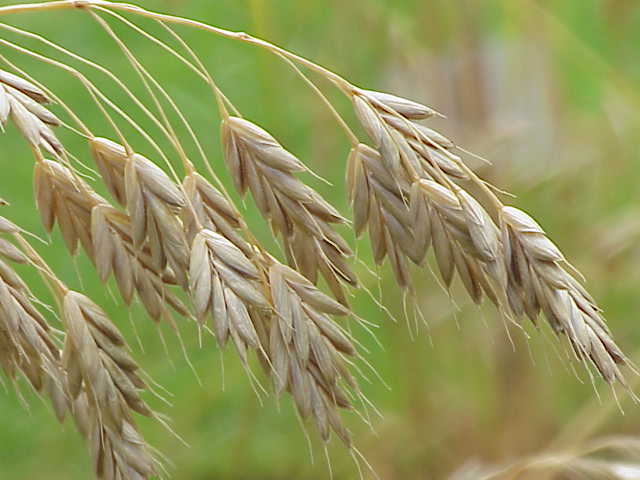
Rye brome is a winter annual grass native to Europe and Western Asia that is often found growing alongside cereal crops. Scientifically known as Bromus secalinus, it is distinguished by its nodding seed heads and plump spikelets that closely resemble the grain of cultivated rye.
This species earned the name “cheat” from farmers who believed their crop seeds had transformed into this less valuable grass. It thrives in disturbed soils and is a common sight in wheat fields and along roadsides throughout the Northern Hemisphere.
Key Facts
- Type: Winter annual grass
- Height: 30–100 cm (12–39 in)
- Seeds: Plump, rounded glumes resembling rye
- Habitat: Grain fields, waste ground, and roadsides
- Life Cycle: Germinates in autumn, flowers in summer
Encountering Rye Brome in the Wild
Rye brome is a plant of agricultural edges and disturbed landscapes, typically reaching a height of 30 to 100 cm (12 to 39 in). It is a winter annual, meaning it germinates in the autumn and remains as a low-growing tuft of leaves through the winter before shooting up in the spring. You will most likely encounter it in or around wheat and rye fields where it has successfully mimicked the growth cycle of the crop.
While it is not a primary target for gardeners, it is an important species for those interested in agricultural history and botany. It lacks the aggressive, fire-prone nature of some of its relatives but can still be a persistent presence in small-scale grain plots. It prefers open, sunny positions and does not compete well in established, shady woodlands.
How to Identify Bromus secalinus
Identification relies on the hairless leaf sheaths and the specific shape of the seed head. Unlike many other brome species that have hairy stems, the sheaths of the rye brome are typically smooth or only slightly rough to the touch. The leaves are 5–15 mm (0.2–0.6 in) wide and often have a slight twist in their structure.
The flowering panicle is 5–20 cm (2–8 in) long and tends to nod or droop to one side as the seeds ripen. Each spikelet contains 5–15 individual flowers and measures 1–2 cm (0.4–0.8 in) in length. When the plant is in fruit, the glumes become hard and rounded, which is the key feature that makes them look like rye grains.
- Stems: Upright, smooth, and hollow between nodes.
- Ligule: Short, membranous, and often frayed at the top.
- Awns: Short bristles (3–8 mm) that emerge from the tip of the seed.
- Roots: A fibrous, relatively shallow root system.
Preferred Habitat and Growing Conditions
Rye brome thrives in moist, nutrient-rich disturbed soils that are common in temperate farming regions. It is particularly well-adapted to loamy or clay-heavy soils that retain some moisture during its spring growth spurt. In its native range, it is almost exclusively associated with man-made habitats like fallow fields and edges of arable land.
The plant requires full sun to produce its large, heavy seeds and will rarely flower in significant shade. Because it is a winter annual, it needs a period of cold temperatures (vernalization) to trigger flowering the following year. It is hardy down to USDA zone 3, making it capable of surviving harsh continental winters as a dormant seedling.
Ecological Role and Impact
As a wind-pollinated grass, rye brome provides pollen for various insects and seeds for small birds and rodents. Its seeds are relatively heavy and do not travel far by wind; instead, they rely on the movement of soil, water, or contaminated agricultural machinery for dispersal. In modern agriculture, it is often viewed as a weed because it competes with cereal crops for nitrogen and water.
In the past, this grass was much more common in grain fields before the advent of modern seed-cleaning technology. Because its seeds are a similar size and weight to rye (Secale cereale), it was difficult to separate them during harvest. This led to the grass being repeatedly sown alongside the crop, ensuring its survival across centuries of farming.
Distribution and Conservation Status
Rye brome is widely distributed across Europe, North Africa, and Western Asia, and has been introduced to North America and Australia. While it is common in many areas, it has actually declined in parts of its native European range due to more efficient farming practices. It is currently listed as Least Concern on many regional red lists but is considered rare in some specifically managed agricultural landscapes.
In North America, it is often grouped under the general term “cheat grass,” though it is less invasive than the notorious Bromus tectorum. It tends to stay localized to areas with high soil disturbance and adequate moisture, rather than taking over vast tracts of rangeland.
Historical Uses of Rye Brome
Historically, the seeds of rye brome were ground into flour during times of famine, although the resulting bread was often described as dark and bitter. It was never a preferred food source but served as a vital emergency calorie supply for rural populations. The plant has also been used as a low-quality forage for livestock when more desirable grasses are unavailable.
In some traditional agricultural systems, it was tolerated because it could provide a backup yield if the main cereal crop failed due to pests or disease. However, it contains significantly less protein than true rye and was generally phased out as soon as better grain varieties became available. There are no modern commercial uses for the plant.
Similar Species: Rye Brome vs Cheatgrass
The most common confusion occurs between Bromus secalinus and cheatgrass (Bromus tectorum). While both are annual bromes, cheatgrass is typically smaller, has much longer and more delicate awns, and is covered in fine, soft hairs. Rye brome is a sturdier plant with smoother stems and fatter seed heads that do not turn the distinct purple-red color characteristic of drying cheatgrass.
Another look-alike is the meadow brome (Bromus commutatus), which also grows in similar habitats. Meadow brome can be distinguished by its slightly narrower spikelets and the fact that its lower leaf sheaths are usually hairy, whereas those of the rye brome are smooth. Comparing the length of the awns is the fastest way to tell them apart in the field.
- Rye (Secale cereale): Has much longer awns and a rigid, unbranched seed spike.
- Soft Brome (Bromus hordeaceus): Shorter, more compact seed heads with soft, velvety hairs.
- Barren Brome (Anisantha sterilis): Very long awns and a much more open, drooping panicle.
Frequently Asked Questions
Why is it called Cheat grass?
It is called 'cheat' because it often appeared in grain fields where farmers expected rye or wheat to grow. Because the seeds look similar to rye, farmers felt the plant had 'cheated' them by taking the place of their valuable crop.
What is the difference between Rye Brome and Cheatgrass?
Rye brome (Bromus secalinus) has smooth stems and plump seeds, while cheatgrass (Bromus tectorum) is covered in soft hairs and has much longer, needle-like awns. Cheatgrass also tends to turn a reddish-purple color as it dries, which rye brome does not do.
Is Rye Brome invasive?
In North America, it is considered a naturalized weed but is generally less invasive than other brome species. It primarily sticks to disturbed agricultural areas and doesn't usually dominate natural ecosystems like rangelands.
Can you eat the seeds of Rye Brome?
While the seeds are non-toxic and were used as famine food in the past, they are not considered palatable. They are hard, bitter, and produce a very poor quality flour compared to true rye or wheat.
How do you identify Rye Brome?
Look for a grass 30–100 cm tall with smooth, hairless leaf sheaths and a drooping seed head. The individual spikelets are plump and rounded, making them look like thick grains of rye with very short bristles at the tips.
Sources & Verification
Taxonomy and distribution are checked against the databases below. Care guidance is written for cultivated species only and reviewed by our editor. How We Build Plant Profiles →
