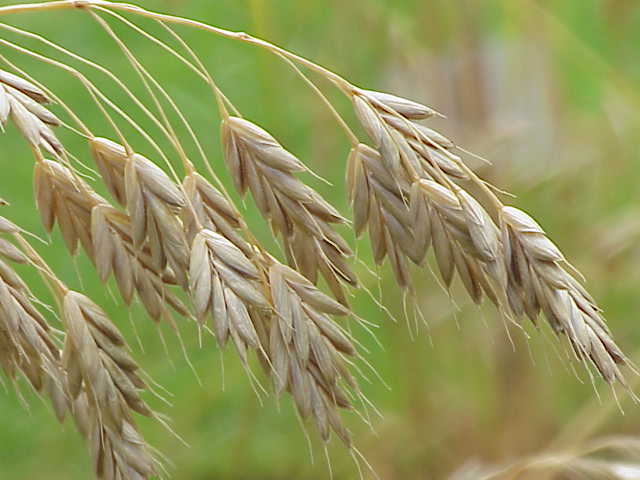
Smooth brome is a long-lived perennial grass in the Poaceae family, originally native to Europe and temperate Asia, known for its deep rhizomes and hairless stems. It is scientifically named Bromus inermis, which refers to its ‘unarmed’ or awnless flower spikes.
While introduced to North America in the 1880s as a drought-tolerant forage crop, it now dominates many native grasslands. You will most likely encounter it in road verges, hayfields, and disturbed prairies where it forms dense, monocultural mats that exclude native flora.
Key Facts
- Height: typically reaches 45 to 120 cm (18 to 47 in)
- Spread: aggressive rhizomes form dense, permanent sod mats
- Native Range: Europe and temperate Asia; invasive in North America
- Identification: distinct ‘W’ or ‘M’ constriction on the leaf blade
- Wetland Status: classified as a Facultative Upland (FACU) species
Is Smooth Brome a Good Addition to the Landscape?
Smooth brome is generally not recommended for garden planting in North America because it behaves as an aggressive invader. It spreads rapidly through thick underground rhizomes, quickly outcompeting native wildflowers and other grasses in a residential or restoration setting. While it provides soil stabilization on steep embankments, its ability to escape into natural areas makes it a liability for local ecological health.
In its native European range, it is a standard component of temperate meadows. However, in the United States and Canada, it is primarily managed as a weed in conservation areas. You should only consider it for large-scale erosion control where native alternatives are unavailable and containment is possible.
Smooth Brome Identification and Features
You can identify Bromus inermis by the distinctive W or M shaped constriction found halfway up the leaf blade. This grass grows in upright clumps but spreads to form a continuous sod, reaching heights of up to 1.2 m (4 ft). The leaves are typically 5 to 15 mm (0.2 to 0.6 in) wide, grey-green, and notably hairless, which separates it from many other brome species.
- Ligule: a very short, translucent membrane about 0.5 mm long.
- Inflorescence: an open panicle 10 to 20 cm (4 to 8 in) long with branches that spread.
- Spikelets: cylindrical and 2 to 3 cm (0.8 to 1.2 in) long, containing 7 to 10 flowers.
- Awns: absent or very short, usually less than 2 mm.
- Rhizomes: thick, brownish underground stems that are difficult to pull by hand.
Typical Habitat for Bromus inermis
Smooth brome thrives in cool-season environments with well-drained soils, particularly in northern temperate regions. It is frequently found in disturbed sites such as roadsides, ditch banks, and abandoned pastures where it was historically sown for hay. While it prefers full sun, it can tolerate partial shade at the edges of woodlands or in hedgerows.
In terms of moisture, it is classified with a facultative upland (FACU) wetland indicator status. This means it usually occurs in non-wetlands but is occasionally found in damp areas. It is drought-tolerant once established, thanks to a root system that can penetrate 1.5 m (5 ft) deep into the soil profile.
Ecology and Environmental Impact
In its introduced range, smooth brome alters the nitrogen cycle of the soil to favor its own growth over native species. By forming dense monocultures, it reduces the biodiversity of insects and birds that rely on a variety of native prairie plants. The thick sod it creates prevents the seeds of native plants like leadplant (Amorpha canescens) from reaching the soil surface to germinate.
Despite its invasive status, it does provide some ecological services. Its massive root system prevents erosion on slopes and cut banks. Various species of grasshoppers and some butterfly larvae utilize the foliage, and it remains a high-protein food source for cattle and elk in early spring before other grasses emerge.
Why Is Smooth Brome Considered Invasive?
The primary concern with smooth brome is its uncontrolled spread through vegetative reproduction. While it does produce viable seeds, the rhizomes allow it to expand outward by several centimeters each year. In North American tallgrass prairies, it can replace native big bluestem (Andropogon gerardii) within a few decades if left unmanaged.
Management typically requires a combination of high-intensity grazing and late-spring prescribed burning. Mowing alone often fails to control the plant because it reallocates energy to its underground rhizomes. Because it starts growing earlier in the spring than most native warm-season grasses, it gains a competitive head start on light and nutrients.
Historical and Modern Uses
Historically, smooth brome was extensively planted as a primary forage grass across the Great Plains and Midwest. It was favored for its high palatability and its ability to withstand heavy trampling by livestock. Farmers valued its stay-green quality, which provided nutritious grazing later into the summer than many other cool-season grasses.
Today, its use is largely restricted to specific agricultural and industrial contexts. It is used for stabilizing soil on mine spoils or construction sites where few other species will establish. It is still harvested for hay in some regions, often grown in a mixture with alfalfa (Medicago sativa) to improve the nutrient profile of the feed.
Common Agricultural Cultivars of Smooth Brome
- ‘Lincoln’ – a southern-type cultivar adapted to warmer climates
- ‘Achenbach’ – historically significant for pasture production
- ‘Manchar’ – a northern-type variety with high seed yield
- ‘Carlton’ – a Canadian variety known for cold hardiness
How to Tell Smooth Brome Apart from Similar Grasses
You can distinguish smooth brome from meadow brome (Bromus riparius) by checking for hairs on the leaves and sheaths. Meadow brome is distinctly hairy, whereas smooth brome is almost entirely smooth. Additionally, meadow brome has longer awns on its spikelets, usually exceeding 2 mm (0.08 in).
- Quackgrass (Elymus repens): has long, pointed auricles at the leaf base which smooth brome lacks.
- Reed Canary Grass (Phalaris arundinacea): has a much larger, more prominent ligule and prefers wetter soil.
- Cheatgrass (Bromus tectorum): an annual grass with very long, drooping awns and fuzzy leaves.
- Field Brome (Bromus arvensis): an annual with shorter, more compact flower clusters and hairy stems.
Frequently Asked Questions
What is the common name of Bromus inermis?
It is most widely known as Smooth Brome or Awnless Brome, referring to its hairless stems and the lack of long bristles on its flower spikes.
Is Bromus inermis invasive?
Yes, it is considered highly invasive in North America, where it was introduced for forage and has since displaced native prairie vegetation.
What is the wetland indicator status of smooth brome?
It is generally classified as Facultative Upland (FACU), meaning it usually occurs in non-wetland areas but can tolerate occasional moisture.
How do I identify Bromus inermis?
Look for the hairless leaf blades and the distinctive 'W' or 'M' shaped constriction or wrinkle found about halfway up the leaf.
Where is Bromus inermis native to?
It is native to Europe and temperate regions of Asia, where it is a common component of natural meadows and grasslands.
Sources & Verification
Taxonomy and distribution are checked against the databases below. Care guidance is written for cultivated species only and reviewed by our editor. How We Build Plant Profiles →