
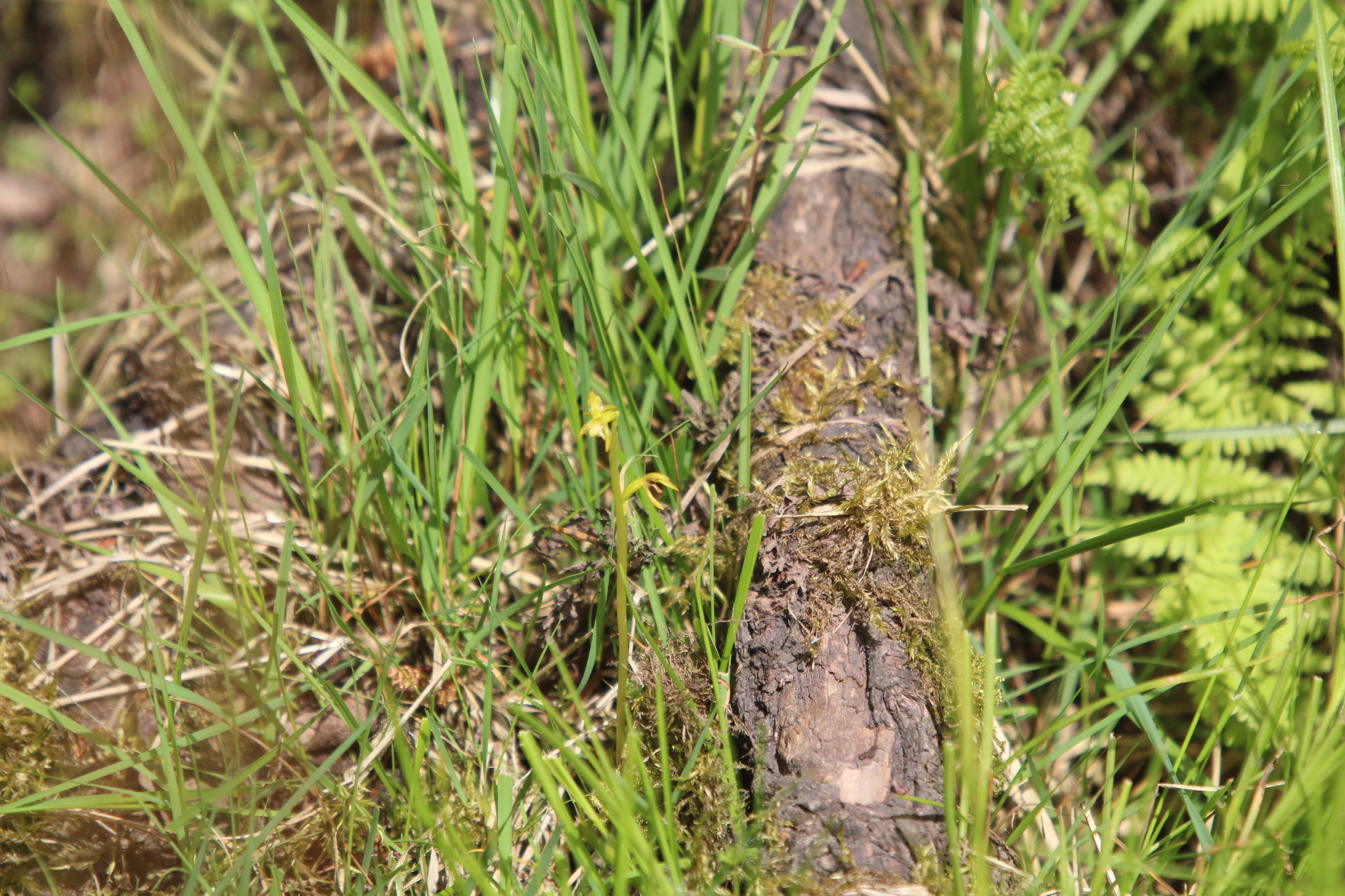
Corallorhiza trifida is a small, pale orchid found across the damp forests and bogs of the Northern Hemisphere. It is often called the early coralroot because it blooms weeks before most other wild orchids, typically appearing between May and July.
This plant lacks green leaves and chlorophyll, appearing as a yellowish or greenish-white stem. You will usually find it hidden in deep leaf litter or moss where it survives by stealing energy from soil fungi rather than sunlight.
Key Facts
- Type: Mycoheterotrophic orchid
- Height: 5-25 cm (2-10 in)
- Flowers: 3-12 small, yellowish-green blooms
- Habitat: Damp woods, bogs, and dune slacks
- Bloom: Late spring to early summer
Encountering the Coralroot Orchid in the Wild
Finding a coralroot orchid requires patience and sharp eyes because its pale, leafless stems blend into the forest floor. You cannot grow this plant in a garden; it is a wild specialist that survives only through a complex relationship with specific soil fungi. It is a target for nature photographers and hikers who frequent damp, undisturbed woodlands during the late spring.
Because it lacks chlorophyll, it does not need sunlight for energy, often appearing in the darkest corners of a pine forest where other flowers fail to grow. The plant is entirely dependent on a complex underground network, making it highly sensitive to any changes in its environment. If you find one, it is a sign of a healthy, intact ecosystem.
- Stems are often less than 15 cm (6 in) tall.
- The plant appears suddenly and disappears quickly after seeding.
- It is never found in gardens or nurseries.
How to Identify Corallorhiza trifida
Look for a leafless, yellowish-green stem that stands 5-25 cm (2-10 in) tall. Unlike most plants, the early coralroot has no green parts because it does not photosynthesize. The stem is smooth, fleshy, and lacks the purple or reddish tint found in other species of the same genus.
The flowers are small, roughly 5 mm (0.2 in) wide, and grow in a loose cluster of 3 to 12 blooms. The most distinctive feature is the “lip” or bottom petal, which is white and often marked with tiny red spots, though some specimens have a plain white lip. The roots are actually a branched, coral-like rhizome hidden underground, which gives the plant its name.
- Flowers: Yellowish-green sepals and petals.
- Lip: White, often with 2 small lobes at the base.
- Leaves: Reduced to 2-4 translucent scales on the stem.
- Fruit: A drooping, egg-shaped capsule.
Where Does Early Coralroot Grow?
This orchid thrives in damp, shaded environments including coniferous forests, birch woodlands, and lime-rich fens. In the UK, it is a rare sight often associated with damp dune slacks or pine woods in Scotland and Northern England. It prefers moist, alkaline to neutral substrates where the soil is rich in organic matter.
The species has a circumboreal distribution, meaning it is found across the high latitudes of North America, Europe, and Asia. You might spot it in the leaf litter of a Canadian spruce forest or the mossy floor of a Siberian birch grove. It specifically requires the presence of certain fungi, which limits its range to undisturbed habitats.
- Commonly found near pine (Pinus) and willow (Salix) trees.
- Occurs at elevations from sea level to 2,500 m (8,200 ft).
- Prefers areas with consistent moisture throughout the year.
The Parasitic Ecology of Coralroot
The coralroot orchid is a mycoheterotroph, meaning it obtains all its nutrients from fungi rather than sunlight. It specifically targets fungi in the Thelephora and Tomentella genera, which are often found in symbiotic relationships with nearby trees. By tapping into these fungal threads, the orchid indirectly steals carbon from the trees, a process known as epiparasitism.
This allows the plant to survive without green leaves, though it still produces a small amount of its own energy in some environments. The relationship is so specific that if the fungi die due to soil compaction or chemical changes, the orchid disappears immediately. This complex web of life makes the coralroot one of the most specialized plants in the forest.
- Fungi: Provides water, minerals, and carbon.
- Host Trees: Indirectly support the orchid via the fungi.
- Chlorophyll: Present in trace amounts but insufficient for survival.
Conservation Status and Threats
While globally listed as Least Concern by the IUCN, the coralroot orchid is rare and strictly protected in many regions. In the UK, it is a priority species under the Biodiversity Action Plan because its specialized habitat is easily disturbed. You should never attempt to dig up a specimen, as the fragile, coral-like rhizomes will not survive the move.
Most populations are found in protected nature reserves or remote northern forests where the soil remains undisturbed. Monitoring these plants helps scientists understand the health of the invisible fungal networks beneath the forest floor. Threats include the drainage of wetlands, heavy trampling by livestock or hikers, and the loss of host trees due to logging.
- Protected under CITES Appendix II.
- Vulnerable to local extinction if groundwater levels drop.
- Requires undisturbed leaf litter for seed germination.
Historical and Modern Uses
There are no established culinary or commercial uses for this orchid due to its rarity and parasitic nature. Historically, some indigenous groups in North America used related Corallorhiza species for medicinal purposes, but the early coralroot was rarely targeted. Its primary value today is as an indicator of a healthy, undisturbed forest ecosystem.
In the past, dried stalks of larger coralroots were traditionally used by some tribes to prepare teas for treating fevers or skin conditions. However, because Corallorhiza trifida is so small and difficult to find, it has no record of significant medicinal use. It remains a plant of purely botanical and ecological interest.
- Indicator Species: Signals the presence of complex fungal networks.
- Research: Studied for its unique parasitic relationship with fungi.
- Observation: Valued by botanists for its unique evolutionary adaptations.
The Life Cycle of Corallorhiza trifida
The life cycle of the coralroot orchid begins with microscopic seeds that contain almost no energy reserves. These seeds must be infected by a compatible fungus almost immediately to germinate and form a protocorm. It can take several years of underground growth before the plant finally sends up a flowering spike.
Once the flowers are pollinated, usually by small flies or through self-pollination, the plant produces thousands of dust-like seeds. These seeds are then dispersed by the wind to find new patches of compatible fungi. Because the seeds are so small, they can travel long distances, but the chance of landing in the perfect environment is very low.
- Germination: Requires specific Thelephora fungi.
- Growth: Spends most of its life as an underground rhizome.
- Dispersal: Wind-blown seeds can travel kilometers.
Similar Species and Look-Alikes
The early coralroot is most often confused with the spotted coralroot (Corallorhiza maculata), which is much larger and usually reddish-purple. You can distinguish the early coralroot by its smaller size and yellowish-green coloration. Other similar species include the spurred coralroot (Corallorhiza wisteriana), which has a distinct chin-like structure behind the flower.
In European woodlands, it might be mistaken for the bird’s-nest orchid (Neottia nidus-avis), which is entirely brown and honey-colored. In very rare cases, it might be confused with the ghost orchid (Epipogium aphyllum), though that species has much larger, drooping flowers. Unlike the hooded coralroot (Corallorhiza striata), the early coralroot never has striped petals.
- Spotted coralroot: Larger, purple stems, spotted lip.
- Bird’s-nest orchid: Brown, found in beech woods.
- Ghost orchid: Translucent white, very rare, drooping blooms.
Frequently Asked Questions
Is coralroot an orchid?
Yes, it is a true orchid belonging to the Orchidaceae family, despite lacking green leaves and traditional roots.
Where can I find coralroot orchid in the UK?
It is primarily found in Scotland and Northern England, specifically in damp pine woods, birch forests, and dune slacks.
Why is it called coralroot?
The name refers to its underground rhizome, which is highly branched and resembles the structure of sea coral.
Does it have leaves?
No, it has no true leaves. It only possesses small, translucent scales at the base of the stem that do not perform photosynthesis.
Can I grow coralroot orchid in my garden?
No, it is impossible to cultivate because it relies on a specific symbiotic relationship with wild fungi that cannot be replicated in a garden setting.
Information about traditional or historical uses is provided for educational interest only and is not medical advice. Do not use any plant to treat a condition without speaking to a qualified professional.
Sources & Verification
Taxonomy and distribution are checked against the databases below. Care guidance is written for cultivated species only and reviewed by our editor. How We Build Plant Profiles →