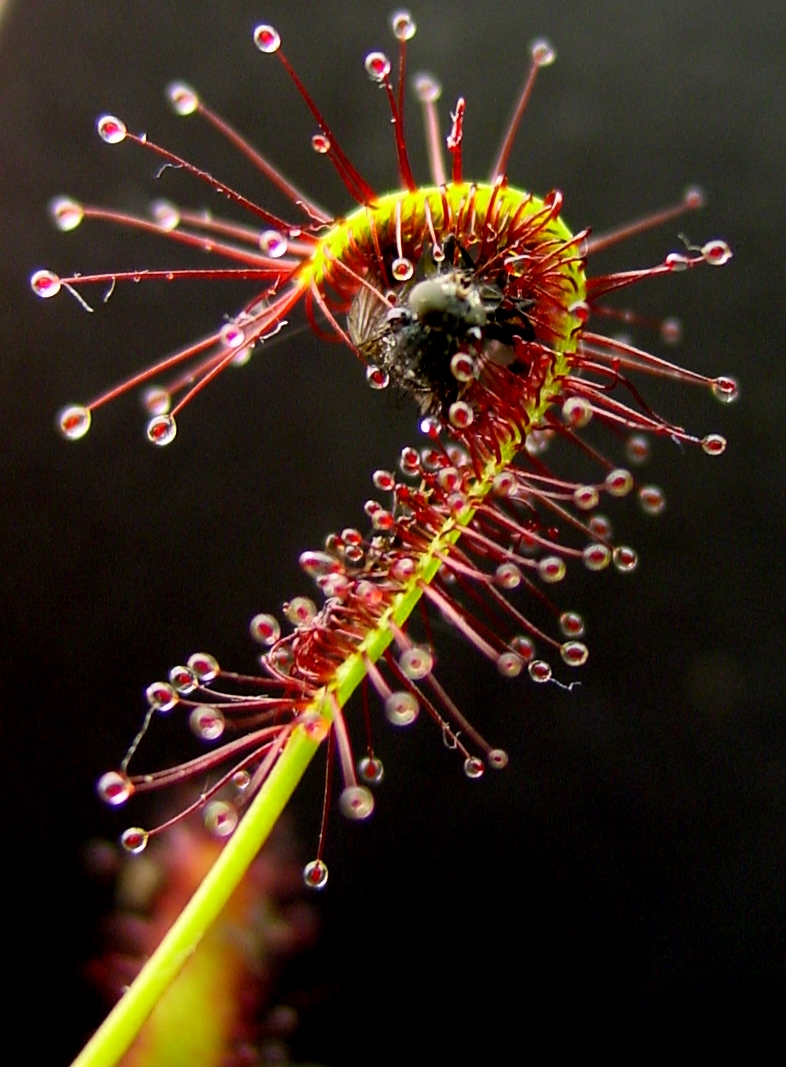
Round-leaved sundew (Drosera rotundifolia) is a carnivorous flowering plant belonging to the Droseraceae family, found across circumboreal peat bogs, marshes, and fens in North America, Europe, and Asia. It is easily recognised by its rosettes of circular leaves covered in reddish glandular hairs that glisten with sticky digestive fluid.
You will typically encounter this species in nutrient-poor, highly acidic wetlands where root uptake alone cannot supply enough nitrogen. The plant supplements its diet by trapping and dissolving small insects on its glandular tentacles.
Key Facts
- Type: Carnivorous perennial wildflower
- Habitat: Acidic bogs and fens
- Distribution: Circumboreal Northern Hemisphere
- Leaf shape: Distinctly round blades
- Toxicity: Non-toxic to mammals
Who Will Spot Round-Leaved Sundew in the Wild
You will find Drosera rotundifolia thriving exclusively in waterlogged, highly acidic environments where few other plants can survive. It suits botanists, wetland hikers, and nature observers willing to look closely at damp peat moss carpets. Because it measures only 5 cm to 20 cm (2 in to 8 in) across, you must step carefully in bogs to spot individual rosettes.
This species demands pristine, undisturbed wetland conditions and rapidly disappears when bogs are drained, fertilised, or altered by human activity. Encountering it requires visiting protected nature reserves, upland moors, or remote peatlands during spring and summer months.
How to Identify Round-Leaved Sundew
You can identify Drosera rotundifolia by its flat, circular leaf blades measuring 5 mm to 15 mm (0.2 in to 0.6 in) wide, set on distinct, hairy leaf stalks. Each leaf is densely studded with crimson glandular tentacles tipped with glistening droplets of sticky mucilage that catch the sunlight.
- Leaves: Rounded horizontal blades abruptly distinct from their stalks
- Tentacles: Reddish glandular hairs that bend inward when prey lands on them
- Flowers: Tiny white or pale pink blossoms held on slender, upright scapes up to 15 cm (6 in) tall
- Roots: A sparse, dark root system primarily used for anchorage rather than nutrient absorption
The flower scapes rise well above the rosette leaves to prevent pollinating insects from becoming trapped in the sticky digestive fluid below.
Natural Habitat and Growing Conditions
Drosera rotundifolia grows natively across circumboreal regions in bogs, fens, quaking mires, and wet acidic heathlands. The soil is almost exclusively nutrient-deficient sphagnum peat with a highly acidic pH ranging from 3.5 to 5.0. It requires constant high moisture and waterlogged substrate to prevent the delicate root systems from drying out.
This plant demands full sun exposure to maintain its deep red pigmentation and trigger active insect digestion. Shaded specimens under tall shrubs or dense sedges typically appear pale green and produce fewer sticky secretions.
Carnivorous Ecology and Prey Capture
Drosera rotundifolia survives in nutrient-poor environments by trapping insects on its glandular tentacles and secreting enzymes to digest them. When a midge, gnat, or small fly touches the sticky mucilage droplet, surrounding tentacles slowly curve inward over 10 minutes to 3 hours to pin the prey against the leaf surface.
- Attraction: Glistening droplets mimic nectar and emit enticing chemical volatiles
- Capture: Viscous polysaccharide glue prevents insect escape
- Digestion: Acidic enzymes break down soft tissues over several days
- Absorption: Nitrogen, phosphorus, and potassium are absorbed directly through the leaf cuticle
Once digestion is complete, the tentacles slowly unroll back to their original outward-pointing position, leaving behind only the empty chitin exoskeleton.
Conservation Status in the Wild
Drosera rotundifolia is classified globally as Least Concern by the IUCN, but local populations face severe threats from habitat destruction. Peat extraction, wetland drainage, agricultural runoff, and climate change continually degrade natural bog ecosystems across its historic range.
Many regional jurisdictions grant protected status to wild populations, making it illegal to harvest plants or seeds from nature reserves. Protecting intact sphagnum bogs remains the only effective way to preserve wild colonies.
Traditional Uses and Homeopathic Medicine
Drosera rotundifolia has a long history in traditional herbalism and homeopathic medicine, where extracts were prepared to treat respiratory conditions. Historical herbalists utilized the whole plant to make teas and tinctures for dry coughs, whooping cough, bronchitis, and asthma symptoms.
- Active compounds: Contains plumbagin, droserone, and various flavonoids with antimicrobial properties
- Homeopathy: Frequently diluted into remedies marketed for spasmodic coughs and throat irritation
- Harvesting note: Commercial homeopathic preparations are cultivated rather than wild-harvested to protect natural populations
While historic texts document extensive traditional applications, modern clinical evidence regarding concentrated extracts remains limited.
Similar Species and Look-Alikes
Drosera rotundifolia can be distinguished from related carnivorous plants by its uniquely circular leaves. When you search bogs, you may encounter several similar species that share its wetland habitat.
- English sundew (Drosera anglica): Features elongated, narrow spatula-shaped leaves rather than round blades
- Oblong-leaved sundew (Drosera intermedia): Displays wedge-shaped, semi-erect leaves on longer stalks
- Great sundew (Drosera binata): Produces deeply forked, strap-shaped leaves native to the Southern Hemisphere
- Butterwort (Pinguicula vulgaris): Bears pale violet flowers and butter-textured, greasy green leaves instead of tentacle hairs
Natural hybrids occasionally form where Drosera rotundifolia grows alongside Drosera anglica, producing the sterile hybrid species known as Drosera x obovata.
Frequently Asked Questions
What are the 30 or 200 uses of drosera rotundifolia in homeopathic medicine?
Drosera rotundifolia has various traditional and homeopathic applications, though it is not credited with 200 distinct uses. Homeopathic preparations most commonly target spasmodic respiratory complaints, dry coughs, and throat irritation.
How does drosera rotundifolia catch insects?
Drosera rotundifolia catches insects using sticky, glistening mucilage droplets on its leaf tentacles that trap prey and trigger the tentacles to curl inward.
Can you buy drosera rotundifolia seeds?
Yes, you can purchase seeds from specialized carnivorous plant nurseries, but growing them requires specific bog conditions like acidic peat and constant moisture.
Is drosera rotundifolia toxic to cats and dogs?
No, drosera rotundifolia is non-toxic to cats, dogs, and humans, as it contains no harmful systemic poisons.
Where does drosera rotundifolia grow naturally?
Drosera rotundifolia grows naturally in circumboreal bogs, fens, and wet acidic peaty soils across North America, Europe, and Asia.
Information about traditional or historical uses is provided for educational interest only and is not medical advice. Do not use any plant to treat a condition without speaking to a qualified professional.
Sources & Verification
Taxonomy and distribution are checked against the databases below. Care guidance is written for cultivated species only and reviewed by our editor. How We Build Plant Profiles →