
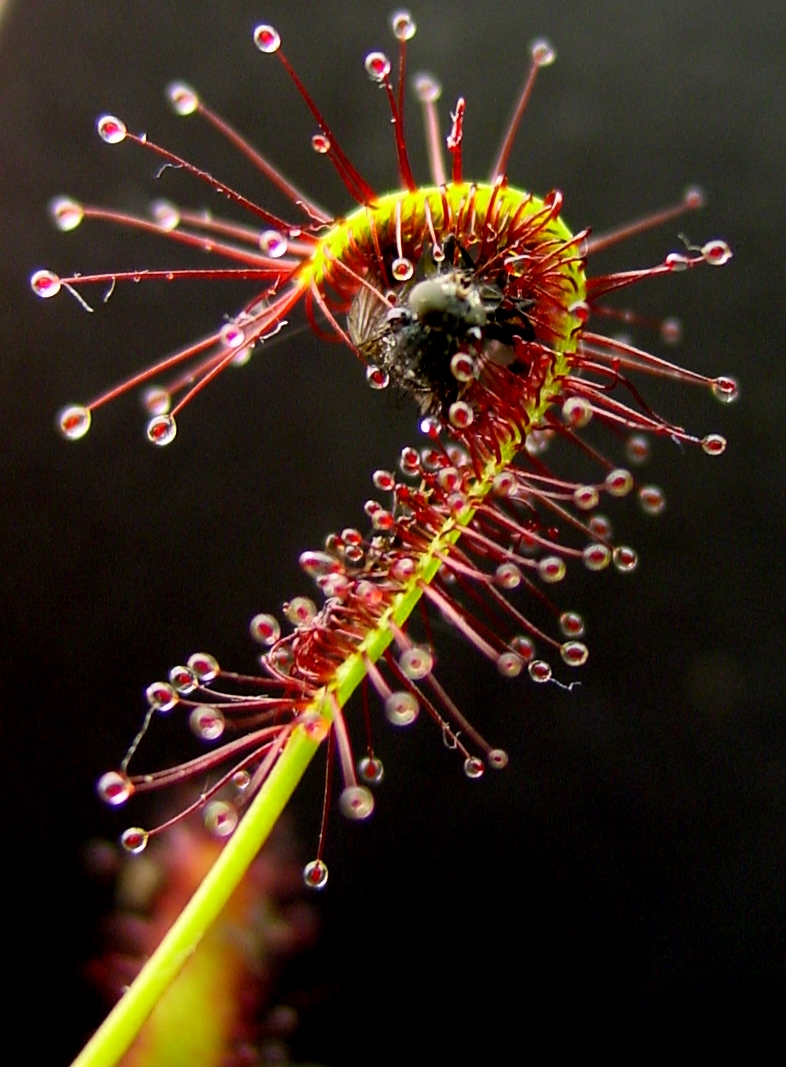
Cape sundew (Drosera capensis) is a carnivorous perennial herb native to the boggy seeps of the Western and Eastern Cape provinces in South Africa. Its linear leaves are blanketed in crimson, nectar-tipped tentacles that capture insects and curl tightly around them to extract essential nutrients.
Unlike many temperate carnivorous species, this sundew requires no winter dormancy period and thrives on a sunny indoor windowsill provided you keep its roots permanently wet with mineral-free water.
Key Facts
- Light: At least 4-6 hours direct sun daily
- Water: Keep pot standing in 1-2 cm (0.5-0.8 in) distilled water
- Soil: 50:50 mix of pure peat moss and horticultural perlite
- Feeding: 1-2 small gnats or rehydrated bloodworms per month
- Dormancy: None; grows actively year-round indoors
- Hardiness: USDA zones 9-11; protect below 5 °C (41 °F)
Cape Sundew Fit: What to Expect Indoors
Cape sundew is the easiest carnivorous plant to grow on a domestic windowsill, requiring only intense light and pure, standing water. It stays compact at under 20 cm (8 in) tall, fitting comfortably on small shelves, terrarium trays, or next to sink areas where fruit flies gather.
The plant suits beginners who want a functional natural insect trap, but it demands strict discipline regarding water quality. Tap water, standard potting compost, and ordinary fertilizers will quickly kill it.
Cape Sundew Look and Identification
Cape sundew forms a dense rosette of narrow, strap-like leaves measuring 6-15 cm (2.4-6 in) long and up to 5 mm (0.2 in) wide, topped with glandular trichomes. These hairs are translucent red or pink and secrete clear, glistening droplets of adhesive mucilage that mimic morning dew.
As older leaves die, mature specimens develop a small, woody stem reaching 5-10 cm (2-4 in) tall, covered in the papery remains of dry foliage. When an insect touches the blade, nearby tentacles bend inward within 30 minutes, and the entire leaf blade curls lengthwise around the prey over 2 to 6 hours.
How Much Light Does Cape Sundew Need?
Position Cape sundew where it receives at least 4 to 6 hours of direct sunlight every day. An unobstructed south-facing or west-facing window is ideal for keeping the gland tentacles bright crimson and sticky.
If sunlight is insufficient, the plant rapidly loses its red pigment and stops producing glue droplets. When natural light is weak during winter or in north-facing rooms, provide supplemental lighting:
- Place full-spectrum LED grow lights 15-25 cm (6-10 in) above the foliage.
- Run artificial lights on a timer for 12 to 14 hours daily.
- Maintain a color temperature between 5000K and 6500K to stimulate dew production.
Watering Cape Sundew: the Tray Method
Always keep the Cape sundew pot sitting in 1 to 2 cm (0.4 to 0.8 in) of standing mineral-free water at all times. Never allow the growing medium to dry out, as dehydrated root systems cause rapid dieback of active leaves.
Water quality determines the lifespan of this plant because dissolved solids accumulate in the crown and burn sensitive tissue:
- Use only distilled water, reverse osmosis (RO) water, or clean rainwater.
- Target a total dissolved solids (TDS) reading below 50 ppm (ideally below 10 ppm).
- Never use domestic tap water, bottled spring water, or water softened with salts.
- Top up the saucer from below rather than pouring water over the crown.
Best Soil Mix for Cape Sundew
Pot Cape sundew into an acidic, nutrient-depleted substrate composed of equal parts sphagnum peat moss and perlite. Standard commercial potting soils and composts contain added fertilizers that cause fatal root burn within weeks.
Select plastic, glazed ceramic, or resin containers with bottom drainage holes, avoiding unglazed terracotta that leaches minerals into the compost. Pre-soak the peat moss thoroughly with pure water before blending it with rinsed perlite or horticultural silica sand.
Cape Sundew Humidity and Temperature Needs
Maintain indoor ambient temperatures between 18 °C and 26 °C (65 °F and 79 °F) for continuous, vigorous leaf production. While high relative humidity of 50-70% increases dew bubble size, standard room humidity of 40-50% is adequate if the soil remains waterlogged.
The plant tolerates brief drops to 5 °C (41 °F) in winter without dying, though prolonged freezing will blacken all surface growth. Keep plants away from dry forced-air heating registers and cooling air-conditioner vents.
How Cape Sundew Eats and How to Feed It
Feed Cape sundew one or two tiny insects per plant every two to three weeks, and never apply chemical plant fertilizers to the soil. In an ordinary home, the plant readily catches fungus gnats, fruit flies, and mosquitoes without manual assistance.
If grown in a sealed terrarium or pest-free room, supplemental feeding accelerates leaf development:
- Place a dead fruit fly, rehydrated freeze-dried bloodworm, or crushed fish flake onto 1-2 leaves.
- Feed only green leaves that possess glistening dew drops.
- Avoid overfeeding; placing large food particles on every leaf causes mold and tissue rot.
- Never feed cooked meat, cheese, or mammalian protein, which rot the foliage.
How to Propagate Cape Sundew
Cape sundew propagates reliably via leaf cuttings, root cuttings, and fresh seed, with leaf cuttings generating plantlets within 4 to 6 weeks. It is one of the most prolific spreaders in cultivation.
To produce new clones using leaf cuttings:
- Snip a healthy, active leaf near the base of the petiole with clean scissors.
- Float the leaf face up in a small, covered container of pure distilled water.
- Place the container in bright, indirect light at 20-24 °C (68-75 °F).
- Watch for tiny green strike rosettes forming along the margins within 30 days.
- Transfer rooted plantlets onto standard peat-perlite mix once leaves measure 1 cm (0.4 in).
Common Cape Sundew Problems and Pests
The loss of glistening mucilage is the most frequent problem, caused almost universally by insufficient light levels or low moisture. Increase daily direct light exposure and confirm that the saucer holds standing distilled water to restore dew within 7 days.
Aphids occasionally attack the growing center, distorting emerging leaves, while gray mold (Botrytis cinerea) can strike rotting, overfed leaf blades. Rinse aphids away with a spray of distilled water or submerge the pot entirely underwater for 24 hours to drown sap-sucking pests without using oil-based chemical insecticides.
Is Cape Sundew Toxic to Pets?
Cape sundew is completely non-toxic to cats, dogs, and humans according to veterinary poison guidelines. The digestive enzymes and mucilage secreted on the tentacles are formulated solely to break down arthropod exoskeletons and present no chemical hazard to pets.
However, curious cats may bite off the leaf tips or knock over water trays. Place your pots inside broad trays or on high, well-lit plant shelves out of reach of grazing animals to prevent mechanical damage.
Cape Sundew Flowers and Seed Production
Cape sundew sends up tall flower stalks measuring 20 to 30 cm (8 to 12 in) high bearing 10 to 30 pink or white blossoms from late spring through summer. The scapes elevate the blooms well above the sticky rosettes to prevent pollinating insects from becoming trapped.
Flowers open sequentially for a few hours in morning sunlight and self-pollinate without human intervention. Within a month of blooming, the dried seed capsules release hundreds of dust-like black seeds that self-sow readily into surrounding pots of Venus flytrap (Dionaea muscipula), pitcher plant (Sarracenia purpurea), or butterwort (Pinguicula moranensis).
Year-Round Cape Sundew Care
| Spring | Trim off blackened dead leaves near the base using sterilized scissors. Increase the water tray level to 2 cm (0.8 in) as daylight hours lengthen and new rosettes uncurl. |
|---|---|
| Summer | Ensure the water tray never goes dry during hot spells, replenishing with pure distilled water every few days. Offer an occasional mosquito or fungus gnat if indoor pests are scarce. |
| Autumn | Cut spent flower stalks back to the base to avoid unwanted self-seeding in adjacent plant pots. Clean algae from the water tray and inspect the rosette crown for aphids. |
| Winter | Move the pot to your sunniest south-facing window or install an LED grow lamp for 12 hours daily. Reduce the water level to 1 cm (0.4 in) while keeping the root ball constantly wet. |
Why Is My Cape Sundew Dying? Quick Diagnosis
| What you see | Likely cause | What to do |
|---|---|---|
| No dew droplets on tentacles | Low light intensity or soil drying out | Move to a sunny south-facing windowsill and keep the pot in 2 cm (0.8 in) of pure water. |
| Entire plant turning pale green or yellow | Mineral buildup from tap water or inadequate direct sun | Flush the pot with copious distilled water and provide at least 4 hours of direct sunlight. |
| Foliage blackening and rotting around prey | Overfeeding with oversized insect pieces or meat | Snip off the rotting leaf and feed only tiny insect pieces smaller than half the leaf width. |
| Emerging central leaves curled and stunted | Aphid infestation feeding on sap | Submerge the entire foliage in pure distilled water for 24 hours to drown the pests. |
Popular Cape Sundew Cultivars and Forms
- Typical – bright red tentacles with bright pink flowers
- ‘Alba’ – entirely white flowers and clear gland hairs lacking red anthocyanin
- ‘Broad Leaf’ – wider leaf blades and robust, compact rosette habit
- ‘Rubra’ – deep solid crimson foliage throughout when given high light
- ‘Giant’ – extra-large form reaching up to 30 cm across
Frequently Asked Questions
Can Cape sundew survive on tap water?
No, tap water contains dissolved minerals and salts that burn the sensitive roots and kill the plant within a few months. Always use distilled water, reverse osmosis water, or collected rainwater.
Does Cape sundew need winter dormancy?
No, Cape sundew is a subtropical plant from South Africa and does not require a cold winter rest period. It continues growing actively year-round on an indoor windowsill.
How does Cape sundew digest insects?
When an insect touches the mucilage droplets, the tentacle bends to pull the prey against the leaf blade while neighboring tentacles enclose it. The glands release digestive enzymes, including proteases and esterases, that dissolve the insect's soft tissues into liquid nutrients that the leaf absorbs.
Can you use standard potting soil for Cape sundew?
No, standard potting soils contain mineral salts, compost, and chemical fertilizers that will burn and destroy the roots. Use a 50:50 blend of pure sphagnum peat moss and perlite or coarse silica sand.
Should you cut off Cape sundew flower stalks?
You can leave the flower stalk to enjoy the blooms, but cutting it off redirects energy toward producing more carnivorous leaves. If you leave the flower to set seed, it will shed hundreds of tiny seeds that easily sprout in nearby pots.
Sources & Verification
Taxonomy and distribution are checked against the databases below. Care guidance is written for cultivated species only and reviewed by our editor. How We Build Plant Profiles →
