
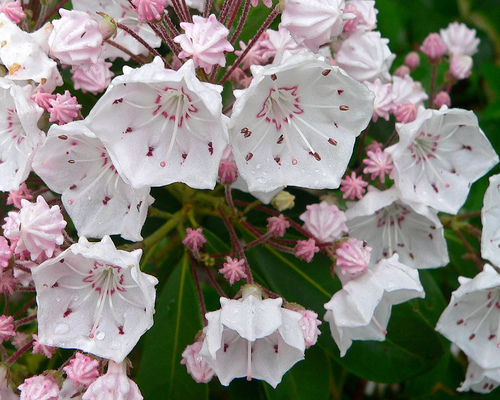
Mountain laurel (Kalmia latifolia) is a broadleaf evergreen shrub native to the eastern United States, from Maine to Florida. It belongs to the heath family and is the state flower of both Pennsylvania and Connecticut, recognized by its distinctive umbrella-shaped flower clusters.
This species is significantly more difficult to establish than the related Catawba rhododendron (Rhododendron catawbiense) because it demands very specific soil acidity. It contains grayanotoxins in all parts, which makes it hazardous to livestock and pets if ingested.
Key Facts
- Light: Partial shade to full sun in cool climates
- Soil: Strongly acidic (pH 4.5–5.5), well-drained, and rich
- Water: Consistent moisture without waterlogging
- Hardiness: USDA zones 4 to 9
- Toxicity: Highly toxic to humans, dogs, cats, and horses
Fitting Mountain Laurel into Your Landscape
Mountain laurel is a slow-growing evergreen that demands acidic, well-drained soil to survive in a garden setting. It is an ideal choice for woodland borders where the soil is naturally rich in organic matter. You should avoid planting it near livestock pastures or areas where pets roam freely, as the entire plant is poisonous.
Because it grows slowly, often only 10-20 cm (4-8 in) per year, it works well as a permanent structural element that won’t quickly outgrow its space. It provides year-round interest with leathery foliage, but the main appeal is the late spring bloom. It thrives in the company of other acid-loving plants like blueberries (Vaccinium) or pieris (Pieris japonica).
Identifying the Mountain Laurel Flower and Foliage
The mountain laurel is most easily identified by its hexagonal, cup-shaped flowers that feature 10 distinct pockets for the anthers. These blooms are typically 2-3 cm (0.8-1.2 in) across and appear in large clusters called corymbs. The foliage is dark green, leathery, and lance-shaped, measuring 5-12 cm (2-5 in) in length.
- Flowers feature unique purple or maroon dots inside the cup.
- Leaves are alternate, though they often appear whorled at the stem tips.
- The stems are often gnarled and twisted, especially in older specimens.
- Bark on mature branches is thin and shreds in long, narrow flakes.
Mature Size and Growth Habits
A typical garden mountain laurel reaches 2 to 5 metres (7 to 15 feet) in height and spread. In their native Appalachian habitat, some ancient specimens can reach 10 metres (33 feet), taking on a tree-like form with thick, gnarled trunks. In most residential landscapes, however, they remain dense, multi-stemmed shrubs.
The growth habit is naturally rounded, but it can become leggy if grown in too much shade. Because of the slow growth rate, a 1-metre (3-foot) nursery plant may take five years or more to double in size. This density makes it an effective screen for privacy if several are planted in a row.
Selecting the Best Planting Site
Your mountain laurel requires partial shade and protection from high winds to prevent leaf desiccation. While it can tolerate full sun in northern regions, it needs consistently moist soil to prevent foliage scorch in those conditions. The soil must be acidic; if your soil pH is above 6.0, the plant will suffer from nutrient deficiencies and eventually die.
Avoid low-lying areas where water pools after rain, as this species is highly susceptible to root rot. A north-facing slope or the edge of a wooded area provides the ideal balance of light and drainage. Ensure there is enough space for air to circulate around the shrub to prevent fungal leaf spots.
Planting and Establishing Your Shrub
When planting, ensure the top of the root ball is slightly above the soil surface. Dig a hole twice as wide as the root ball but no deeper, as planting too deep will suffocate the shallow root system. Backfill with a mix of native soil and organic matter like peat moss or aged pine bark to lower the pH and improve drainage.
- Remove any burlap or wire cages from the root ball before backfilling.
- Space multiple shrubs 1.5-2.5 metres (5-8 feet) apart.
- Water deeply immediately after planting to settle the soil.
- Apply a 5-10 cm (2-4 in) layer of pine needle mulch to retain moisture.
Mountain Laurel Care and Feeding
Apply a fertilizer formulated for acid-loving plants in early spring before new growth starts. Do not over-fertilize, as mountain laurel is sensitive to salt buildup in the soil; a single application of slow-release food is usually sufficient. Supplement the soil with elemental sulfur if a soil test shows the pH is rising toward neutral levels.
Watering is the most frequent maintenance task during the first two years. The soil should feel like a wrung-out sponge—moist but not dripping. Once the root system is established, the shrub can tolerate brief dry spells, but a thick layer of organic mulch is necessary to keep the roots cool and moist throughout the summer heat.
How to Prune Mountain Laurel
Pruning should be done immediately after the flowers fade in early summer. This timing allows the plant to set buds for the following year on the new wood. Avoid heavy pruning in autumn or winter, as you will remove the next season’s flower display. For older, leggy plants, you can perform rejuvenation pruning by cutting the stems back to 15-30 cm (6-12 in) from the ground.
- Deadhead spent flower clusters to encourage better foliage growth.
- Remove dead, damaged, or diseased wood whenever it is spotted.
- Thin out inner branches to improve air circulation and light penetration.
- Shape the shrub lightly to maintain its natural rounded form.
Why Are My Mountain Laurel Leaves Turning Yellow?
Yellowing leaves with green veins usually indicate iron chlorosis caused by high soil pH. If the soil is not acidic enough, the plant cannot absorb iron, leading to stunted growth and pale foliage. Another common problem is leaf spot (Phyllosticta kalmicola), which presents as circular brown or grey spots with purple borders.
Lace bugs are the primary insect pest, sucking sap from the leaf undersides and causing a yellow-stippled appearance on the upper surface. If the entire plant wilts suddenly despite moist soil, it likely has Phytophthora root rot. To fix this, you must improve the drainage or move the plant to a higher, drier spot immediately.
Protecting Your Shrub During Winter
In cold climates, mountain laurel needs protection from drying winter winds to prevent winter burn. Because it is an evergreen, it continues to lose moisture through its leaves even when the ground is frozen. Water the plant deeply in late autumn before the first hard freeze to ensure it is fully hydrated entering the winter months.
If your garden is in an exposed, windy location, you can wrap young shrubs in burlap or construct a temporary windbreak. Avoid using plastic wraps, which can trap heat and cause the plant to break dormancy too early. A thick layer of pine needle or bark mulch will help insulate the shallow roots against extreme temperature fluctuations.
Mountain Laurel Through the Seasons
| Spring | Apply an acid-tone fertilizer and check soil pH. Mulch with pine needles and monitor for lace bug activity as temperatures rise. |
|---|---|
| Summer | Deadhead spent blooms in June. Provide 2.5 cm (1 in) of water per week during dry spells to prevent leaf scorch. |
| Autumn | Water deeply before the ground freezes. Replenish mulch to a depth of 10 cm (4 in) to protect roots from frost heave. |
| Winter | Check for snow load on branches and gently brush off heavy accumulation. Inspect for deer browsing damage in late winter. |
Mountain Laurel Care and Disease Solutions
| What you see | Likely cause | What to do |
|---|---|---|
| Yellow leaves with green veins | Iron chlorosis from high soil pH | Apply elemental sulfur or chelated iron to lower soil pH. |
| Circular grey spots with purple borders | Phyllosticta leaf spot fungus | Improve air circulation and remove fallen infected leaves. |
| Stippled yellowing on leaf tops | Lace bug infestation | Spray the undersides of leaves with insecticidal soap in late spring. |
| Sudden wilting and branch dieback | Phytophthora root rot | Relocate the plant to a well-drained site or a raised bed. |
Popular Mountain Laurel Cultivars
- ‘Olympic Fire’ – bright red buds opening to pink flowers
- ‘Minuet’ – a dwarf variety reaching only 1 metre (3 feet)
- ‘Nathan Hale’ – compact habit with deep pink blossoms
- ‘Snowdrift’ – pure white flowers and dark green glossy leaves
- ‘Bullseye’ – white flowers with a distinct purple-red band
Frequently Asked Questions
Is mountain laurel toxic to dogs?
Yes, mountain laurel is highly toxic to dogs and contains grayanotoxins that interfere with nerve and muscle function. Symptoms include drooling, vomiting, and in severe cases, coma or death.
How is mountain laurel different from Texas mountain laurel?
Mountain laurel (Kalmia latifolia) is an acid-loving shrub from the eastern US with pink/white flowers, while Texas mountain laurel (Dermatophyllum secundiflorum) is a drought-tolerant plant from the southwest with purple, grape-scented flowers.
Can you grow mountain laurel from seed?
Yes, but it is difficult as seeds require a period of cold stratification and can take several months to germinate. Most gardeners prefer to use nursery-grown plants or semi-hardwood cuttings.
Why is my mountain laurel not blooming?
The most common reasons are too much shade, which prevents bud set, or pruning the plant too late in the summer and removing the developing buds.
What was mountain laurel wood used for?
The wood is extremely hard and fine-grained, which led to its traditional use for carving spoons, tool handles, and tobacco pipes.
Information about traditional or historical uses is provided for educational interest only and is not medical advice. Do not use any plant to treat a condition without speaking to a qualified professional.
Sources & Verification
Taxonomy and distribution are checked against the databases below. Care guidance is written for cultivated species only and reviewed by our editor. How We Build Plant Profiles →