
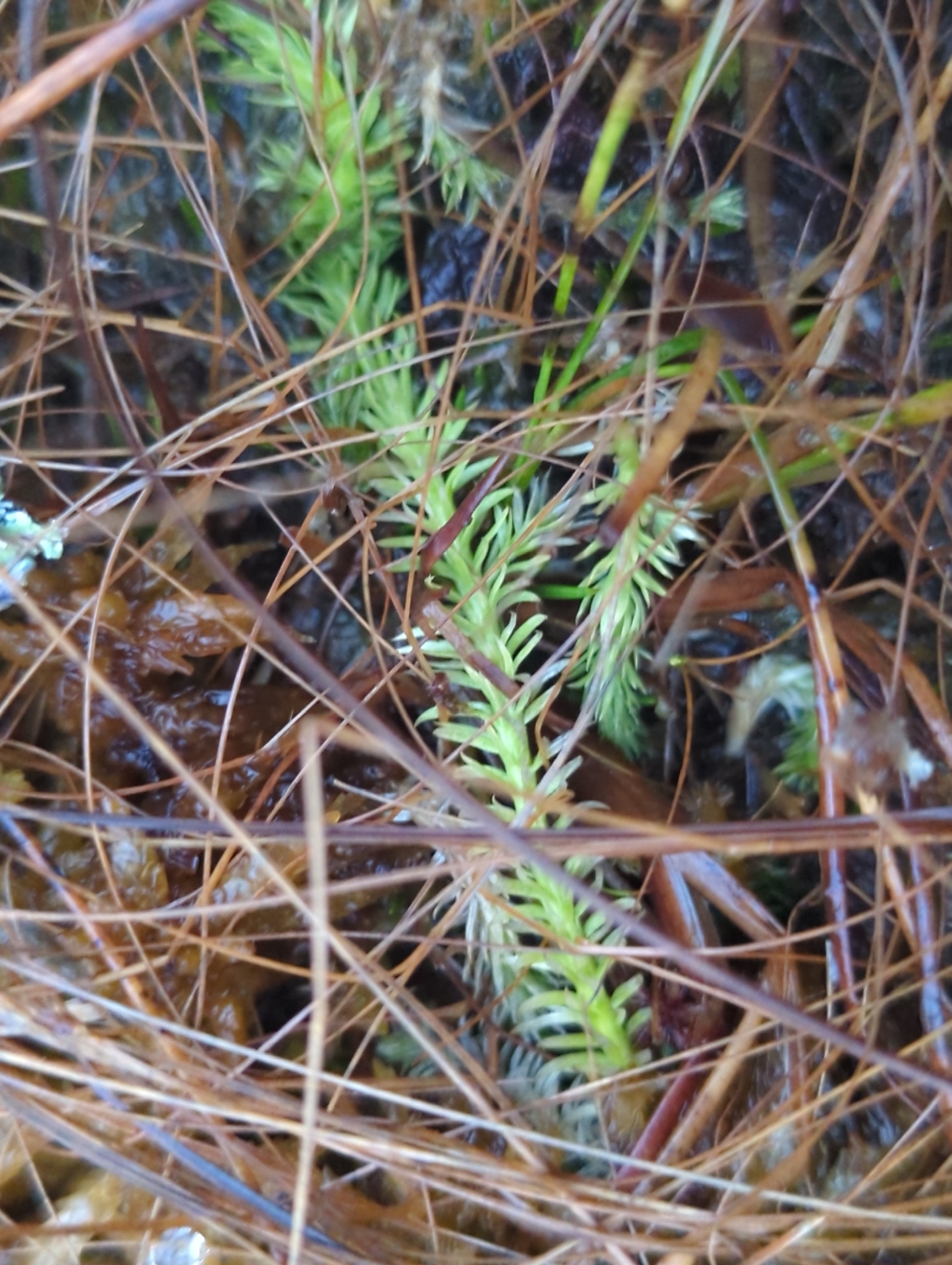
Bog clubmoss (Lycopodiella inundata) is a small, spore-bearing vascular plant native to wet peatlands and damp sand across the Northern Hemisphere. It forms low horizontal stems anchored by fine roots in saturated, acidic substrate.
Unlike true mosses, this lycophyte possesses internal vascular tissue and reproduces via cone-like structures called strobili. It thrives almost exclusively in exposed, nutrient-poor bog hollows where low-growing vegetation leaves wet peat open to sunlight.
Key Facts
- Plant Type: Spore-bearing perennial lycophyte
- Native Range: Circumboreal Eurasia and North America
- Habitat: Wet peat bogs and acidic lake shores
- Height: Creeping stems up to 10 cm (4 in) tall
- Substrate pH: Highly acidic, 3.8 to 5.0
- Reproduction: Spores produced in late summer strobili
Understanding Bog Clubmoss in the Wild
Bog clubmoss is an ancient, spore-bearing vascular plant that colonizes exposed peat and wet sand in nutrient-poor wetland systems.
It operates as a pioneer species on wet, disturbed peat where larger bog vegetation has not yet established dominance. Because it relies on open sun and bare peat, it quickly disappears if tall sedges or shrubs shade out its low horizontal stems.
Nature enthusiasts and botanists observe it in acidic habitats alongside insectivorous plants like round-leaved sundew (Drosera rotundifolia).
How to Identify Lycopodiella inundata
Lycopodiella inundata produces prostrate stems 5 to 15 cm (2 to 6 in) long that root into wet substrate, ending in upright spore-bearing cones.
Leaves (microphylls) measure 3 to 6 mm (0.12 to 0.24 in) in length, remaining narrow, pointed, and spirally arranged along the creeping main stem. During late summer, single unbranched fertile stems rise 3 to 10 cm (1.2 to 4 in) high, terminating in a dense, yellowish-green cylindrical strobilus.
Key physical characteristics include:
- Prostrate stems: Flat-creeping green stems measuring 1 to 2 mm (0.04 to 0.08 in) thick that die back at the trailing base each winter.
- Microphylls: Linear, sharp-pointed leaves curving slightly upward along both sterile and fertile stems.
- Strobili: Solitary vertical cones 1 to 3 cm (0.4 to 1.2 in) long appearing from July through September.
- Winter buds: A compact terminal tip that overwinters while older stem tissue turns brown and decomposes.
Lycopodiella inundata Habitat Requirements
Lycopodiella inundata requires open, permanently saturated peat or acidic sand with a substrate pH between 3.8 and 5.0.
It inhabits active quaking bogs, margins of oligotrophic lakes, moist tundra hollows, and abandoned gravel pits or borrow pits where ground water meets bare mineral sand. High water tables are essential; the horizontal stems often sit submerged under 1 to 3 cm (0.4 to 1.2 in) of water during spring thawing.
The species cannot compete with aggressive turf-forming vegetation. Periodic localized disturbance, such as ice scouring, seasonal water level fluctuations, or moderate foot traffic, maintains the open ground necessary for spore germination and gametophyte development.
Ecological Role and Spore Lifecycle
The lifecycle of northern bog clubmoss requires subterranean gametophytes that depend on specific mycorrhizal fungi for nutrition.
When strobili mature in late summer, they release microscopic yellow spores that are wind-dispersed across wet peat. Once a spore settles in saturated substrate, it germinates into a tiny subterranean gametophyte that lacks chlorophyll and relies entirely on fungal hyphae for carbohydrates over several years.
The reproductive lifecycle follows these stages:
- Spore release: Sporangia open in dry late-summer breeze to shed dust-like spores.
- Gametophyte stage: Subterranean structure develops slowly underground with obligate fungal partners.
- Fertilization: Swimming sperm travel through film water to fertilize egg cells on the gametophyte.
- Sporophyte growth: New leafy green creeping stems emerge above ground to complete the cycle.
Conservation Status and Threats
Lycopodiella inundata holds a global status of Least Concern (LC), though local populations are declining rapidly in agricultural regions due to wetland drainage.
In Western Europe and parts of eastern North America, habitat fragmentation has wiped out historical peat bog colonies. Water abstraction, peat extraction, and atmospheric nitrogen deposition accelerate succession by enabling fast-growing grasses and shrubs to smother the clubmoss.
Conservation management relies on protecting hydrological regimes and retaining exposed peat scraped clean of dense heather or sedge cover.
Traditional Uses of Lycopodiella inundata
Historical records document limited traditional use of Lycopodiella inundata spores as fine dusting powder and pyrotechnic material.
Like spores from stag’s-horn clubmoss (Lycopodium clavatum), the hydrophobic spore dust of species in the Lycopodiaceae family was historically collected for dry coating pills in apothecary shops and early flash photography. However, due to the small stature and relative scarcity of northern bog clubmoss, commercial gathering primarily focused on larger terrestrial relatives.
No modern commercial or medicinal applications exist for this species today, and harvest from wild wetland habitats is restricted in many jurisdictions.
Distinguishing Northern Bog Clubmoss from Similar Species
Northern bog clubmoss differs from related lycophytes by its single unbranched strobili and annual die-back of trailing stems.
Field botanists encounter several co-occurring or visually similar lycophytes in wetland and heathland habitats:
- Foxtail bog clubmoss (Lycopodiella alopecuroides): Features thicker, arching stems with widely spreading leaf margins and larger strobili, found primarily in warmer southern wetlands.
- Southern bog clubmoss (Lycopodiella prostrata): Leaves lie flat against the stem with distinct leaf teeth, occupying coastal plain bogs.
- Stag’s-horn clubmoss (Lycopodium clavatum): Forms long, trailing evergreen stems with paired strobili raised on long peduncles in dry woodlands or heath.
- Interrupted clubmoss (Spinulum annotinum): Features stiff, horizontal stems with distinct annual growth rings and sessile strobili in drier acidic woods.
- Slender clubmoss (Pseudolycopodiella caroliniana): Possesses strongly dimorphic leaves arranged in distinct lateral rows along flat creeping stems.
Frequently Asked Questions
What is bog moss and how does it differ from bog clubmoss?
Bog moss refers to Sphagnum species, which are non-vascular bryophytes forming dense sponge-like cushions. Bog clubmoss (Lycopodiella inundata) is a true vascular plant with roots, internal fluid-conducting tissue, and cone-like spore structures.
Is Lycopodiella inundata the same as northern bog clubmoss?
Yes, Lycopodiella inundata (synonym Lycopodiella inundata (L.) Holub) is the scientific name for northern bog clubmoss. It is also referred to as inundated clubmoss or marsh clubmoss across its range.
How do you distinguish foxtail bog clubmoss from northern bog clubmoss?
Foxtail bog clubmoss (Lycopodiella alopecuroides) has arching stems and bristly strobili that resemble a fox's tail. Northern bog clubmoss (Lycopodiella inundata) has lower prostrate stems and slender, solitary strobili.
Can you grow northern bog clubmoss in a garden bog container?
Northern bog clubmoss is extremely difficult to cultivate outside its natural peatland environment due to its dependence on specific subterranean fungi and constant high water tables. Wild collection is restricted in many areas to protect fragile ecosystems.
Why is Lycopodiella inundata restricted to wet peat bogs?
Lycopodiella inundata requires acidic substrate with a pH between 3.8 and 5.0 and full sunlight to survive. It lacks deep root systems and relies on continuous saturation in peat or wet sand to prevent stem desiccation.
Information about traditional or historical uses is provided for educational interest only and is not medical advice. Do not use any plant to treat a condition without speaking to a qualified professional.
Sources & Verification
Taxonomy and distribution are checked against the databases below. Care guidance is written for cultivated species only and reviewed by our editor. How We Build Plant Profiles →