
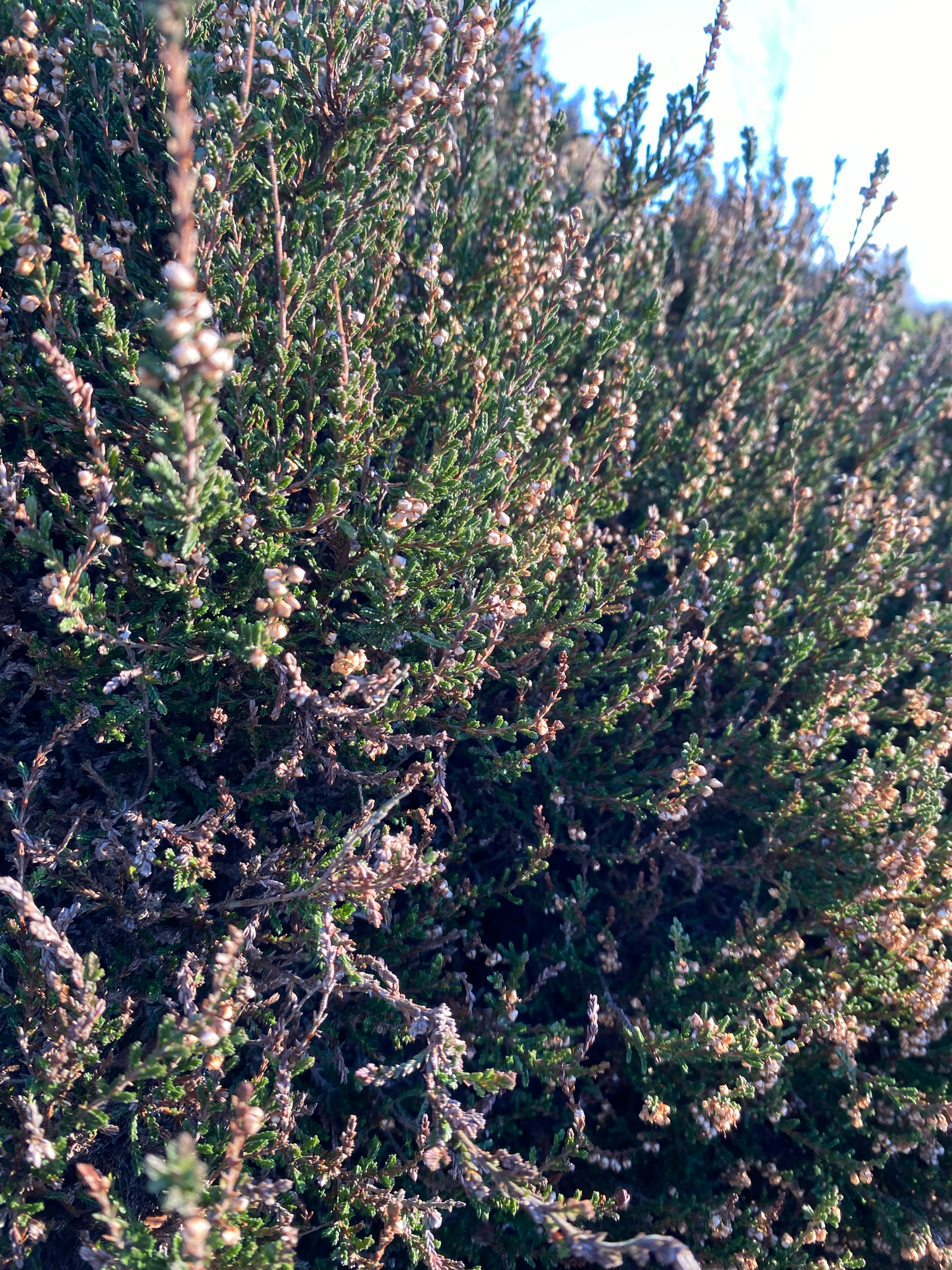
Heather is a low-growing, evergreen shrub native to the moorlands and bogs of Europe and Asia Minor, belonging to the genus Calluna vulgaris. It is the only species in its genus, distinguished from other heaths by its tiny, scale-like leaves that overlap in four distinct rows along the woody stems.
This plant requires acidic soil to survive and will often die within a single season if planted in alkaline or lime-rich ground. While it thrives in exposed, windy environments, the heather care plant needs consistent moisture during its first year to establish its shallow root system.
Key Facts
- Soil pH: strictly acidic between 4.5 and 5.5
- Light: minimum of 6 hours of full sun daily
- Bloom Time: late summer to mid-autumn
- Hardiness: cold tolerant down to -30 °C (-22 °F)
Fitting Heather into Your Garden
Heather works best as a low-maintenance groundcover in acidic rock gardens or coastal landscapes. It is a primary choice for gardeners dealing with nutrient-poor, sandy soils where other shrubs struggle to take root. Because it remains under 60 cm (24 in) in height, it provides year-round texture without obstructing views of taller specimens.
You should choose this plant if you can provide the specific soil chemistry it demands, as it will not tolerate being moved once established. It is frequently used in mass plantings to mimic the appearance of wild moors. It provides a nectar source for bees late in the season when most other garden flowers have faded.
Identifying Calluna vulgaris
You can identify Heather by its minute, scale-like leaves that are arranged in opposite pairs and overlap to hide the stem. These leaves are typically 2-3 mm (0.08-0.12 in) long and turn from green to bronze or purple shades during the winter months. This leaf structure is the primary way to tell it apart from the needle-like foliage of winter heath (Erica carnea).
The flowers are bell-shaped and deeply lobed, appearing in dense, spike-like clusters called racemes. Each individual flower is roughly 4 mm (0.15 in) long and sits within a calyx that is the same color as the petals. The woody stems are tough and fibrous, historically used for making functional household tools.
Heather Mature Size and Growth Habit
Heather typically reaches a mature height of 20-60 cm (8-24 in) with a slightly wider spread. It grows as a dense, mounded shrub that eventually forms a thick carpet of foliage. The growth rate is slow, usually adding only 5-10 cm (2-4 in) of new wood each year depending on the soil quality.
In the wild, older plants can become leggy and develop a woody, open center if they are not grazed or managed. In a garden setting, regular maintenance keeps the habit compact and bushy. The root system is shallow and wide-spreading, which helps the plant anchor itself in thin, rocky soils.
Choosing the Right Site for Heather
Place your Heather in a location that receives at least six hours of direct sunlight every day. Full sun is required to produce the most intense flower colors and to ensure the foliage stays dense rather than leggy. While it can survive in partial shade, the plant will produce fewer blooms and may become susceptible to fungal issues.
The site must have excellent drainage, as the roots will rot if they sit in standing water. It thrives in open, airy positions and is highly resistant to salt spray, making it suitable for coastal gardens. Avoid areas where the soil is naturally alkaline or near concrete structures that might leach lime into the ground.
How to Plant Heather
The best time for planting is early spring or early autumn when the soil is moist. Dig a hole twice as wide as the root ball but no deeper, ensuring the top of the root ball sits flush with the soil surface. Planting too deeply can lead to stem rot, while planting too high can cause the shallow roots to dry out.
- Mix 50% ericaceous compost into the native soil if the pH is slightly high
- Space plants 30-45 cm (12-18 in) apart for a solid groundcover effect
- Water thoroughly immediately after planting to settle the roots
- Apply a 5 cm (2 in) layer of pine bark mulch to maintain acidity
Heather Care and Maintenance
Water your Heather regularly during its first two growing seasons to keep the soil consistently damp but not waterlogged. Once established, the plant is moderately drought-tolerant but will flower poorly if left completely dry during the heat of summer. Use rainwater instead of tap water if you live in a hard-water area, as tap water can gradually raise the soil pH.
Feeding is rarely necessary if the plant is grown in appropriate acidic soil. If growth seems stunted, apply a small amount of fertilizer designed for acid-loving plants in early spring. Avoid high-nitrogen fertilizers, which encourage weak, sappy growth that is easily damaged by winter frosts.
When and How to Prune Heather
Prune your Heather annually in early spring before new growth starts to maintain a compact shape. Use garden shears to trim off the faded flower spikes from the previous year, cutting just below the old blooms. Never cut back into the old, brown wood, as Heather rarely regenerates from leafless stems and you may end up with permanent dead spots.
Regular pruning prevents the plant from becoming leggy and splitting open in the center. If a plant has been neglected for several years, it is often better to replace it than to attempt a hard rejuvenation prune. In wild landscapes, this role is often filled by controlled burning or grazing by livestock.
Common Pests and Diseases
The most serious threat to Heather is Phytophthora root rot, which occurs in heavy or poorly drained soils. Symptoms include sudden wilting and the foliage turning a dull grey-green or brown. There is no cure for root rot once it takes hold, so prevention through proper site selection is the only effective strategy.
- Check for spider mites during hot, dry spells which cause yellow mottling
- Watch for Heather Beetle (Lochmaea suturalis) which strips foliage
- Ensure good air circulation to prevent powdery mildew
- Remove fallen leaves from the canopy to prevent fungal spotting
Winter Protection and Cold Hardiness
Heather is extremely cold hardy, surviving temperatures as low as -30 °C (-22 °F) without significant damage. However, the evergreen foliage is prone to desiccation from cold, drying winds when the ground is frozen. In very exposed gardens, a temporary screen or a light covering of evergreen boughs can protect the plants during the harshest weeks.
Snow cover actually acts as an insulator and is beneficial for the plant. If you grow Heather in containers, the pots are more vulnerable to freezing solid; wrap the containers in burlap or move them to a sheltered corner. Avoid salting nearby paths, as runoff can be lethal to the plant’s sensitive roots.
Traditional and Modern Uses of Ling
Historically, Heather was a vital resource for making besom brooms, thatch, and insulation in rural Europe. The stems were bundled together to create hardy sweeping tools, while the flowers were used to produce a yellow dye for wool. It was also a key ingredient in traditional heather ale before hops became the standard bittering agent.
Traditionally, the plant was used in folk medicine as a diuretic and to treat urinary tract discomfort. In modern landscapes, it is primarily grown for its ability to provide color in late summer and for the high-quality honey produced by bees that forage on its nectar. It remains a symbolic plant in Scotland, often associated with luck and protection.
Year-Round Heather Care
| Spring | Prune back the previous year’s flower spikes before new growth begins. Apply a fresh layer of acidic mulch and check soil pH if the foliage looks yellow. |
|---|---|
| Summer | Monitor soil moisture during heatwaves and water with rainwater if possible. Watch for heather beetle damage and ensure the plant isn’t being crowded by weeds. |
| Autumn | Enjoy the peak flowering period. This is the ideal time to plant new specimens or move container-grown plants into the ground before the first hard freeze. |
| Winter | Protect from harsh, drying winds with a temporary screen if necessary. Ensure container-grown plants are sheltered and avoid using de-icing salts near the root zone. |
Common Heather Problems Explained
| What you see | Likely cause | What to do |
|---|---|---|
| Foliage turning brown and brittle | Drought stress or winter desiccation | Increase watering frequency and provide a windbreak in winter. |
| Yellowing leaves (Chlorosis) | Soil pH is too high (alkaline) | Apply sulfur or ericaceous fertilizer to lower the soil pH. |
| Sudden wilting and death | Phytophthora root rot | Improve drainage or relocate future plantings to a higher spot. |
| Leggy, sparse growth | Insufficient sunlight or lack of pruning | Move to a full sun position and prune annually after flowering. |
Popular Heather Cultivars
- ‘Firefly’ – deep terracotta foliage that turns brick red in winter
- ‘Wickwar Flame’ – yellow summer foliage changing to orange and red
- ‘Kinlochruel’ – double white flowers on compact green mounds
- ‘Silver Knight’ – grey-silver woolly foliage with lavender blooms
- ‘County Wicklow’ – low-growing with shell-pink double flowers
- ‘Darkness’ – intense crimson-purple flowers in late summer
Frequently Asked Questions
What is the difference between Heather and Heath?
Heather (Calluna vulgaris) has scale-like leaves and blooms in late summer, while Heaths (Erica species) have needle-like leaves and many bloom in winter or spring.
Is Heather toxic to dogs or cats?
No, Heather is considered non-toxic to dogs, cats, and horses according to the ASPCA.
Why is my heather plant dying after one year?
The most common reason is alkaline soil; if your soil pH is above 6.0, the plant cannot absorb nutrients and will slowly decline.
How do you heather a shirt?
In textiles, 'heathering' refers to blending different colored fibers to create a mottled look; it is a manufacturing process and has nothing to do with the Calluna plant.
Are celebrities like Heather Mills or Heather Locklear related to the plant?
No, these individuals share a common English name derived from the plant, but they have no direct botanical or historical association with Calluna vulgaris.
Can I grow Heather indoors?
No, Heather requires a period of winter dormancy and high light levels that are impossible to replicate in a standard home environment.
Information about traditional or historical uses is provided for educational interest only and is not medical advice. Do not use any plant to treat a condition without speaking to a qualified professional.
Sources & Verification
Taxonomy and distribution are checked against the databases below. Care guidance is written for cultivated species only and reviewed by our editor. How We Build Plant Profiles →