
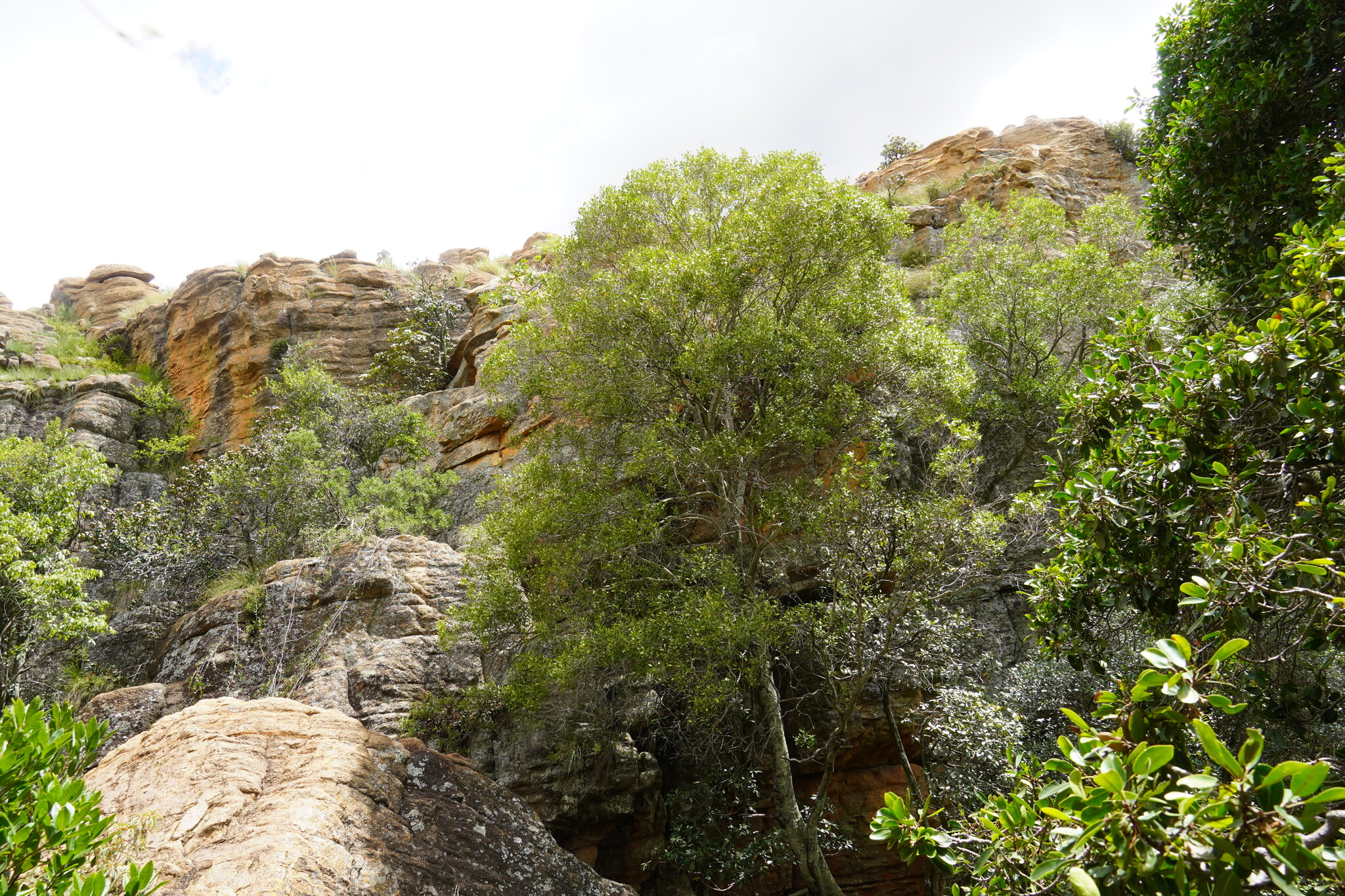
Black ironwood (Olea capensis) is an evergreen tree or shrub native to sub-Saharan Africa, Madagascar, and the Comoros, belonging to the olive family Oleaceae.
It produces some of the hardest and dense wood in Africa, with seasoned timber that sinks in fresh water rather than floating.
Key Facts
- Plant Type: Evergreen tree or large shrub
- Native Range: Sub-Saharan Africa and Madagascar
- Wood Density: Up to 1,290 kg/m³ (80 lb/cu ft)
- Water Sinkability: Sinks completely in fresh water
- Fruit: Purple oblong drupe 1-2 cm long
Where Black Ironwood Fits in the Landscape
Black ironwood grows as a multi-stemmed coastal shrub of 5 m (16 ft) or an evergreen forest canopy tree up to 40 m (130 ft) tall depending on local humidity and wind exposure.
In coastal dunes and exposed rocky ridges, it remains compact with dense branching. In deep afro-montane forests, it develops a long, straight clear bole topped by a rounded crown.
How to Identify Black Ironwood
Identify black ironwood by its opposite, leathery dark green leaves, small scented white flowers, and purple oblong fruits.
The leaves measure 3-10 cm (1.2-4 in) long and 1.5-5 cm (0.6-2 in) wide with smooth, slightly wavy margins and a pale underside. Bark on young stems is light grey and smooth, turning dark grey to black and deeply vertical-fissured on mature trunks.
- Leaves: Simple, opposite, stiffly elliptic, dark glossy green above
- Flowers: Bisexual or male, cream-white, held in terminal panicles 3-15 cm (1.2-6 in) long
- Fruit: Oval drupe 1-2 cm (0.4-0.8 in) long, ripening from green to dark reddish-purple
- Bark: Light grey smooth young bark developing dark grey fissured ridges with age
Where Is Black Ironwood Found in the Wild
Black ironwood is native across sub-Saharan Africa, stretching from Sudan, Ethiopia, and Somalia south to South Africa, and west to Cameroon, Sierra Leone, and Madagascar.
It occurs from sea level in littoral coastal scrub up to 2,400 m (7,870 ft) elevation in montane evergreen forests. The species adapts to diverse conditions, including rocky outcrops, river banks, and dense forest slopes.
Ecological Role and Fruit Production
The fleshy black ironwood fruit serves as a food source for birds, monkeys, and wild mammals throughout eastern and southern Africa.
Avian species such as the Knysna turaco feed on ripe drupes and disperse the seeds through forest corridors. Insects pollinate the fragrant white flowers during the main bloom period from October to February.
Conservation Status and Threats
Black ironwood holds a global conservation status of Least Concern (LC) on the IUCN Red List due to its wide distribution across the African continent.
However, localized populations in high-canopy forests face habitat fragmentation from agricultural land clearing and historical logging for durable timber. Regional forestry laws in South Africa protect mature specimens from unauthorized felling.
Black Ironwood Lumber, Density, and Uses
Black ironwood timber features an air-dry density of 1,100 to 1,290 kg/m³ (68-80 lb/cu ft), making it so heavy that seasoned logs sink immediately in water.
The wood has a pale yellowish sapwood and a dark reddish-brown to dark brown heartwood with irregular darker streaks. With a Janka hardness rating exceeding 3,600 lbf (16,000 N), it poses extreme resistance to sawing and hand tools, rapidly dulling carbon steel blades.
- Density: 1,100–1,290 kg/m³ (68–80 lb/cu ft), sinks in water
- Hardness: Janka rating ~3,600 lbf; extremely hard and abrasion-resistant
- Lumber uses: Railway sleepers, heavy construction, turnery, bridge timbers
- Specialty uses: Acoustic guitar fingerboards, bridges, and high-end knife handles
- Cost: Expensive specialty timber due to harvesting restrictions and processing difficulty
Black Ironwood vs Desert Ironwood and Other Dense Woods
Black ironwood is distinguished from other dense timbers by its opposite simple leaves and African olive family lineage.
Several unrelated trees share the common name ‘ironwood’, which causes confusion in timber markets and field identification:
- Desert Ironwood (Olneya tesota): Native to the Sonoran Desert in North America; features pinnately compound leaves, purple pea-like flowers, and belongs to the legume family Fabaceae.
- Florida Black Ironwood (Krugiodendron ferreum): Native to South Florida and the West Indies; belongs to the buckthorn family Rhamnaceae and produces small green-yellow flowers.
- Black Locust (Robinia pseudoacacia): Native to eastern North America; produces compound leaves and white pea-like flowers, with lighter wood that floats in water.
- Black Palm (Borassus flabellifer): A monocot palm species with fibrous dark bundles rather than true dicot hardwood rings.
Frequently Asked Questions
Does black ironwood float in water?
No, black ironwood does not float in water. Its air-dry density ranges from 1,100 to 1,290 kg/m³ (68–80 lb/cu ft), which exceeds the density of water and causes the wood to sink.
Is black ironwood expensive?
Yes, black ironwood is expensive and difficult to source commercially. Its high density causes rapid wear on cutting tools, increasing milling costs for specialty luthiers and woodturners.
How hard is black ironwood?
Black ironwood is exceptionally hard, with a Janka hardness rating of approximately 3,600 lbf (16,000 N). This makes it twice as hard as white oak and difficult to work with hand tools.
Is black ironwood found in Florida?
The African black ironwood (Olea capensis) is not native to Florida. References to black ironwood in Florida usually refer to Krugiodendron ferreum, a small tree native to South Florida and the Caribbean.
What is black ironwood used for?
Black ironwood timber is used for railway sleepers, heavy structural beams, turnery, guitar bridges, fingerboards, and high-wear architectural items.
Sources & Verification
Taxonomy and distribution are checked against the databases below. Care guidance is written for cultivated species only and reviewed by our editor. How We Build Plant Profiles →
