
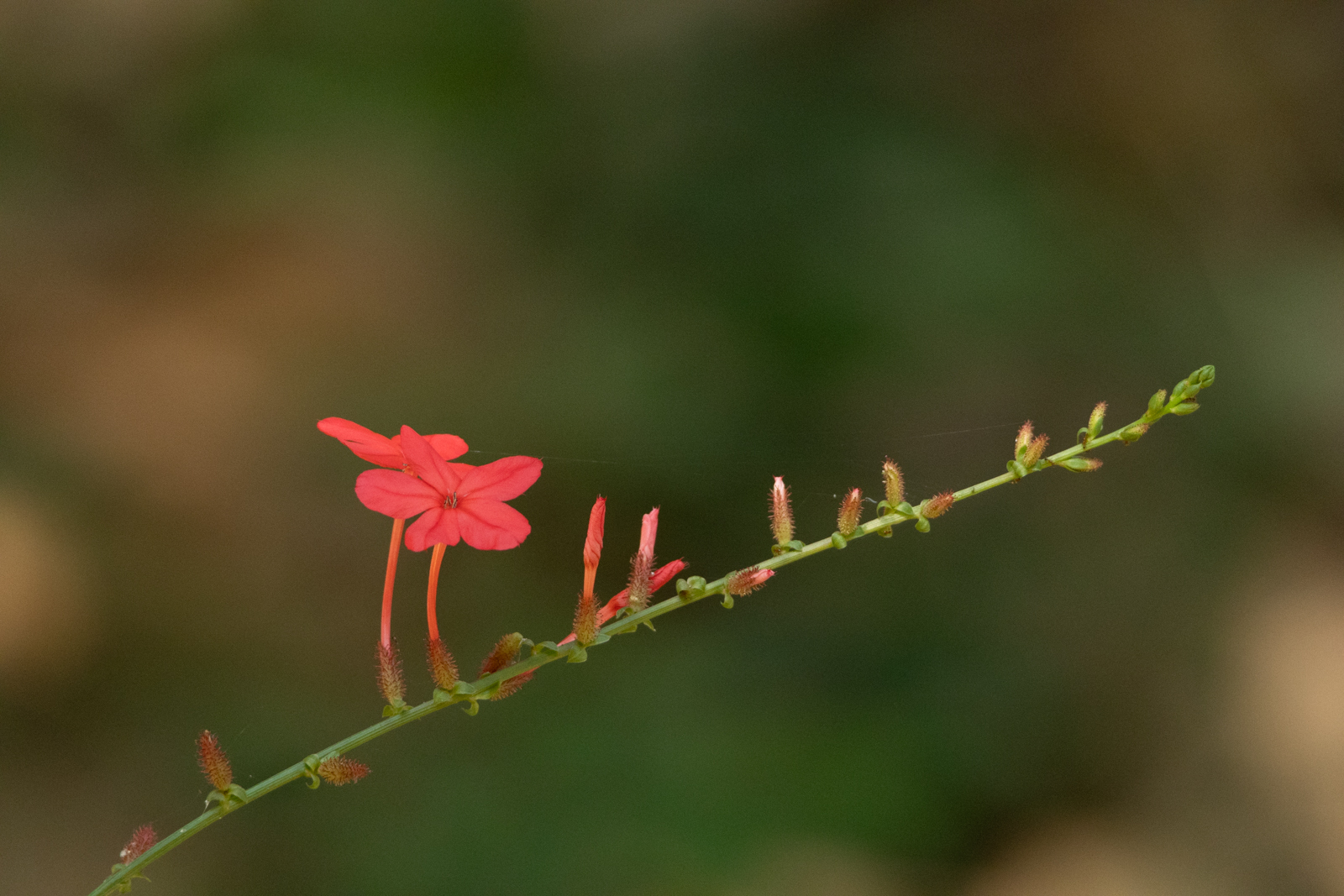
Indian leadwort (Plumbago indica) is a sprawling evergreen subshrub native to Southeast Asia, Indonesia, the Philippines, and Yunnan in southern China. It grows 1 to 2 m (3.3 to 6.6 ft) tall and produces terminal spikes of vivid red to scarlet flowers.
This species requires winter temperatures remaining above 10 °C (50 °F) to survive outdoors. All plant parts contain the organic compound plumbagin, which causes skin irritation and blistering upon contact with raw sap.
Key Facts
- Light: Full sun to partial light
- Height: 1 to 2 m (3.3 to 6.6 ft)
- Hardiness: USDA zones 10 to 11
- Soil pH: 5.5 to 7.0
- Toxicity: Severe skin irritant; toxic if ingested
Is Indian Leadwort Right for Your Garden?
Indian leadwort thrives outdoors only in warm climates falling within USDA zones 10 through 11. Gardeners in cooler zones grow it in containers brought indoors for winter.
This shrub features a lax, vining habit that requires staking or wall support to remain upright. It suits sunny borders, tropical garden beds, and large patio containers.
- Minimum winter temperature: 10 °C (50 °F)
- Growth habit: Scrambling shrub needing mechanical support
- Maintenance level: Moderate annual pruning required
How to Identify Plumbago indica
Indian leadwort produces unbranched terminal racemes 10 to 30 cm (4 to 12 in) long covered in five-lobed scarlet-red flowers. Each tubular bloom measures 2 to 2.5 cm (0.8 to 1 in) across.
The alternate leaves are oval to elliptic, measuring 5 to 15 cm (2 to 6 in) in length. Leaf blades feature slightly wavy margins and short petioles that clasp the stem base. Stems are slender, green when young, and turn grey-brown and woody with age.
The calyx surrounding the flower tube is covered in sticky, glandular hairs that trap small insects. Roots are thick, fibrous, and yield a yellowish-brown sap containing active naphthoquinones.
Light and Soil Needs for Scarlet Leadwort
Position scarlet leadwort in full sun where it receives at least 6 hours of direct sunlight daily for dense blooming. In regions with summer temperatures exceeding 35 °C (95 °F), light afternoon shade prevents leaf scorch.
Plant in well-draining soil with a pH of 5.5 to 7.0. Mix organic compost into sandy or clay soils to improve moisture retention while preserving drainage. Waterlogged soil causes root rot within 2 weeks.
How to Plant Indian Leadwort
Space young shrubs 1 to 1.5 m (3.3 to 5 ft) apart to accommodate their spread. Plant in spring when soil temperatures reach 18 °C (64 °F).
Dig a hole twice as wide as the root ball and equal in depth. Fill around the plant with loose topsoil mixed with 25% organic compost, then water thoroughly to settle air pockets.
- Planting window: Late spring after frost risk passes
- Hole depth: Equal to original container depth
- Initial stake: Insert a 1.2 m (4 ft) cane at planting for support
Watering and Fertiliser Schedule
Water when the top 2.5 cm (1 in) of soil dries out completely during the active growing season. Reduce watering frequency in autumn and winter.
Apply a liquid fertiliser high in potassium every 4 weeks from April through August. Container-grown specimens require liquid feeding every 2 weeks to sustain flower development.
- Spring/Summer watering: 1 to 2 times weekly during dry spells
- Winter watering: Every 2 to 3 weeks, allowing soil to dry halfway
- Fertiliser ratio: High-potassium liquid feed diluted to half strength
How and When to Prune Indian Leadwort
Prune stems back by one-third in late winter before new spring growth emerges. Because flowers form on current season’s wood, early spring pruning promotes maximum flower spike production.
Always wear thick gloves and long sleeves when handling cut stems. The plant sap contains plumbagin, which causes contact dermatitis and blistering on exposed skin.
How to Propagate Plumbago indica
Propagate Indian leadwort using 10 to 15 cm (4 to 6 in) semi-ripe cuttings taken in early summer. Select healthy shoot tips without flower buds.
Dip the cut end in rooting hormone powder and insert it into a 50:50 mixture of perlite and peat moss. Keep the medium moist at 21 to 24 °C (70 to 75 °F); roots establish within 3 to 4 weeks.
Common Indian Leadwort Pests and Diseases
Mealybugs and spider mites represent the primary pest threats, especially when grown under glass or indoors. Inspect leaf undersides monthly for white cottony spots or fine webbing.
Treat infestations promptly with insecticidal soap sprays applied early in the morning. Prevent fungal powdery mildew by keeping foliage dry and maintaining clear air circulation around stems.
- Mealybugs: Remove with cotton swabs dipped in 70% isopropyl alcohol
- Spider mites: Increase ambient humidity above 50% and spray leaves
- Root rot: Prevent by using free-draining pot soil and pots with drainage holes
Overwintering Indian Leadwort in Cold Climates
Move pot-grown plants indoors when nighttime temperatures fall to 10 °C (50 °F). Store container specimens in a bright room receiving 4 to 6 hours of sunlight daily.
Stop all fertiliser applications between October and March. Maintain indoor temperatures between 13 and 18 °C (55 and 65 °F) to prevent cold shock and leaf drop.
Year-Round Care for Indian Leadwort
| Spring | Prune back old stems by one-third in March. Resume regular watering as new shoots appear and apply a balanced liquid feed. |
|---|---|
| Summer | Water thoroughly once or twice weekly. Apply a high-potassium fertiliser every 2 to 4 weeks to support flower spikes. |
| Autumn | Reduce watering frequency as growth slows. Bring container plants indoors before temperatures drop below 10 °C (50 °F). |
| Winter | Keep indoor plants in a bright sunny spot at 13 to 18 °C (55 to 65 °F). Water sparingly every 2 to 3 weeks and withhold fertiliser. |
Indian Leadwort Leaf and Flower Problems
| What you see | Likely cause | What to do |
|---|---|---|
| Yellow leaves and wilting stems | Overwatering or waterlogged soil | Allow top soil to dry completely between waterings and verify pot drainage holes are unobstructed. |
| Few or no red flowers | Insufficient sun exposure | Move the plant to a location receiving at least 6 hours of direct sun daily. |
| White powdery patches on foliage | Powdery mildew fungal infection | Improve air circulation and apply a copper-based fungicide spray. |
| Fine webbing beneath leaf nodes | Spider mite infestation | Spray leaves with insecticidal soap and raise ambient humidity. |
Best Companion Plants for Red Plumbago
Pair Indian leadwort with blue plumbago (Plumbago auriculata) to create a striking contrast between crimson and sky-blue flowers. Both species share similar sunlight and watering requirements.
Other suitable companions include white leadwort (Plumbago zeylanica), Chinese plumbago (Ceratostigma willmottianum), and European leadwort (Plumbago europaea).
- Plumbago auriculata (Blue Plumbago)
- Plumbago zeylanica (White Leadwort)
- Ceratostigma willmottianum (Chinese Plumbago)
- Plumbago europaea (European Leadwort)
Frequently Asked Questions
What is the common name of Plumbago indica?
The primary common name for Plumbago indica is Indian leadwort. It is also widely known as scarlet leadwort or whorled plantain.
What are the traditional uses of Plumbago indica root?
The root of Plumbago indica was traditionally used in South Asian herbal systems to stimulate digestion and treat skin ailments. However, raw roots contain high levels of plumbagin, which is toxic and causes severe blistering.
Is Plumbago indica toxic to cats and dogs?
Yes, Plumbago indica is toxic to pets and humans. All parts contain plumbagin, causing mouth irritation, blistering, drooling, and digestive distress if ingested.
What does the 'L.' mean in Plumbago indica L.?
The 'L.' in Plumbago indica L. stands for Carl Linnaeus, the Swedish botanist who formally named and classified the species in 1753.
How does Plumbago indica differ from Plumbago auriculata?
Plumbago indica produces bright red to scarlet flowers and has smaller hardiness tolerance, whereas blue plumbago (Plumbago auriculata) produces pale blue to sky-blue blooms and tolerates slightly cooler conditions down to 7 °C (45 °F).
Information about traditional or historical uses is provided for educational interest only and is not medical advice. Do not use any plant to treat a condition without speaking to a qualified professional.
Sources & Verification
Taxonomy and distribution are checked against the databases below. Care guidance is written for cultivated species only and reviewed by our editor. How We Build Plant Profiles →
