
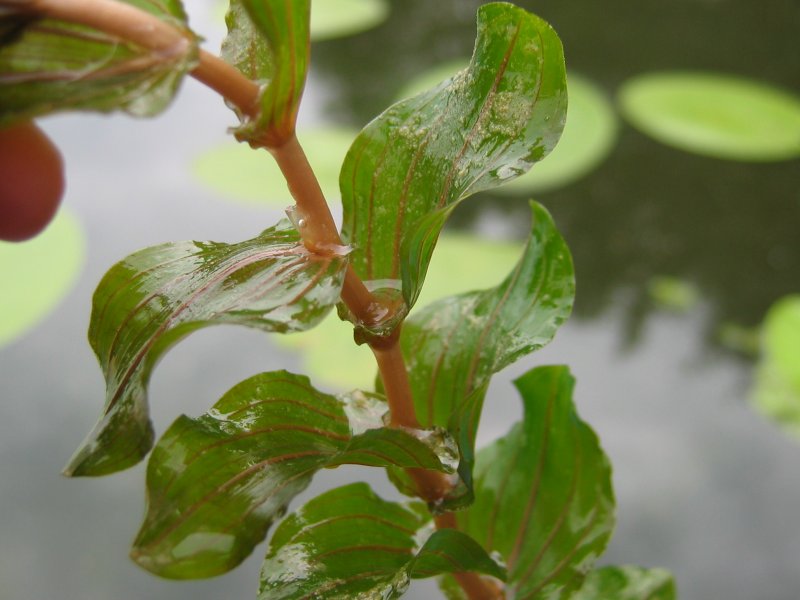
Clasped pondweed (Potamogeton perfoliatus) is a perennial submerged macrophyte with distinct round-based foliage found across waterways on almost every continent. It anchors into riverbeds and lake sediments with a spreading rhizome network.
Known in North America as redhead grass, the plant demands clear, calcareous water and collapses rapidly when agricultural runoff clouds the water column.
Key Facts
- Family: Potamogetonaceae (pondweed family)
- Plant type: Submerged freshwater perennial
- Depth range: 0.5 to 3 m (1.6 to 10 ft)
- Water type: Neutral to alkaline standing or flowing water
- Wildlife value: Major food source for redhead ducks
Encountering Clasped Pondweed in Natural Waters
You will encounter clasped pondweed entirely underwater in clean lakes, slow-moving rivers, and estuaries with salinity below 12 parts per thousand. The plant stays submerged through all seasons, extending stem tips toward the surface without producing floating leaves.
Boaters and anglers encounter dense beds in depths between 1 m (3.3 ft) and 2.5 m (8.2 ft). These underwater meadows anchor shifting river silts, absorb dissolved nutrients, and dampen wave action along open shorelines.
Identifying Potamogeton perfoliatus in the Wild
You can identify clasped pondweed by its heart-shaped leaf base that completely encircles the stem. The leaves are translucent, oval to lance-shaped, measuring 2 to 6 cm (0.8 to 2.4 in) long and 1 to 3 cm (0.4 to 1.2 in) wide with wavy margins.
Key diagnostic features include:
- Leaf arrangement: Alternate along flexible, branched green stems that grow 1 to 3 m (3.3 to 10 ft) long.
- Leaf attachment: Fully amplexicaul (clasping) with no petiole, revealing 5 to 17 visible parallel longitudinal veins.
- Inflorescence: A short, dense spike 1 to 3 cm (0.4 to 1.2 in) long held just above the water on a stout stalk in July and August.
- Fruit: Small, olive-green achenes 2 to 3 mm (0.08 to 0.12 in) long with a blunt beak.
- Overwintering structures: Slender white rhizomes that form dormant winter buds (turions) in autumn sediments.
Native Habitat and Water Requirements
Clasped pondweed requires calcareous, alkaline fresh to brackish water with moderate to high clarity. It grows across temperate regions of Europe, Asia, North America, and North Africa, extending locally into Australia.
The roots anchor best in fine sand, silty loam, or organic marl rather than pure coarse gravel. Growth declines sharply in turbid water where light cannot penetrate beyond 0.8 m (2.6 ft), and the plant disappears entirely from acidified waterways with a pH below 6.0.
Ecological Role as Redhead Grass
This species provides critical winter forage for migratory diving ducks, earning its North American common name redhead grass. The diving redhead duck (Aythya americana) consumes the starch-rich winter rootstocks, seeds, and stems as a primary food source in coastal bays such as the Chesapeake Bay.
Submerged colonies also support complex aquatic food webs:
- Invertebrate habitat: Leaves support high densities of Chironomidae midges, freshwater snails, and caddisfly larvae.
- Fish nursery: Stems create shelter for juvenile northern pike (Esox lucius) and yellow perch (Perca flavescens).
- Water oxygenation: Active underwater photosynthesis enriches benthic zones with dissolved oxygen during summer.
Conservation Status and Environmental Threats
While classified globally as Least Concern by the IUCN, clasped pondweed has experienced severe localized declines in developed river basins. The primary driver of loss is cultural eutrophication caused by excess nitrogen and phosphorus runoff.
Elevated nutrients trigger dense planktonic algae blooms and filamentous epiphytic algae that coat the submerged leaves. Because the plant cannot form aerial foliage, heavy shading starves the rhizomes of energy, causing beds to die out within one to two growing seasons.
Uses in Native Aquariums and Wetland Restoration
Wetland managers use clasped pondweed for shallow-water habitat restoration and natural pond planting. When established in stabilized gravel or mud substrates, the spreading rhizomes reduce shoreline turbidity and outcompete opportunistic cyanobacteria.
In coldwater aquariums, specialized aquarists grow the plant (frequently sought in Europe under its German name Durchwachsenes Laichkraut) under high-intensity lighting. It requires water temperatures below 22 °C (72 °F) and water with carbonate hardness above 6 dKH to prevent stem rot.
Similar Pondweed Species
Clasped pondweed is easily confused with other broad-leaved pondweeds, but its fully encircling leaf base separates it from look-alikes. Several related species share similar waterways:
- Richardson’s pondweed (Potamogeton richardsonii): Leaves clasp only one-half to three-quarters of the stem circumference and taper to a sharper point.
- White-stemmed pondweed (Potamogeton praelongus): Leaves clasp the stem at the base but have a hood-shaped, boat-like tip that splits when flattened.
- Curled pondweed (Potamogeton crispus): Non-native in North America, with heavily serrated, crimped margins and unclasped leaf bases.
- Long-stalked pondweed (Potamogeton amplifolius): Possesses massive curved submerged leaves and large floating leaves, which clasping pondweed never produces.
Frequently Asked Questions
What is the common name of Potamogeton perfoliatus?
Its primary common names are clasped pondweed, clasping-leaf pondweed, and redhead grass in North America.
Can you grow Potamogeton perfoliatus in an aquarium?
Yes, but only in coldwater or temperate aquariums with intense lighting and hard, alkaline water. It deteriorates in tropical aquariums heated above 22 °C (72 °F).
Why is Potamogeton perfoliatus called redhead grass?
It is called redhead grass along the Atlantic coast because it serves as a staple winter food for migrating redhead ducks (Aythya americana).
What family does Potamogeton perfoliatus belong to?
It belongs to the pondweed family, Potamogetonaceae, a group of aquatic monocots found in fresh and brackish waters.
Does clasped pondweed have floating leaves?
No, clasped pondweed produces only submerged leaves along its stems, though its flowering spikes briefly emerge above the water surface in summer.
Sources & Verification
Taxonomy and distribution are checked against the databases below. Care guidance is written for cultivated species only and reviewed by our editor. How We Build Plant Profiles →
- Kew Plants of the World OnlineTaxonomic status and native distribution data.
- IUCN Red List of Threatened SpeciesGlobal conservation assessment and ecological notes.
- USDA PLANTS DatabaseNorth American distribution and habitat records.
- GBIF — Global Biodiversity Information Facilitytaxonomy, synonyms, occurrence records
- Wikipediageneral reference