
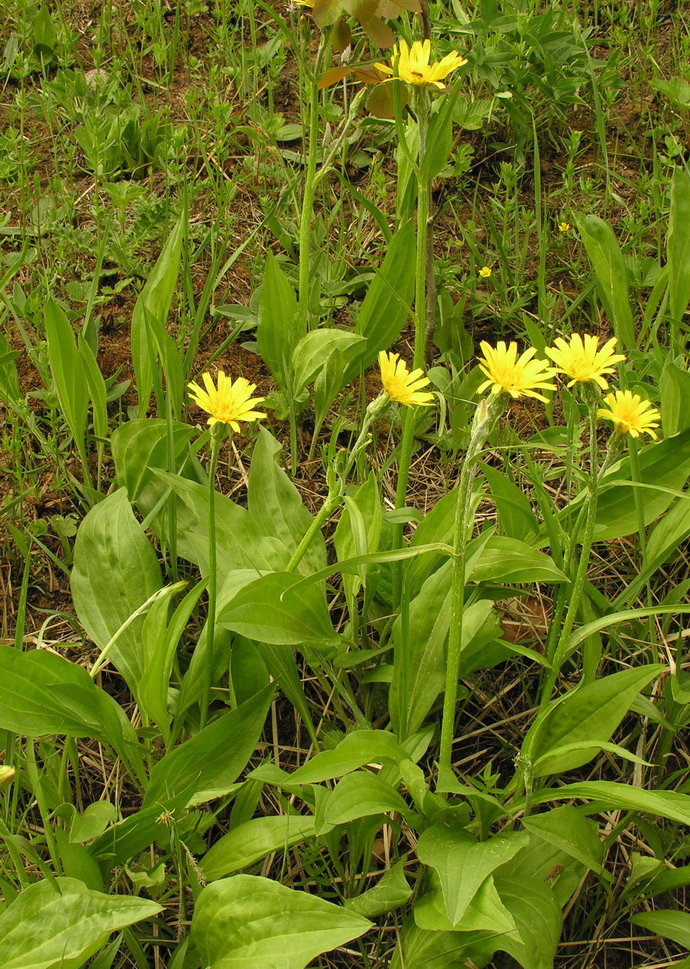
Viper’s-grass (Scorzonera humilis) is a rosette-forming perennial wildflower native to European damp meadows and fen margins, recognised by its solitary yellow flower heads and narrow, prominently ribbed foliage. It belongs to the dandelion tribe of the daisy family (Asteraceae) and produces a dark, latex-bearing taproot.
In Britain, the species is an extreme rarity restricted to isolated colonies in Dorset, Warwickshire, and Glamorgan, where it serves as a strict indicator of undisturbed, unfertilised lowland grassland.
Key Facts
- Plant type: Herbaceous perennial wildflower
- Flowering period: May to July
- Mature height: 10–40 cm (4–16 in)
- Soil requirement: Seasonally moist, nutrient-poor, mildly acidic to neutral peat or loam
- Conservation status: Regionally endangered in Britain; widespread in continental Europe
Understanding Viper’s-Grass in the Wild
Viper’s-grass survives primarily as a stress-tolerant perennial of ancient, low-productivity grasslands. It relies on a long-lived subterranean taproot that stores energy across dry periods and regrows early each spring. Because it lacks competitive vigor against fast-growing agricultural grasses, it disappears quickly wherever chemical fertilisers are introduced.
Encountering Scorzonera humilis in the wild signals unbroken pasture history, typically where low-intensity grazing or single late-summer hay cuts have checked aggressive shrubs and taller turf.
How to Identify Scorzonera humilis
The plant is distinguished by a solitary yellow flower head atop an unbranched, leafless or sparsely leafed stem rising 10–40 cm (4–16 in) high. The pale lemon-yellow ligules measure 25–35 mm (1.0–1.4 in) across, often developing a distinctive pink or reddish tint on the outer underside as they dry.
Key diagnostic features include:
- Leaves: Basal, linear-lanceolate to elliptic, 5–25 cm (2–10 in) long, tapering into petioles, with 3–5 pronounced longitudinal veins.
- Foliage texture: Glabrous to lightly cobwebbed when young, smooth at maturity.
- Stem: Usually erect, grooved, bearing zero to two much-reduced bract-like leaves.
- Root: Vertical, cylindrical black taproot exuding white milky latex when damaged.
- Seeds: Achenes measuring 7–9 mm (0.28–0.35 in) crowned with a dirty-white, feathery pappus.
Habitat and Soil Preferences
Viper’s-grass colonises seasonally waterlogged, nutrient-poor soils within unimproved pastures, heath margins, and purple moor-grass flushes. It favours damp peaty sands, silts, and heavy clay loams with a pH between 5.0 and 6.8.
In Britain, colonies sit in species-rich Molinia-dominated damp meadows alongside plants like meadow thistle (Cirsium dissectum) and tormentil (Potentilla erecta). In continental Europe, it extends into subalpine meadows and open birch or pine woodlands up to 1,500 m (4,900 ft) elevation.
Ecological Role and Pollinators
Flowers provide an accessible source of nectar and pollen for solitary bees and hoverflies between May and July. The broad, shallow flower heads attract generalist pollinators from the families Andrenidae and Syrphidae.
The seeds depend primarily on wind dispersal via their plume-like pappus, although heavy damp seeds frequently fall within 1 m (3.3 ft) of the mother plant. Low seed mobility makes colonization of isolated modern meadows rare once historical patches are broken.
Conservation Status and Threats
Viper’s-grass is listed as Least Concern across Europe as a whole, but is Critically Endangered in Great Britain. Agricultural intensification, drainage schemes, and commercial nitrogen application have wiped out over 80% of historical British colonies since the mid-20th century.
Modern threats in remnant sites include:
- Scrub encroachment: Gorse (Ulex europaeus) and bracken (Pteridium aquilinum) crowding out basal rosettes due to abandoned grazing.
- Eutrophication: Atmospheric nitrogen deposition allowing coarse grasses to outshade low leaves.
- Hydrological changes: Ditching and groundwater extraction drying out spring fen meadows.
Traditional Uses and Historical Folklore
The common and generic names stem from historical folk medicine using the root against snakebites. The generic name Scorzonera likely derives from the Old French escorzon (viper) or Italian scorza nera (black bark), referencing both the dark taproot and an ancient Doctrine of Signatures belief that the plant cured venomous bites.
The taproot was traditionally boiled and eaten during periods of crop failure across Central and Northern Europe. Although edible, it yields significantly thinner, more fibrous roots than its cultivated relative, black salsify (Scorzonera hispanica).
Viper’s-Grass vs Salsify and Other Look-Alikes
Field observers frequently confuse Scorzonera humilis with common salsify (Tragopogon porrifolius) and meadow salsify (Tragopogon pratensis), but the plants differ sharply in habit and structure. Meadow salsify carries narrow, clasping, grass-like leaves along a branched stem, whereas viper’s-grass confines broad, longitudinally ribbed foliage to a low basal rosette.
Key distinguishing species include:
- Cultivated black salsify (Scorzonera hispanica): Taller habit up to 1 m (3.3 ft), heavily branched stems with multiple flower heads, and broader cultivated roots.
- Meadow salsify (Tragopogon pratensis): Stem leaves clasp the stem with a widened base, flower heads close strictly by midday, and phyllaries distinctly exceed the yellow florets.
- Autumn hawkbit (Scorzoneroides autumnalis): Toothed or deeply lobed leaves rather than entire, parallel-veined foliage; flowers appear later from July to October.
- Mouse-ear hawkweed (Pilosella officinarum): Far smaller solitary heads with pale lemon flowers, producing extensive above-ground leafy runners.
Frequently Asked Questions
What is the difference between salsify and scorzonera?
True salsify (Tragopogon porrifolius) produces pale tan, tapered taproots and purple flowers, whereas cultivated scorzonera (Scorzonera hispanica) features dark brown to black-skinned roots and yellow blooms. The wild viper's-grass (Scorzonera humilis) is a smaller, unbranched wild relative with yellow blooms and slender non-commercial taproots.
Can you grow Scorzonera humilis from seeds?
Yes, seeds collected from ethical, cultivated wildflower sources germinate reliably if cold-stratified for 4–6 weeks at 4 °C (39 °F). Sow them on the surface of damp, peat-free acidic seed compost in early spring without burying them deeply, as light aids germination.
Why is Scorzonera humilis called viper's grass?
The name originates from medieval folk medicine, where the plant's black, scaled-looking taproot led herbalists to prescribe root infusions as an antidote to viper venom. There is no modern scientific evidence supporting antivenom properties.
Is Scorzonera humilis edible?
The taproot and young spring leaves are non-toxic and edible when cooked, containing inulin and white latex. However, wild foraging is prohibited or strongly discouraged in regions like the UK where the plant is protected and near extinction.
Where does Scorzonera humilis grow naturally?
It grows across Central, Northern, and Eastern Europe in damp, uncultivated fen meadows, acidic heath edges, and peaty moorland clearings. In the UK, it is limited to damp pasture reserves in Dorset, Warwickshire, and South Wales.
Information about traditional or historical uses is provided for educational interest only and is not medical advice. Do not use any plant to treat a condition without speaking to a qualified professional.
Sources & Verification
Taxonomy and distribution are checked against the databases below. Care guidance is written for cultivated species only and reviewed by our editor. How We Build Plant Profiles →