
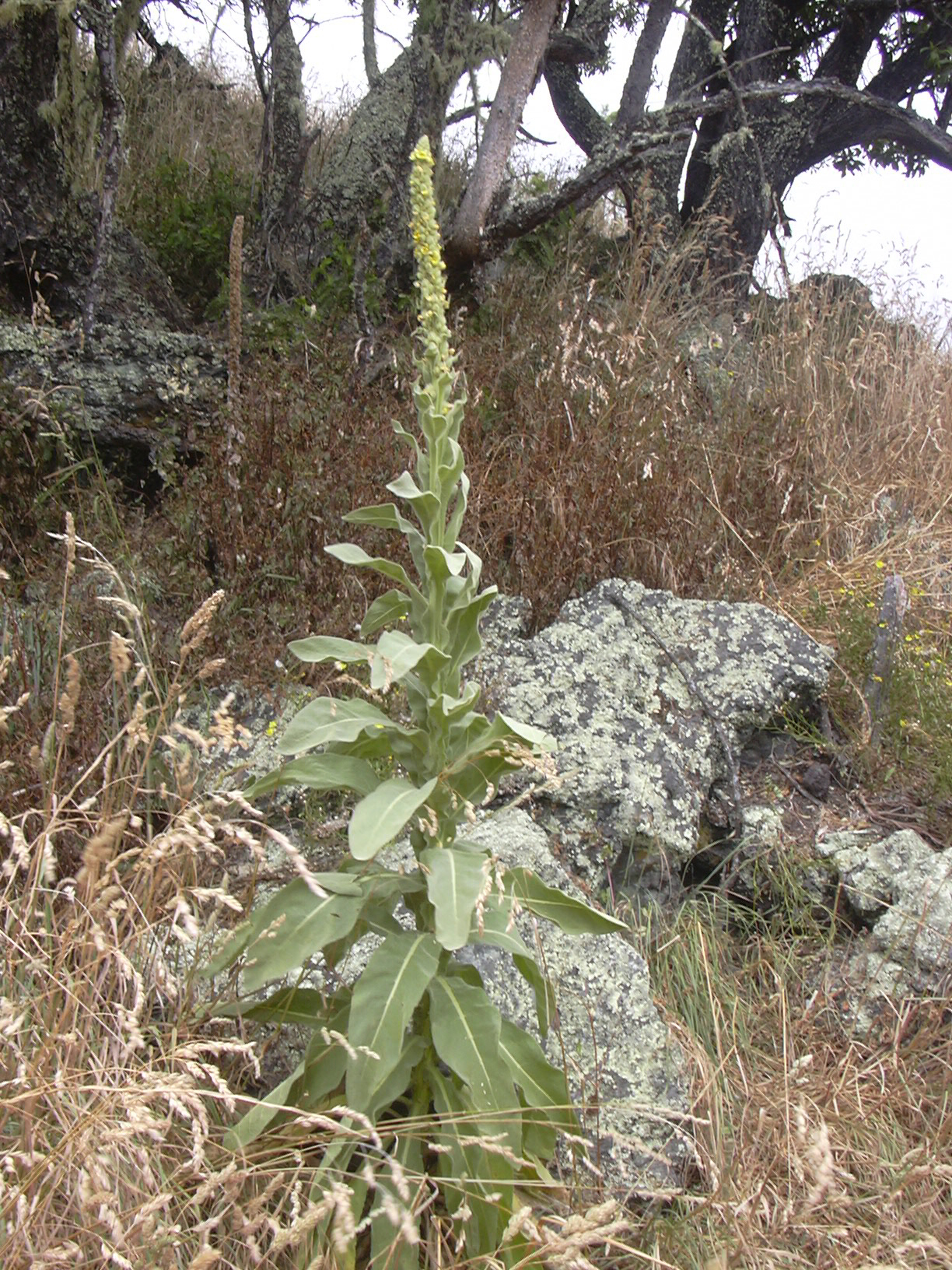
Common mullein (Verbascum thapsus) is an upright biennial wildflower native to Europe, northern Africa, and temperate Asia, recognized by its dense rosette of woolly, felted grey-green foliage.
A single flowering spike can shed over 100,000 seeds that remain viable in disturbed soil for more than a century, rapidly colonizing barren roadsides and abandoned pastures.
Key Facts
- Life cycle: strict biennial flowering only in year two
- Height: 0.5 to 2 m (1.6 to 6.6 ft)
- Light: requires full sun in open, bare ground
- Soil: dry, gravelly, alkaline to neutral earth
- Toxicity: seeds contain harmful saponins; leaves cause skin irritation
Encountering Common Mullein in the Wild
Common mullein establishes almost exclusively in open, disturbed ground exposed to direct sun where dense vegetation is absent. You will find it along railway embankments, gravel pits, highway verges, and overgrazed cattle pastures.
The plant follows a rigid two-year lifecycle that dictates where and how it persists. During the first year, it develops a low-lying, velvety rosette and drives a deep taproot into subsoil moisture. In the second year, the root reserves fuel a vertical spike that can surpass 2 m (6.6 ft) before the entire plant dies.
How to Identify Verbascum thapsus
You can confirm common mullein by checking for thick, flannel-textured leaves covered in dense, branched star hairs that feel soft like wool to the touch. These multicellular hairs protect the plant from drying winds and deter grazing livestock.
- Basal leaves: oblanceolate, up to 50 cm (20 in) long, forming a ground-level rosette.
- Stem leaves: alternate, smaller, with decurrent bases that form leafy wings down the stem.
- Central stem: solitary, rigid, light green, unbranched, and densely hairy.
- Flower spike: cylindrical, crowded terminal spike comprising one-third to one-half the total plant height.
If you break an active leaf or stem, it reveals pale, fibrous tissue without milky sap. The downy fuzz on older dried leaves can easily detach and irritate bare skin or mucous membranes.
Flowering Spike and Seed Biology
Common mullein flowers open in erratic clusters for around 80 to 100 days between June and September, opening around dawn and closing by mid-afternoon. Each individual sulfur-yellow bloom spans 1.5 to 3 cm (0.6 to 1.2 in) across with five fused petals and five stamens.
Fertilization occurs via bumblebees or automatic self-pollination when flowers close. After petal drop, the plant forms rounded, two-valved seed capsules roughly 6 mm (0.24 in) wide.
- A vigorous plant produces 100,000 to 180,000 seeds per season.
- Each pitted seed weighs less than 0.1 mg and measures roughly 0.7 mm (0.03 in).
- Buried seeds have demonstrated field germination after 100 years of dormancy.
Native Range and Global Distribution
The native range of Verbascum thapsus spans continental Europe, northern Africa, and western to central Asia, stretching east to the Himalayas and western China. Within this zone, it functions as a natural early-successional colonizer of landslides, river floodplains, and talus slopes.
Purposely introduced to North America in the early 1700s as a medicinal garden herb and fish poison, the plant quickly escaped cultivation. Today, it grows wild in all 50 US states, southern Canada, temperate Australia, New Zealand, and parts of South America.
Ecological Value and Wildlife Relationships
Common mullein acts as a vital pollen source for wild bees and syrphid flies during midsummer dry spells when shallow-rooted wildflowers wither. While the blossoms offer little nectar, bees collect the abundant, bright orange pollen.
- Wild pollinators: visited heavily by bumblebees (Bombus species) and sweat bees (Halictus species).
- Bird forage: small finches, including the American goldfinch, feed on seeds from dried stalks in winter.
- Insect shelter: hollow, dead stems provide dry overwintering cavities for beneficial predatory bugs and solitary bees.
Grazing herbivores such as cattle, deer, and sheep reject the foliage entirely. The dense mat of branched trichomes makes the leaves bitter and mechanically unpalatable.
Is Common Mullein Considered Invasive?
Common mullein is categorized as a noxious or secondary weed in over a dozen states, particularly throughout the intermountain western United States. It presents a major management challenge in newly burned woodlands, national parks, and dry meadows.
Because it establishes earlier in spring than many native perennial grasses, mullein seedlings seize bare soil and monopolize sunlight. However, it cannot tolerate shade or persistent root competition; once perennial prairie grasses or shrubs close the canopy, mullein rosettes disappear naturally.
For wild land managers, hand-pulling rosettes before flower stalks develop remains the most reliable eradication method, provided the fleshy crown is sliced at least 5 cm (2 in) below ground.
Traditional Uses and Mullein Tea
Folk practitioners have long harvested the dried leaves and flowers of common mullein to brew herbal tea traditionally consumed for chest colds and dry coughs. The leaves contain mucilage, flavonoids, and saponins that historically justified this use.
- Herbal infusions: boiling water poured over dried leaves, always poured through fine cloth to eliminate throat-stabbing hairs.
- Primitive torches: dried flower stalks dipped in animal tallow, providing the old English name high taper.
- Yellow dye: flower petals boiled in water to yield a golden wash for wool and natural textiles.
- Fish stunning: crushed seeds thrown into still ponds to temporarily immobilize fish via concentrated saponins.
Similar Species and Look-Alikes
Common mullein is frequently confused with moth mullein, dark mullein, and non-flowering common foxglove during its juvenile vegetative stage. Key structural details help differentiate them before and during bloom.
- Moth mullein (Verbascum blattaria): possesses hairless, dark green, glossy leaves and delicate yellow or white flowers with purple bearded stamens.
- Dark mullein (Verbascum nigrum): perennial species featuring heart-shaped, stalked leaves with sparser hairs and red-violet stamen filaments.
- White mullein (Verbascum lychnitis): bears branched flowering stalks and pale yellow or white flowers, lacking the continuous winged stem.
- Common foxglove (Digitalis purpurea): basal leaves are toothed, wrinkled, and non-felted; flowers are tubular, pink-purple, and severely toxic.
- Lamb’s ear (Stachys byzantina): ground-hugging perennial mat under 40 cm (16 in) tall with woolly foliage but opposite leaves and square stems.
Frequently Asked Questions
Why is common mullein called Aaron's rod?
Common mullein received the folk name Aaron's rod because its tall, golden-flowered spike resembles a blooming ceremonial staff. The name references the Old Testament narrative where Aaron's wooden rod sprouted miraculous flowers.
What is the biblical Aaron's rod compared to Moses's rod?
In biblical tradition (Numbers 17:8), Aaron's rod was an almond branch that miraculously blossomed and produced ripe almonds to confirm his priesthood, later preserved in or beside the Ark of the Covenant. In contrast, Moses's rod was the shepherd's staff used in Exodus to perform miraculous signs, split the Red Sea, and draw water from rock.
Is common mullein tea safe to drink?
Common mullein leaf infusions have a documented history of traditional use, but the liquid must be strained through a fine coffee filter to catch microscopic stellate hairs that severely irritate the throat. Never include seeds in tea, as they contain toxic compounds.
Are the seeds of Verbascum thapsus poisonous?
Yes, common mullein seeds contain high concentrations of saponins and rotenone, which are toxic if ingested. Indigenous peoples and early European settlers historically threw crushed seed capsules into slow-moving water to paralyze fish.
How can you get rid of common mullein in a pasture?
Sever the thick taproot at least 5 cm (2 in) below the soil line with a sharp spade before the central stalk produces open flowers. Do not till or disturb the ground unnecessarily, as soil disturbance activates dormant seeds from the seed bank.
Information about traditional or historical uses is provided for educational interest only and is not medical advice. Do not use any plant to treat a condition without speaking to a qualified professional.
Sources & Verification
Taxonomy and distribution are checked against the databases below. Care guidance is written for cultivated species only and reviewed by our editor. How We Build Plant Profiles →