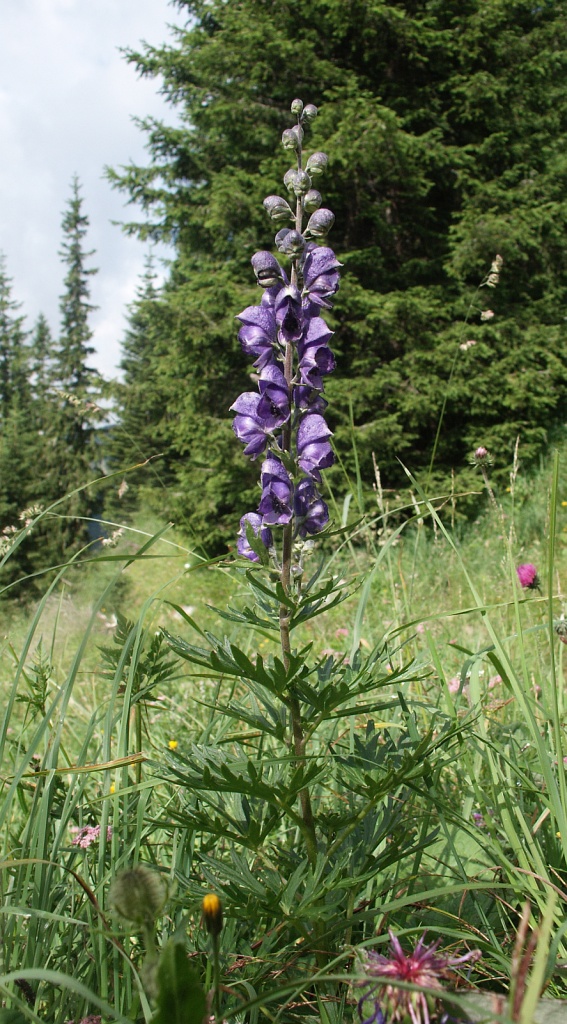
Aconitum carmichaelii is a robust, upright perennial from the Ranunculaceae family, native to China and Vietnam. It is best known for its dense spikes of hooded, deep blue flowers that appear when most other garden plants have finished blooming.
You should approach this plant with caution, as all parts contain potent alkaloids. It thrives in cool, moist garden borders where it can provide late-season colour from late summer into mid-autumn.
Key Facts
- Light: Partial shade to full sun in cool climates
- Water: Keep soil consistently moist throughout the growing season
- Height: Reaches 1.2 m (4 ft) at maturity
- Toxicity: Highly toxic if ingested; wear gloves when handling
- Bloom: Produces blue flowers from late August to October
Why Grow Autumn Monkshood
Autumn Monkshood is the premier choice for gardeners looking to extend the flowering season into the cooler months. Its architectural stems and deep blue, helmet-shaped flowers provide a distinct vertical element to the back of a border.
This plant suits those who can provide a cool, moisture-retentive site. It remains relatively low-maintenance once established, provided you avoid disturbing its root system. It is an excellent companion for late-blooming perennials that appreciate similar soil conditions.
How to Identify Autumn Monkshood
You can identify Aconitum carmichaelii by its distinctive hooded flowers, which resemble a monk’s cowl. The plant typically grows to 1.2 m (4 ft) tall, featuring deeply lobed, dark green, glossy leaves arranged alternately along the stem.
The flowers are clustered in dense, terminal racemes. Each bloom features a large upper sepal that forms the characteristic helmet shape, hiding the petals inside. The root system consists of thick, tuberous structures that store nutrients for the next season.
Where to Plant Monkshood
Choose a site that receives partial shade, especially in regions with hot summers. While it tolerates full sun in cooler northern climates, the flowers last longer if protected from the intense afternoon heat.
Ensure your soil is rich in organic matter and stays consistently damp. Avoid areas that dry out completely in summer, as this often leads to stunted growth or premature flower drop. It performs best in a sheltered spot away from strong, drying winds.
How to Plant and Propagate
Plant your Monkshood in early spring or autumn, ensuring the crown is set just below the soil surface. Space plants 45 cm (18 in) apart to allow for proper air circulation.
Propagation is most successful through division, which you should perform every 3-4 years in early spring. Always wear gloves during this process to prevent skin contact with the plant’s sap. Avoid growing from seed if you want to maintain the characteristics of specific cultivars like ‘Arendsii’.
Watering and Feeding Requirements
Maintain consistent soil moisture throughout the growing season, particularly during dry spells in July and August. If the soil dries out, the plant will likely wilt and show signs of stress.
Apply a balanced, slow-release granular fertiliser in early spring as new growth emerges. You can also mulch around the base with 5 cm (2 in) of well-rotted compost to retain moisture and suppress weeds. Avoid over-fertilising, as this can lead to weak stems that require staking.
Pruning and Staking
Staking is often necessary for taller varieties to prevent the heavy flower spikes from toppling over in late summer. Use discreet bamboo canes or metal supports installed in late spring before the plant reaches its full height.
After the flowers fade in late autumn, cut the stems back to the ground. This keeps the garden tidy and prevents the plant from self-seeding, which is rarely desired. Always dispose of the clippings carefully, as they remain toxic.
Troubleshooting Common Problems
Most issues with Aconitum carmichaelii stem from improper moisture levels or poor site selection. If you notice yellowing leaves, check if the soil is waterlogged, as this can lead to root rot.
- Wilting leaves: Usually caused by drought; increase watering frequency.
- Stunted growth: Often due to poor soil or excessive heat; move to a cooler, richer site.
- Aphids: Can cluster on flower buds; use a strong jet of water to dislodge them.
- Powdery mildew: Occurs in poor air circulation; thin out stems to improve airflow.
Winter Care for Monkshood
Autumn Monkshood is fully hardy and requires little intervention during the winter months. Once the foliage has died back naturally after the first hard frost, cut the stems down to soil level.
If you live in an area with extremely cold winters, apply a light layer of mulch over the crown to protect the tuberous roots from deep freezes. Ensure the area remains well-drained, as standing water in winter can cause the roots to rot.
Autumn Monkshood Through the Year
| Spring | Apply a balanced fertiliser as new shoots emerge. Divide established clumps every 3-4 years before growth accelerates. |
|---|---|
| Summer | Install stakes for taller varieties. Ensure the soil remains consistently moist, especially during heatwaves. |
| Autumn | Enjoy the late blooms. Once flowers fade and foliage yellows, cut stems back to the ground. |
| Winter | Apply a protective layer of mulch if you live in a region with severe, fluctuating winter temperatures. |
What Is Wrong With My Autumn Monkshood
| What you see | Likely cause | What to do |
|---|---|---|
| Wilting foliage | Drought stress | Increase watering frequency to keep the soil consistently moist. |
| Stems falling over | Lack of support | Use bamboo stakes to support the stems before they reach full height. |
| Yellowing leaves | Waterlogged soil | Improve drainage by adding organic matter to the planting site. |
Autumn Monkshood Varieties Worth Knowing
- ‘Arendsii’ – robust grower with deep blue flowers, reaching 1.2 m (4 ft).
- ‘Cloudy’ – features unique, lighter blue, mottled flower spikes.
- ‘Royal Flush’ – known for its bronze-tinted foliage and violet blooms.
Autumn Monkshood Companions
Pair your Monkshood with other late-season plants that enjoy moist, shaded conditions. Good companions include Japanese Anemone (Anemone hupehensis), which provides a contrast in flower shape and colour.
- Hostas: Provide lush foliage contrast throughout the season.
- Ferns: Complement the vertical spikes with delicate, feathery textures.
- Astilbe: Offers similar moisture requirements and late-season interest.
- Ligularia: Adds bold leaf shapes and yellow flowers to brighten the shade.
Frequently Asked Questions
Is Autumn Monkshood poisonous?
Yes, all parts of Aconitum carmichaelii are highly toxic if ingested and can cause skin irritation upon contact.
What are the traditional uses of Aconitum carmichaelii?
The plant, known as fùzǐ, has been traditionally used in herbal practices, but it requires highly specialised preparation to reduce its extreme toxicity.
How does Autumn Monkshood differ from other Aconitum species?
It is distinguished by its late flowering period, typically starting in late August, and its larger, more robust stature compared to earlier-blooming monkshoods.
Can I grow Monkshood in full sun?
You can grow it in full sun only if you live in a very cool climate; otherwise, it prefers partial shade to prevent the flowers from scorching.
Information about traditional or historical uses is provided for educational interest only and is not medical advice. Do not use any plant to treat a condition without speaking to a qualified professional.
Sources & Verification
Taxonomy and distribution are checked against the databases below. Care guidance is written for cultivated species only and reviewed by our editor. How We Build Plant Profiles →