
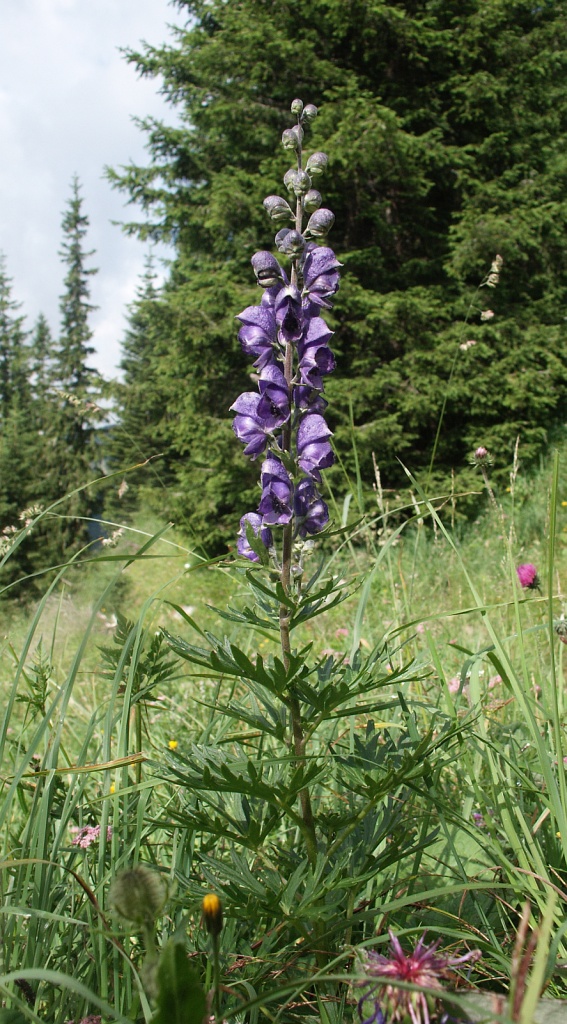
Monkshood (Aconitum napellus) is a long-lived herbaceous perennial native to damp meadows and mountain slopes of western and central Europe, recognised by dense spires of hooded, violet-blue flowers. All parts of the plant contain aconitine and related diterpenoid alkaloids, making it the most lethal wild and garden plant in Europe.
You must wear non-porous gloves whenever touching the foliage, because the cardiac and neurotoxins penetrate unbroken human skin within minutes. It performs reliably in cool, moist border soils where hot midsummer sun will not scorch the root run.
Key Facts
- Toxicity: lethal via ingestion and skin contact
- Type: herbaceous perennial growing from tuberous roots
- Hardiness: USDA Zones 3–8
- Height: 90–120 cm (3–4 ft) tall
- Light: partial shade or cool morning sun
- Water: consistently moist, never boggy or dry
Is Monkshood the Right Plant for Your Garden?
Monkshood is suited only to gardens free of children, grazing pets, and livestock. It offers stately vertical structure and rich violet-blue spikes late in the season when early perennials have faded. It resents heat waves, southern humidity, and disturbance once established.
Because Aconitum napellus poses severe chemical hazards, site it well away from vegetable plots where its tubers could be confused with horseradish or parsnip. The plant thrives in cool, temperate zones and suits experienced growers who want robust architectural color without deer browse.
How to Identify Monkshood
You can identify monkshood by its helmet-shaped sepals and deeply divided, hand-shaped foliage. The plant forms unbranched, smooth stems reaching 90–120 cm (35–47 in) tall, emerging from thickened, tuberous roots.
- Leaves: rounded in outline, 5–10 cm (2.0–3.9 in) wide, palmately divided into 5 to 7 deeply cut, narrow lobes.
- Stems: stiff, hairless, upright, and green, rarely requiring staking unless exposed to gale-force winds.
- Flowers: zygomorphic, 1–2 cm (0.4–0.8 in) high, deep indigo-blue to purple, with the upper sepal forming an arched hood that encloses the petals.
- Seed capsules: clusters of 3 to 5 dry pods (follicles) containing small, winged, dark angular seeds.
Choosing the Best Site and Soil
Monkshood requires dappled partial shade and moisture-retentive, humus-rich soil. In regions with cool summers, such as coastal climates or northern zones, it tolerates full sun provided the soil remains consistently damp around the crown.
Avoid hot, dry sites with baking afternoon sun, which leads to crispy foliage margins and stunted flower spikes. Heavy clay must be amended with leaf mold or compost to ensure good aeration, as waterlogged winter soil rots the fleshy resting tubers.
Planting Monkshood Safely
Always wear thick, waterproof gauntlet gloves when handling monkshood crowns or potted nursery stock. Plant dormant tubers or container-grown crowns in early spring or autumn before high temperatures arrive.
- Dig a planting hole twice the width of the root ball and equal to its depth.
- Set the tuber so the growing tips or crown sit 5 cm (2 in) below the soil surface.
- Backfill with garden soil blended with compost, firm gently without crushing brittle roots, and water thoroughly.
- Space individual plants 30–45 cm (12–18 in) apart to allow adequate air movement between mature stems.
- Wash gardening tools with hot soapy water immediately after planting to remove toxic sap.
Watering Schedule and Fertilizer
Supply 2.5 cm (1 in) of water per week throughout the active growing period if rainfall is lacking. Never let the root zone dry out completely, especially during bud formation in June and July.
Monkshood needs minimal supplemental feeding if grown in compost-enriched soil. Apply a balanced 5 cm (2 in) layer of shredded leaf mulch or well-rotted manure each spring around the base, keeping the organic matter 5 cm (2 in) clear of the emerging stems. High-nitrogen fertilizers cause weak, floppy growth and diminish bloom quality.
Pruning and How to Remove Monkshood Safely
Cut stems back to 5 cm (2 in) above the ground in late autumn after the foliage blackens with hard frost. Leave seed heads on the stem in late summer only if you plan to gather seed, as spent spikes can be deadheaded down to lateral buds to encourage smaller secondary blooms.
To permanently remove an unwanted plant:
- Wear full eye protection, long sleeves, and waterproof nitrile or rubber gloves.
- Lever the entire root clump out with a spade, digging 30 cm (12 in) out from the crown to capture all brittle tuberous side-roots.
- Place all plant material directly into heavy-duty disposal bags for municipal incineration or landfill; never add to home compost.
- Rinse the spade and footwear thoroughly with a hose before removing your protective gloves.
How to Grow Monkshood from Seed and Division
Sow fresh seed in autumn, as monkshood requires 60 to 90 days of cold, moist stratification below 4 °C (40 °F) to break dormancy. Germination is notoriously slow and erratic, often taking up to 12 months for spring-sown flats.
Division is possible but stressful to the root system. Divide mature clumps in early spring just as new green points emerge. Lift the cluster with a garden fork, slice cleanly through the connecting rhizomes with a sharp knife leaving at least two dormant eyes per piece, and replant immediately. Do not allow the fleshy roots to dry in the wind.
Winter Care and Dormancy
Monkshood is hardy to -40 °C (-40 °F) (USDA Zone 3) and requires cold winter temperatures to reset its growth cycle. The top growth naturally collapses and dies after the first hard autumn freezes.
In zones 3 through 5, apply a 7–10 cm (3–4 in) layer of straw or chopped bark after the ground freezes to prevent winter soil heaving. Clear the mulch aside in early spring so warming spring sunlight can reach the underground eyes and initiate uniform shoot growth.
Understanding the Monkshood Bloom Season
Flowering begins in midsummer and continues through late summer, usually from July into late August. The blooms open sequentially from the base of the terminal raceme upward, providing color for 4 to 6 weeks.
Bumblebees are the primary natural pollinators, possessing the physical strength required to push underneath the helmet sepal to reach the nectaries inside. Extremely hot summer spells above 30 °C (86 °F) can cause flower buds to dry up and drop prematurely before opening.
Seasonal Tasks for Monkshood
| Spring | Spread a 5 cm (2 in) layer of compost around crowns, avoiding direct stem contact. Divide mature clumps if needed, wearing protective gloves. |
|---|---|
| Summer | Maintain weekly moisture of 2.5 cm (1 in). Deadhead faded primary spikes down to lateral branchlets to stimulate secondary blossoms. |
| Autumn | Cut blackened stalks back to 5 cm (2 in) above ground level after frost. Sow freshly harvested seeds outdoors in cold frames. |
| Winter | Apply a 7 cm (3 in) layer of straw mulch in USDA Zones 3–5 after soil freezes to shield resting tubers from frost heave. |
Diagnosing Common Monkshood Problems
| What you see | Likely cause | What to do |
|---|---|---|
| White powdery patches covering leaf surfaces in late summer | Powdery mildew from stagnant air and dry root conditions | Water at soil level to keep roots damp and thin crowded border neighbors to improve airflow. |
| Stems wilting suddenly, turning brown, and collapsing from the base | Verticillium wilt or crown rot fungal infection | Dig up and destroy the infected plant and surrounding soil; avoid planting Ranunculaceae in that spot. |
| Lower leaves crisping and browning along the outer margins | Drought stress or excessive direct afternoon sunlight | Increase watering frequency and provide shade cloth or plant taller shade companions to the south. |
| Flower buds turning black and dropping before opening | Heat stress or irregular water availability during spike elongation | Mulch the root zone with 5 cm (2 in) of shredded bark and irrigate deeply during hot weather. |
Distinct Monkshood Cultivars
- ‘Album’ – pure white hooded flowers on 1 m stems
- ‘Bressingham Spire’ – compact 90 cm stems with violet-blue flowers
- ‘Spark’s Variety’ – branching habit with dark indigo flowers to 1.5 m
- ‘Rubellum’ – soft pinkish-lilac flowers on slender 90 cm stems
Companion Plants for Monkshood
Pair monkshood with moisture-loving perennials that match its architectural scale and thrive in partial shade. Its rich blue-violet spikes create high visual contrast against warm pinks, soft yellows, and textured foliage.
- Bugbane (Actaea simplex): dark purple foliage and late bottlebrush blooms complement late monkshood flowers.
- Goat’s beard (Aruncus dioicus): feathery cream plumes provide a frothy backdrop for monkshood’s dense, vertical spires.
- Ligularia (Ligularia dentata): broad, rounded maroon leaves and daisy-like yellow flowers contrast with the cut foliage of monkshood.
- Japanese forest grass (Hakonechloa macra): weeping chartreuse blades soften the base of tall, upright stems.
Frequently Asked Questions
Is monkshood poisonous to touch?
Yes, monkshood is dangerous to touch because its toxic alkaloids, primarily aconitine, absorb directly through intact skin. Gardeners must always wear impermeable gloves when handling, cutting, or dividing any part of the plant.
What is monkshood and wolfsbane also known as?
Monkshood and wolfsbane refer to species within the genus Aconitum, also commonly called aconite, blue rocket, Venus' chariot, and helmet flower. In European folklore and popular fiction like Harry Potter, the names wolfsbane, monkshood, and aconite are used interchangeably for the same toxic plant.
Is monkshood a perennial?
Yes, monkshood is a long-lived herbaceous perennial that returns reliably each spring from underground tuberous roots. The foliage dies back completely to the ground in late autumn and regenerates in April or May.
What does the monkshood flower symbolize?
In the historical language of flowers, monkshood symbolizes danger, caution, deadly enmity, and misanthropy due to its lethal toxicity. It was traditionally used in symbolic floral arrangements to deliver a direct warning of betrayal.
Has monkshood ever had medicinal uses?
Monkshood was traditionally used in tiny, highly diluted homeopathic tinctures and historical Asian medicine as a topical analgesic and febrifuge. Modern medical authorities strictly advise against any home preparations due to the narrow margin between supposed active effects and fatal cardiac arrest.
Information about traditional or historical uses is provided for educational interest only and is not medical advice. Do not use any plant to treat a condition without speaking to a qualified professional.
Sources & Verification
Taxonomy and distribution are checked against the databases below. Care guidance is written for cultivated species only and reviewed by our editor. How We Build Plant Profiles →
- Kew Plants of the World OnlineTaxonomy, native range, and botanical distribution
- Royal Horticultural SocietyHardiness ratings, garden cultural requirements, and toxicity warnings
- NC State Extension Gardener Plant ToolboxIdentification characteristics and chemical poisoning profile
- GBIF — Global Biodiversity Information Facilitytaxonomy, synonyms, occurrence records
- Wikipediageneral reference
