
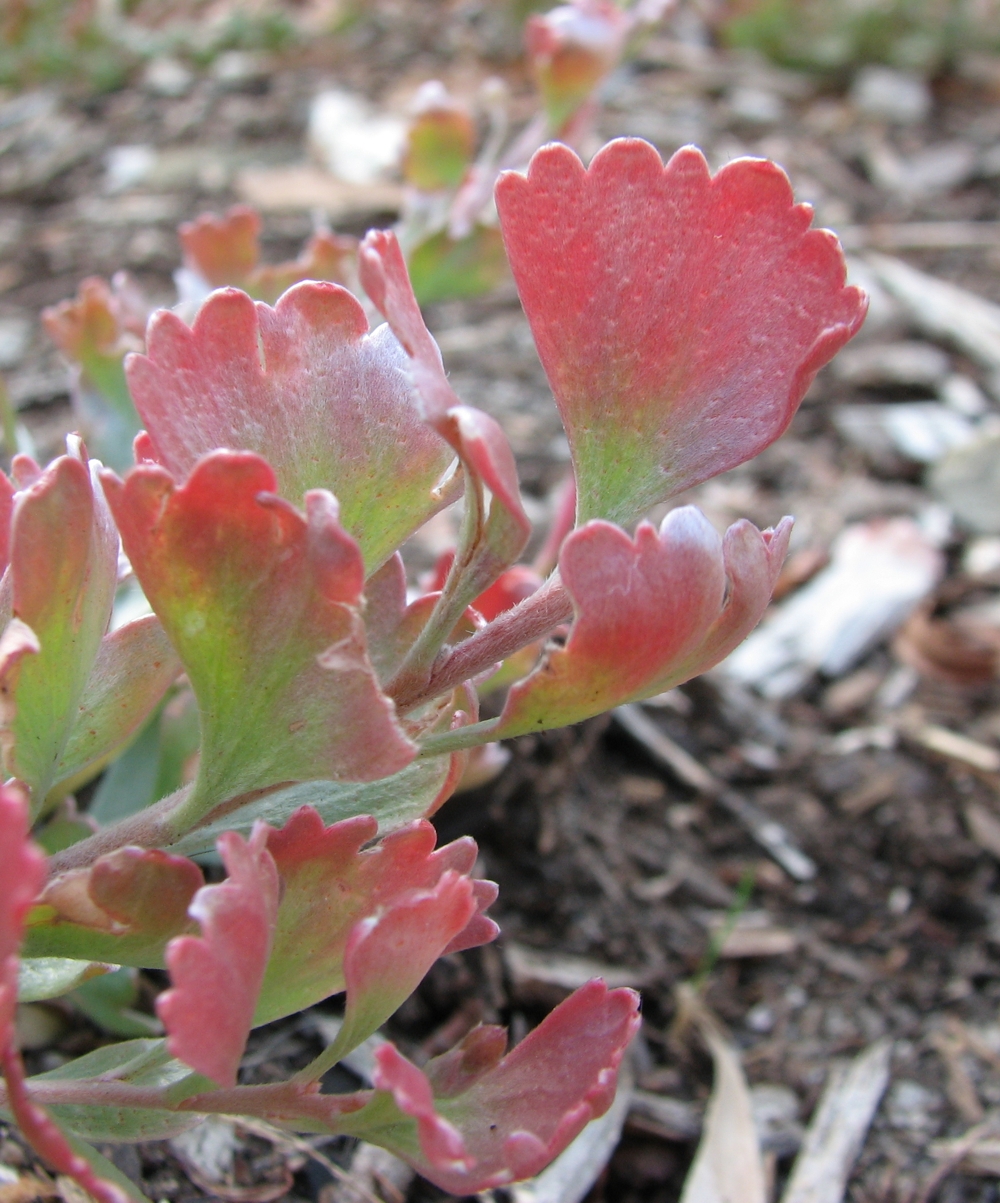
Coastal jugflower (Adenanthos cuneatus) is an evergreen shrub in the Proteaceae family native to the sandy south coast of Western Australia. It produces wedge-shaped leaves covered in fine silvery hairs and dull red tubular flowers.
This species tolerates severe drought once established in Mediterranean climates but fails quickly in phosphorus-rich or waterlogged soil. It functions as a low groundcover or an upright bush reaching up to 2 m (6.5 ft) in height.
Key Facts
- Height: 0.3-2 m (1-6.5 ft)
- Spread: 1-2 m (3.3-6.5 ft)
- Light: Full sun to light partial shade
- Soil: Low-phosphorus sand or gravel
- Hardiness: USDA Zones 9a-11
Is Coastal Jugflower Right for Your Garden?
Coastal jugflower thrives in dry, sunny gardens across USDA Hardiness Zones 9 through 11 where winter temperatures remain above -3 °C (26 °F).
This Western Australian native fits sandy coastal beds, rock gardens, and low-water borders. You can grow erect shrub forms that reach 2 m (6.5 ft) in height or prostrate groundcover forms that spread 1.5-2 m (5-6.5 ft) wide across dry embankments.
You must have coarse sand or gravel soil with sharp drainage. High phosphorus fertilizers and heavy clay soils kill the sensitive Proteaceae root system within weeks.
How to Identify Coastal Jugflower
Coastal jugflower features wedge-shaped leaves 10 to 20 mm (0.4-0.8 in) long that end in three to five shallow lobes and are covered in soft silvery hairs.
The stems flush with bright pinkish-red new foliage during summer before maturing into grey-green leaves. Its small red flowers measure about 15 mm (0.6 in) long, emerging individually from leaf axils along the stems.
- Leaf shape: Cuneate (wedge-shaped) with lobed tips
- Foliage color: Silvery-grey with red young shoots
- Flower structure: Single tubular red blooms in leaf axils
- Habit: Prostrate groundcover to upright shrub up to 2 m (6.5 ft) tall
Ideal Sun and Position for Coastal Jugflower
Coastal jugflower requires full sun with at least 6 hours of direct sunlight daily to produce intense red shoot growth and maintain dense foliage.
In partial shade, the plant develops leggy stems and sparser leaf cover. Plant it in open, windy sites where air circulates freely around the silver foliage.
The site must feature deep silica sand, decomposed granite, or sandy loam with a soil pH between 5.5 and 6.8. Avoid low spots where groundwater accumulates after winter rains.
Soil Prep and Planting Coastal Jugflower
Plant coastal jugflower in autumn or early spring, setting the root crown level with the natural soil surface in a pit twice as wide as the nursery container.
Do not add rich compost, animal manure, or standard potting mix to the planting hole. Proteaceae plants possess specialised cluster roots (proteoid roots) designed to extract nutrients from poor soils, and organic amendments trap moisture around the base.
- Spacing: Space upright shrubs 1.5-2 m (5-6.5 ft) apart; space prostrate varieties 1-1.2 m (3.3-4 ft) apart
- Mulch: Apply a 3-5 cm (1-2 in) layer of crushed stone or coarse gravel, keeping it 10 cm (4 in) clear of the main stem
- Initial watering: Water thoroughly once at planting to settle sandy soil around the root ball
How Often to Water Coastal Jugflower
Water newly planted coastal jugflower once every 7 to 10 days during its first summer, then rely entirely on rainfall once established.
Established bushes survive extended drought along the southern coast of Western Australia. Overwatering triggers root rot caused by soil pathogens.
Never apply standard plant food containing phosphorus. Use zero-phosphorus native fertilizers only if soil testing indicates severe nitrogen deficiencies, applying them at half strength in early spring.
- Establishment period: Water deeply every 10 days for the first 6 months
- Established plants: No supplemental summer watering required in Mediterranean climates
- Fertilizer ratio: Use a low-phosphorus formula with an NPK ratio like 10-0-8
Pruning Coastal Jugflower Bush and Groundcovers
Lightly tip-prune coastal jugflower in late autumn after the main flowering peak, cutting back stem tips by 5 to 10 cm (2-4 in) to encourage bushy growth.
This species possesses a lignotuber (a woody swelling at the base of the trunk) that allows it to resprout after light fires or hard pruning. However, cutting past green wood on young stems without established basals can retard growth.
Trim prostrate forms along edges to control spread without shearing the natural layered silhouette of the grey foliage.
How to Propagate Coastal Jugflower Cuttings
Propagate coastal jugflower using 7 to 10 cm (3-4 in) firm semi-hardwood cuttings taken in late summer or early autumn.
Select healthy side shoots that have turned reddish-brown near the base. Remove leaves from the lower half of the cutting and dip the stem base in a low-concentration rooting powder.
- Medium: Insert cuttings into a sterile mix of 70% coarse perlite and 30% peat moss
- Environment: Place under bottom heat at 18-21 °C (64-70 °F) with high humidity
- Rooting time: Roots develop in 8 to 12 weeks; pot up when roots measure 3 cm (1.2 in)
Common Pests and Diseases of Coastal Jugflower
Phytophthora root rot is the primary disease threat, causing rapid leaf browning and plant death in poorly drained or overwatered soil.
The fine silvery leaf hairs deter most grazing insects, but scale insects and mealybugs occasionally attach to lower stems during warm weather. Scale feeding leaves sticky honeydew that fosters black sooty mold on interior branches.
- Root Rot: Wilting grey foliage and blackened stem bases; improve drainage immediately and stop irrigation
- Scale Insects: Small brown bumps on stems; spray with horticultural oil at a 2% concentration
- Phosphorus Toxicity: Yellowing or burning of leaf tips; avoid bone meal and standard lawn fertilizers
Winter Protection and Cold Hardiness
Coastal jugflower tolerates light frosts down to -3 °C (26 °F) for short durations once established.
Prolonged freezing temperatures damage tip growth and young summer shoots. Protect potted plants by moving them against a sunny south-facing wall during frost advisories.
In cool temperate regions subject to heavy winter rainfall, keep root zones dry by planting on raised mounds of coarse sand and covering soil with gravel mulch.
Coastal Jugflower Flowers and Foliage Seasons
Coastal jugflower blooms continuously throughout the year, peaking with single red flowers in late spring from October to November in its native Southern Hemisphere.
The solitary axillary flowers measure 12-15 mm (0.5-0.6 in) long and attract honeyeaters with nectar. The tubular red perianth opens slightly at the apex, tucked inside the dense silvery wedge leaves.
Following spring flowering, summer triggers a flush of bright pinkish-red shoots that provide leaf color across the plant before aging to silver-grey in autumn.
Companion Plants for Coastal Jugflower
Pair coastal jugflower with Australian native species that share its demand for full sun and low-phosphorus sandy soils.
Combine prostrate forms with upright proteaceous shrubs or low native grasses to create contrasting foliage textures. Ensure companion plants do not shade out the silver wedge leaves.
- Woolly bush (Adenanthos sericeus): Soft grey-green foliage as a taller background shrub
- Showy dryandra (Banksia formosa): Golden-orange flower heads and dark serrated leaves
- Albany daisy (Actinotus superbus): Velvety white flowers that complement silver leaf hairs
- Coastal pigface (Carpobrotus rossii): Trailing succulent groundcover for sandy soils
Frequently Asked Questions
What is the common name of Adenanthos cuneatus?
Coastal jugflower is the primary English common name for Adenanthos cuneatus, though it is also called flamebush, bridle bush, or sweatbush.
How big does Adenanthos cuneatus get?
Coastal jugflower grows between 30 cm and 2 m (1 to 6.5 ft) high and up to 2 m (6.5 ft) wide, depending on whether it grows as an upright shrub or a prostrate cultivar.
Is Adenanthos cuneatus prostrate or upright?
Adenanthos cuneatus grows in both upright shrub forms up to 2 m (6.5 ft) tall and prostrate groundcover forms like 'Flat Out' that stay under 30 cm (12 in) high.
How do you propagate coastal jugflower?
Take 7 to 10 cm (3-4 in) semi-hardwood stem cuttings in late summer, insert them in a perlite-peat mix, and keep them warm under bottom heat at 18-21 °C (64-70 °F).
Does Adenanthos cuneatus need fertilizer?
Coastal jugflower needs minimal fertilizer and dies if exposed to phosphorus-rich plant foods; use only zero-phosphorus native formulas if soil is poor.
Sources & Verification
Taxonomy and distribution are checked against the databases below. Care guidance is written for cultivated species only and reviewed by our editor. How We Build Plant Profiles →