
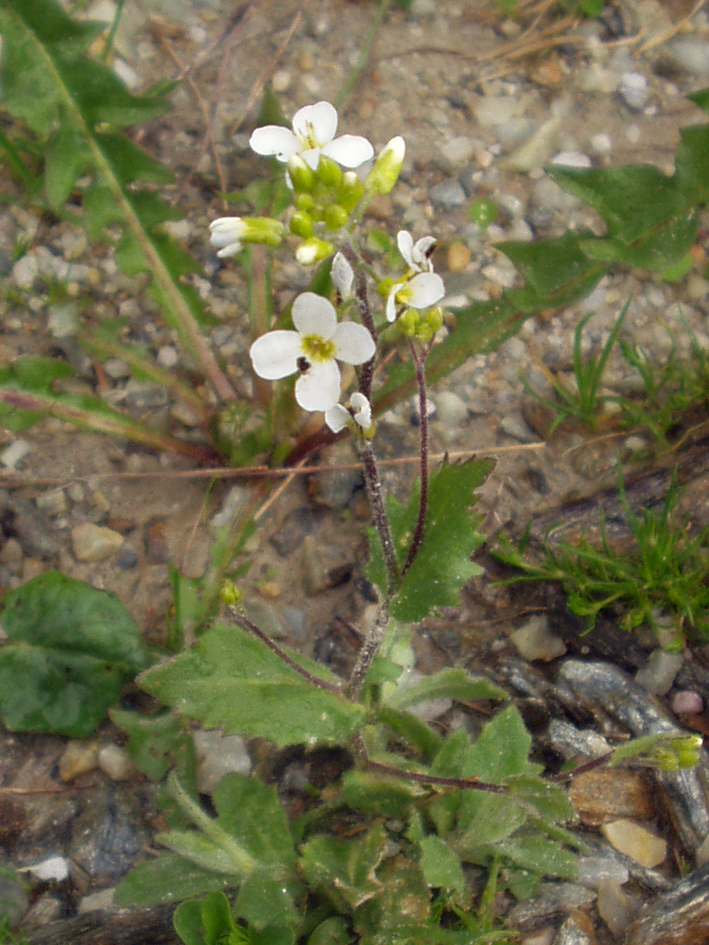
Alpine rock-cress (Arabis alpina) is an evergreen perennial in the family Brassicaceae native to mountainous gravels across Europe, Asia, Africa, and North America. It forms low mats of hairy gray-green foliage that produce white four-petaled flowers from April to June.
This species requires fast-draining limestone or gravelly soil and direct sun exposure, rotting quickly in wet clay. Established plants endure winter conditions down to -34 °C (-30 °F) when winter drainage remains completely clear.
Key Facts
- Hardiness: USDA Zones 4 to 8
- Height: 10–20 cm (4–8 in)
- Spread: 30–50 cm (12–20 in)
- Light: Full sun to partial sun
- Water: Low to moderate
- Soil pH: 6.5 to 7.8
Fitting Alpine Rock-Cress into Rock Gardens and Borders
Alpine rock-cress suits dry stone walls, raised rock garden beds, and gravel pathways where soil drains freely within 30 minutes of rainfall. Plants form loose carpets that spill over rock edges without overtaking neighboring perennials.
In natural habitats such as the Cuillin Ridge on the Isle of Skye, this species inhabits damp gravels and limestone screes. Garden plantings succeed best when placed where runoff moves past root systems rapidly.
- Best placements: Retaining wall crevices, alpine troughs, border edging
- Growth footprint: 10–20 cm (4–8 in) tall by 30–50 cm (12–20 in) wide
- Soil texture target: 50 percent grit, coarse sand, or pea gravel
What Arabis alpina Looks Like
Alpine rock-cress forms low evergreen cushions of oblong, coarsely toothed leaves measuring 2 to 4 cm (0.8 to 1.6 in) long. Foliage features gray-green tones covered in simple and branched stellate hairs that trap humidity in wind-swept alpine settings.
In mid-spring, terminal racemes lift clusters of fragrant, 15 mm (0.6 in) wide flowers above the mat. The blooms display four rounded petals in cross formations, typically pure white, followed by slender seed pods (siliques) reaching up to 6 cm (2.4 in) long.
- Leaf shape: Oblong to spatulate with dentate margins
- Foliage color: Gray-green to silver-green
- Flower stem height: 15–25 cm (6–10 in) during bloom
- Seed format: Narrow flattened siliques containing winged seeds
Selecting Sun Exposure and Soil Types
Provide a site receiving at least 6 hours of direct sunlight daily for maximum flower density and compact foliage. Shaded locations cause flower stems to stretch, weaken, and collapse under rain.
Soil selection must prioritize sharp drainage over nutrient richness. Alkaline soils with a pH between 6.8 and 7.8 mimic natural limestone screes and reduce root disease risks.
- Sunlight requirement: Full sun (6 to 8 hours daily)
- Substrate composition: Lean loam mixed with crushed limestone or quartz grit
- Target pH range: 6.5 to 7.8
Sowing Seeds and Setting Out Young Plants
Sow Arabis alpina seeds indoors 6 to 8 weeks before your last expected spring frost date, leaving seeds unburied as light aids germination. Seeds germinate reliably at 18–21 °C (64–70 °F) within 14 to 21 days.
Space young nursery stock or seedling plugs 30 cm (12 in) apart to permit spreading crowns to fill in without crowding out airflow. Water young plants weekly until root networks anchor into surrounding soil gravel.
- Sowing depth: Surface sow; press lightly into moist seed compost
- Stratification: 2 weeks at 4 °C (39 °F) speeds uneven batches
- Plant spacing: 25–30 cm (10–12 in) center-to-center
Watering and Fertilizer Requirements
Water established plants only when the top 5 cm (2 in) of soil dries out completely during extended summer droughts. Excess irrigation weakens root structures and causes foliar blackening.
Skip high-nitrogen fertilizers entirely, as supplemental feeding causes floppy leaves and reduced cold hardiness. A top-dressing of granite grit or crushed limestone in spring provides sufficient trace minerals.
- Water frequency: Once every 10–14 days during heatwaves
- Fertilizer schedule: None needed; lean soil preserves tight mat habit
- Mulch type: 2 cm (0.8 in) layer of pea gravel or sharp grit
Trimming Alpine Rock-Cress After Blooming
Shear spent flower stems down by 50 percent immediately after flowering finishes in June. Pruning forces new basal shoots that maintain tight crown density through autumn and winter.
Unpruned mats develop leggy wood stems with bare centers over 2 to 3 years. Regular trimming prevents seed pod formation, redirecting plant reserves into root and shoot growth.
- Timing: Mid-June immediately following bloom drop
- Pruning cut level: Trim back to the main evergreen leaf cushion
- Tool requirement: Hand shears or sharp bypass pruners
Propagating Alpine Rock-Cress from Cuttings and Division
Divide overgrown mats every 3 to 4 years in early autumn to revitalize center growth and generate new plants. Lift whole root balls, separate rooted rosettes by hand, and replant into gritty soil instantly.
Softwood stem cuttings root easily in early summer. Cut 5–8 cm (2–3 in) non-flowering shoots, strip lower leaves, and insert into a mix of 70 percent perlite and 30 percent peat moss.
- Division timing: September or early October
- Cutting success rate: Roots form in 14 to 20 days at 18 °C (64 °F)
- Rooting medium: Sharp sand and perlite kept barely moist
Managing Root Rot and Garden Pests
Prevent root rot infections by keeping crown bases elevated above standing water with a 2 cm (0.8 in) surface layer of gravel grit. Heavy clay soils represent the primary cause of plant death in domestic gardens.
Flea beetles and aphids occasionally target young foliage in early spring. Spray affected rosettes with a firm stream of water or apply insecticidal soap if pest populations multiply.
- Root rot symptom: Blackened crown tissue and collapsing leaf rosettes
- Flea beetle sign: Tiny shot-holes pitted into leaf surfaces
- Downy mildew fix: Improve air circulation and avoid overhead watering
Winter Hardiness and Cold Weather Protection
Alpine rock-cress survives severe winter frosts down to -34 °C (-30 °F) under stable snow cover without additional structural protection. Persistent winter wetness poses a greater threat than extreme freezing air temperatures.
Avoid covering mats with heavy bark mulches or fallen tree leaves, which trap surface moisture against crowns and trigger winter rot. In wet maritime winters, ensure gravel mulches remain free of dense leaf litter.
- USDA hardiness zones: 4 through 8
- Winter crown threat: Standing water and wet leaf pack
- Protection measure: Clear falling tree leaves off rosettes in November
Year-Round Alpine Rock-Cress Care Schedule
| Spring | Inspect evergreen rosettes for winter debris. Sow seeds indoors 6 weeks before last frost or clear pea gravel around crowns to prepare for April blooms. |
|---|---|
| Summer | Shear back post-bloom stems by 50 percent in June to force tight foliage growth. Water only during severe heatwaves when soil dries down 5 cm (2 in). |
| Autumn | Divide 3-year-old clumps in September. Clear fallen tree leaves off evergreen cushions in November to prevent crown rot over winter. |
| Winter | Ensure drainage channels around rockeries remain clear of ice dams. Avoid applying salt or rich bark mulches near dormant crowns. |
Alpine Rock-Cress Health Troubleshooting
| What you see | Likely cause | What to do |
|---|---|---|
| Soft black crown and melting leaves | Poor drainage and excessive soil moisture | Replant into 50 percent grit soil and elevate the crown with pea gravel. |
| Leggy, sparse stems with few flowers | Insufficient sun or missing post-bloom prune | Move plant to full sun and shear back top stems by half after spring flowering. |
| Tiny holes pitted into spring leaves | Flea beetle feeding | Rinse foliage with water sprays or apply insecticidal soap early in the morning. |
| Yellowing foliage with fine webbing | Spider mite activity during hot dry weather | Increase ambient humidity around rockery beds with morning base watering. |
Popular Arabis alpina Cultivars and Subspecies
- ‘Snowcap’ (subsp. caucasica) – dense 15 cm (6 in) mat covered in pure white flowers
- ‘Flore Pleno’ (subsp. caucasica) – double white long-lasting flowers resembling small roses
- ‘Variegata’ (subsp. caucasica) – green foliage featuring distinct creamy-white leaf margins
- ‘Rosea’ – soft pink four-petaled flowers emerging on 15 cm (6 in) stems
Best Companion Plants for Rock Gardens
Pair Alpine rock-cress with alpines that demand identical full-sun exposure and gritty, well-drained soil conditions. Matching growth rates prevents vigorous companions from smothering low-growing foliage.
Plant alongside purple aubrieta (Aubrieta deltoidea) for contrasting spring bloom color combinations. Additional structural partners include moss phlox (Phlox subulata), rock alyssum (Aurinia saxatilis), wild thyme (Thymus serpyllum), and snow-in-summer (Cerastium tomentosum).
- Aubrieta deltoidea – matching spring bloom timing in purple tones
- Phlox subulata – low evergreen matting habit with pink or blue flowers
- Aurinia saxatilis – bright yellow flowers contrasting white cress blooms
- Thymus serpyllum – aromatic carpet foliage for rocky steps and edges
Frequently Asked Questions
How do you sow Arabis alpina seeds successfully?
Surface-sow seeds on moist gritty compost indoor seed trays 6 to 8 weeks before the last spring frost. Do not cover seeds because light triggers germination, which occurs within 14 to 21 days at 18–21 °C (64–70 °F).
Why is Arabis alpina used in plant genome research?
Arabis alpina possesses a compact 375-megabase (Mb) diploid genome that serves as a model system for genetic studies on perenniality, flowering cycles, and alpine adaptations. Researchers use it to compare life-history traits against annual species like Arabidopsis thaliana.
What is the difference between Arabis alpina and Aubrieta deltoidea?
Arabis alpina produces pure white or pale pink flowers with coarsely toothed foliage, whereas aubrieta (Aubrieta deltoidea) features purple to magenta flowers with smoother leaf edges. Both share identical alpine growth habits and spring bloom windows.
How do you maintain variegated alpine rock cress?
Grow variegated alpine rock cress ('Variegata') in full sun and prune out any solid green shoots at ground level immediately upon appearance. Solid green reversions grow faster than variegated stems and will crowd out variegated foliage if left unchecked.
Is Alpine rock-cress evergreen in freezing winters?
Alpine rock-cress retains its gray-green foliage cushion throughout winter in USDA Zones 4 through 8. Leaves remain evergreen provided crowns do not sit in waterlogged soil during freeze-thaw cycles.
Sources & Verification
Taxonomy and distribution are checked against the databases below. Care guidance is written for cultivated species only and reviewed by our editor. How We Build Plant Profiles →
- Kew Plants of the World OnlineTaxonomic status and native distribution details
- Global Biodiversity Information Facility (GBIF)Occurrence records and geographic range observations
- Royal Horticultural Society (RHS)Cultivation parameters and plant hardiness data
- NC State University ExtensionLandscape application and environmental tolerances
- Wikipediageneral reference