
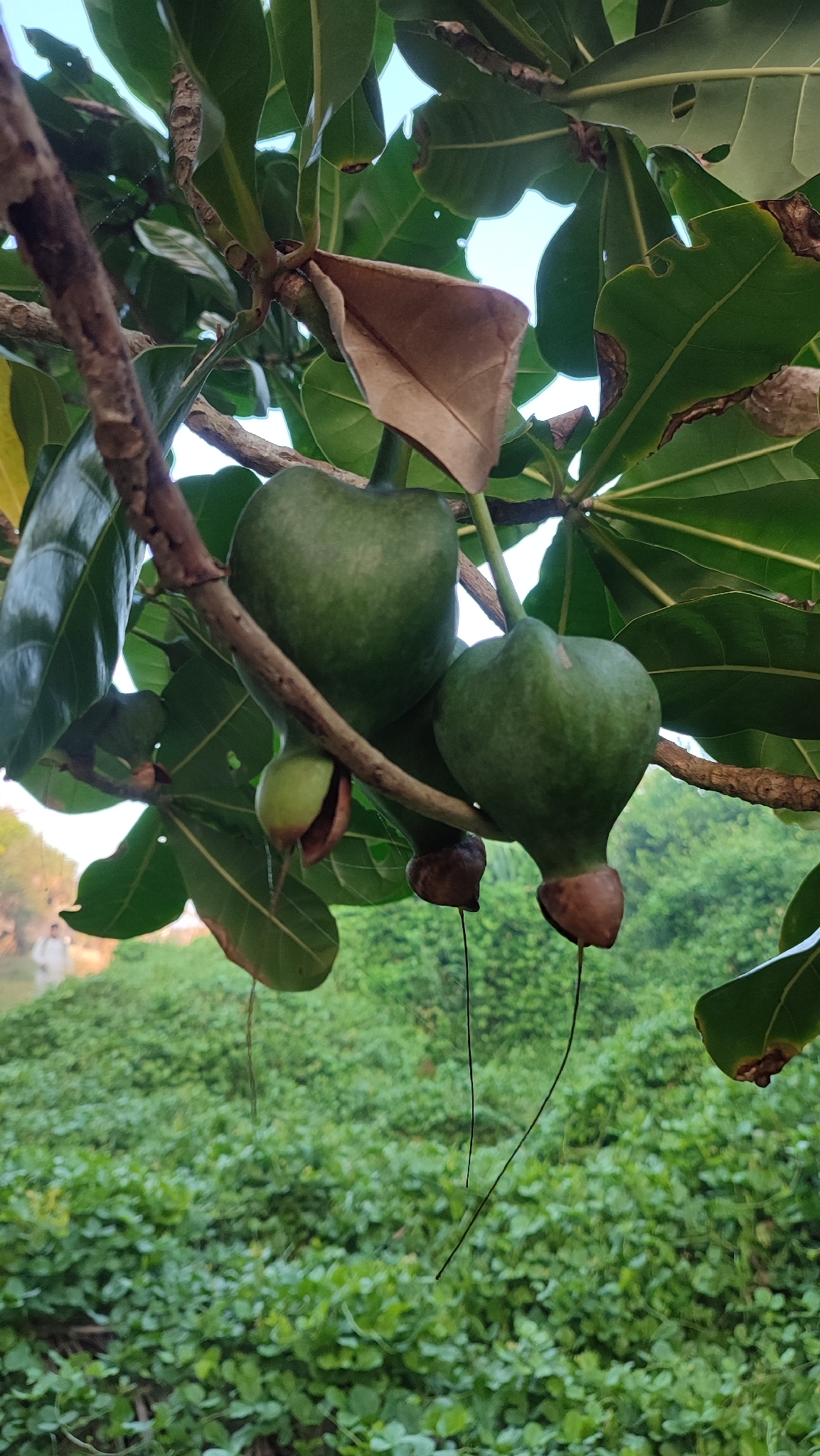
Box fruit tree (Barringtonia asiatica) is an evergreen coastal tree native to tropical beach ecosystems across the Indian and Pacific Oceans. It features large leather-like leaves, nocturnal pink-and-white flowers, and four-sided buoyant fruits that float on ocean currents for months.
The seeds contain high concentrations of saponins, which coastal communities historically used to stupefy fish in tidal pools. Its seeds remain viable after floating in seawater for up to two years.
Key Facts
- Plant Type: Broadleaf evergreen coastal tree
- Native Range: East Africa, South Asia, Philippines, Pacific Islands
- Mature Height: 7-25 m (23-82 ft)
- Fruit Shape: Four-angled lantern shape, 8-15 cm (3-6 in) long
- Seed Dispersal: Floats in seawater up to 24 months
- Toxicity: Seeds toxic to fish and mammals if ingested
Where Box Fruit Tree Fits in Coastal Ecosystems
Box fruit tree grows naturally along sandy beaches and mangrove edges, reaching heights between 7 and 25 m (23 and 82 ft).
It anchors unstable shoreline sand with a dense network of lateral roots. The wide spreading canopy creates shade along littoral forest fringes where few other broadleaf trees survive full ocean wind exposure.
This species thrives directly on the high-tide line where soil salinity is elevated and salt spray is continuous.
- Sun Exposure: Requires 6-8 hours of direct tropical sunlight daily
- Salt Tolerance: High resistance to aerosol salt spray and brackish groundwater
- Canopy Width: Spreads 6-18 m (20-60 ft) across littoral zone edges
- Root Depth: Shallow, spreading lateral roots designed for sandy shores
How to Identify Barringtonia asiatica Leaves, Flowers, and Fruit
Box fruit tree features thick obovate leaves measuring 20-40 cm (8-16 in) long and distinct 8-15 cm (3-6 in) square-based fruits.
The simple leaves grow in terminal rosettes at the ends of thick branches. Young leaves display a bronze tint before maturing into dark glossy green foliage with a pale yellow midrib.
The flowers open at night and drop by sunrise, featuring hundreds of brush-like stamens measuring 10-12 cm (4-5 in) long. The white petals surround stamens tipped with vivid pink. The fruit turns brown when mature and resembles a four-sided bishop’s cap.
- Leaf Arrangement: Alternate, clustered tightly at branch tips
- Flower Lifespan: Opens around dusk, sheds stamens before mid-morning
- Fruit Structure: Fibrous outer husk containing a single dense seed
- Bark Characteristics: Smooth gray-brown bark becoming fissured on old trunks
Native Habitat and Philippines Range of Fish Poison Tree
Fish poison tree inhabits coastal strands from Madagascar and Tanzania through the Philippines to French Polynesia.
In the Philippines, where local communities call it botong or bitung, the tree grows along sandy and rocky beaches in provinces such as Palawan, Cebu, and Davao. It forms part of the natural littoral forest zone situated above the high-water line.
The species requires tropical temperatures that rarely dip below 18 °C (64 °F). It colonizes coralline beaches, quartz sand, and the landward margins of mangrove swamps where mean annual rainfall exceeds 1500 mm (59 in).
- Elevation Limit: Found predominantly from sea level to 50 m (164 ft)
- Soil Types: Coral rubble, quartz sand, volcanic ash, and littoral silt
- Temperature Range: Thrives between 22 °C and 34 °C (72-93 °F)
- Habitat Distribution: Intertidal fringes and coastal dune scrub
Ecology and Seed Dispersal of Beach Barringtonia
Beach Barringtonia relies on ocean currents to transport its buoyant, water-resistant fruits over distances of thousands of kilometers.
The outer layer of the fruit consists of a tough, waterproof skin over a thick spongy husk packed with air cells. This construction keeps the inner seed dry while floating across ocean basins for up to two years without losing germination potential.
Large nectar-rich nocturnal flowers attract pollinators such as fruit bats (genus Pteropus) and large hawk moths (family Sphingidae). The fallen stamens carpet the ground beneath the canopy every morning, releasing a sweet scent that draws littoral crabs and insects.
- Pollination Vectors: Megachiropteran fruit bats and nocturnal moths
- Dispersal Mechanism: Hydrochory (flotation via ocean currents)
- Germination Trigger: Moist sand washed above high tide line
- Wildlife Interactions: Hermit crabs seek shelter beneath fallen husks
Conservation Status and Ecosystem Role
Fish poison tree is classified as Least Concern (LC) on the IUCN Red List due to its broad Indo-Pacific distribution.
Coastal development, beach clearing, and port construction pose localized threats to wild stands in tropical Asia. However, ocean-borne seeds continuously recolonize isolated islands and protected beach reserves.
The broad root network stabilizes beach sand against wave action and storm surges. Removing coastal stands accelerates shoreline erosion and removes nesting sites for sea birds.
- IUCN Category: Least Concern (assessed across native range)
- Primary Threat: Shoreline development and habitat loss
- Ecosystem Function: Coastal storm buffer and sand stabilizer
- Regeneration Capacity: High seedling emergence along undisturbed coasts
Traditional Medicinal Uses and Fish Poisoning Properties
Indigenous communities traditionally extracted saponins from the seeds of fish poison tree to paralyze fish in shallow water with a single crushed seed.
The active compounds, primarily barringtonin saponins, suffocate fish by disrupting gill oxygen absorption without making the fish flesh dangerous for human consumption.
Historically, healers applied ground seed pastes topically to treat fungal skin infections, scabies, and intestinal parasites. Dried bark preparations were used traditionally in Polynesian and Philippine folk remedies to treat coughs and abdominal pain.
- Toxic Component: Barringtonin saponins concentrated inside the seed kernel
- Traditional Fishing Method: Pulped seeds scattered in tidal rock pools
- Wood Characteristics: Soft, light yellow timber susceptible to marine borers
- Craft Uses: Spongy fruit husks used by fishermen as floaters for nets
Distinguishing Barringtonia asiatica from Similar Species
Box fruit tree is distinguished from sea poison tree (Barringtonia racemosa) by its larger four-angled fruits and erect flower clusters.
While Barringtonia racemosa produces hanging racemes up to 1 m (3.3 ft) long with smaller rounded fruits, box fruit tree features upright flower clusters and pyramid-shaped fruits.
It is also confused with beach almond (Terminalia catappa), sea hibiscus (Hibiscus tiliaceus), and Alexandrian laurel (Calophyllum inophyllum). Beach almond leaves turn bright red before shedding, while Alexandrian laurel produces spherical fruits and exudes milky sap when damaged.
- Barringtonia racemosa: Pendulous long flower spikes, smaller ovoid fruits under 7 cm (2.8 in)
- Terminalia catappa: Tiered horizontal branches, leaves turn red before dropping
- Hibiscus tiliaceus: Heart-shaped leaves, yellow cup-shaped flowers with dark centers
- Calophyllum inophyllum: Spherical yellow-green fruits, clear milky sap, parallel leaf veins
Frequently Asked Questions
What is the common name for Barringtonia asiatica?
The primary English common names for Barringtonia asiatica are box fruit tree, fish poison tree, and beach Barringtonia. In the Philippines, it is widely known as botong or bitung.
What are the medicinal uses and benefits of Barringtonia asiatica?
Historically, traditional healers applied crushed Barringtonia asiatica seeds topically to treat fungal skin infections and scabies. Bark preparations were traditionally used in folk medicine to ease stomach pain, though the seeds contain toxic saponins and must not be ingested.
Why is Barringtonia asiatica called the fish poison tree?
The tree earned this name because coastal communities historically pulped its seeds and scattered them into shallow tidal pools to stupefy fish. Saponins in the seeds disrupt gill respiration in fish, causing them to float to the surface.
What does the fruit of Barringtonia asiatica look like?
The fruit of Barringtonia asiatica is a distinct four-sided, pyramid-shaped fruit measuring 8-15 cm (3-6 in) long, resembling a four-pointed lantern or bishop's cap. It features a tough fibrous outer husk surrounding a single seed kernel.
Where is Barringtonia asiatica found in the Philippines?
In the Philippines, Barringtonia asiatica grows naturally along sandy and rocky coastlines across Palawan, Mindoro, Cebu, and Davao. It occupies the littoral beach zone immediately above the high-tide line.
Information about traditional or historical uses is provided for educational interest only and is not medical advice. Do not use any plant to treat a condition without speaking to a qualified professional.
Sources & Verification
Taxonomy and distribution are checked against the databases below. Care guidance is written for cultivated species only and reviewed by our editor. How We Build Plant Profiles →