
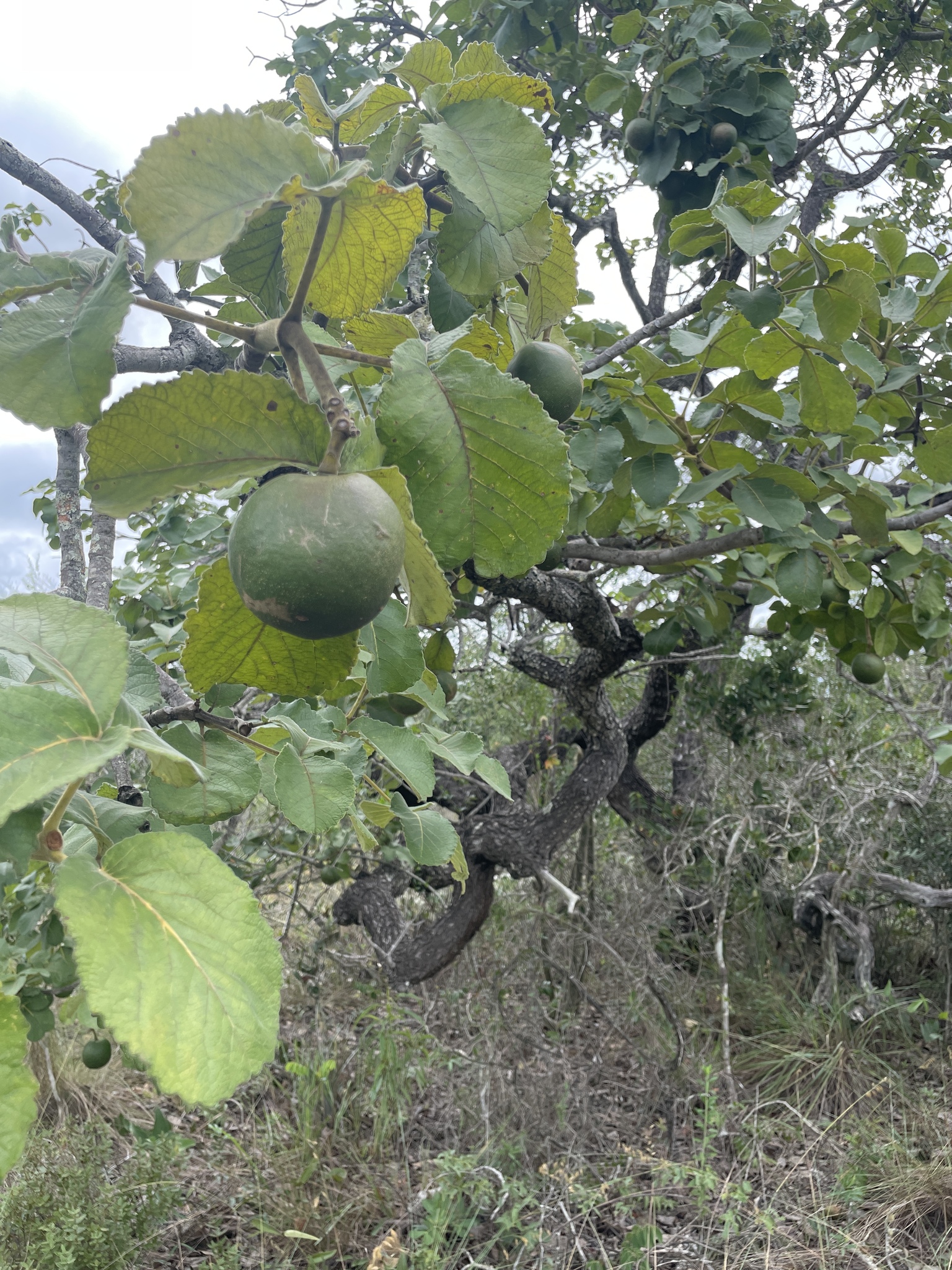
Caryocar brasiliense, commonly known as the Pequi or Pekea Nut, is a canopy tree native to the Brazilian Cerrado grasslands. It is defined by its thick, corky bark and large, oily yellow fruits that are a staple of regional Brazilian culture.
This species thrives in the nutrient-poor, acidic soils of the central-west highlands and is adapted to survive seasonal fires. It produces a significant fruit crop between September and February, providing a source of nutrient-dense oil used in both traditional cooking and modern hair care.
Key Facts
- Native Range: Brazilian Cerrado biome
- Fruit Season: September to February
- Seed Warning: Contains sharp internal thorns
- Tree Height: Reaches 7-15 m (23-49 ft)
- Oil Uses: Cooking, skin, and hair care
Encountering the Pequi Tree in the Wild
Living alongside the Caryocar brasiliense requires an understanding of its slow growth and seasonal rhythms. In its native Brazil, the tree is a permanent fixture of the landscape, often left standing even when land is cleared for pasture because of its economic value. It is not a tree for small gardens, as its deep taproot and wide canopy require significant space to develop.
The tree is deeply integrated into the local economy of states like Goiás and Minas Gerais. Harvesting is done by hand, usually by gathering the fallen fruit from the ground rather than picking it from the branches. This method ensures the fruit is fully ripe, as the oily pulp only reaches its peak flavor and nutritional content once it naturally detaches.
- Growth Habit: Open, spreading canopy
- Lifespan: Can live for over 100 years
- Climate: Requires a distinct dry season to trigger flowering
How to Identify Caryocar brasiliense
The Pequi tree is distinguished by its thick, corky bark which can reach 2 cm (0.8 in) in thickness to protect the inner cambium from Cerrado fires. The leaves are trifoliate, meaning they grow in groups of three, and are covered in fine, rough hairs. Each leaflet can measure up to 20 cm (8 in) in length and has a leathery texture that minimizes water loss during the dry season.
During the flowering season, the tree produces large, hermaphroditic flowers that are pale yellow or cream-colored. These flowers are clustered at the ends of branches and have numerous long stamens that give them a brush-like appearance. The fruit itself is a drupe, roughly the size of an orange, with a green skin that turns slightly yellowish-brown as it matures on the ground.
- Bark: Deeply fissured, suberous, and fire-resistant
- Leaf Arrangement: Opposite, trifoliate leaflets
- Flower Size: Roughly 8 cm (3.1 in) in diameter
- Fruit Shape: Globose to ovoid drupe
The Cerrado Habitat of the Pekea Nut
Pequi trees grow naturally in acidic, nutrient-poor latosols characterized by high aluminum content. These soils are often very deep, allowing the tree to extend its roots several meters down to reach the water table during the six-month dry season. The species is most common on the high plateaus, or Chapadas, of central Brazil at elevations between 500-1,200 m (1,640-3,937 ft).
The habitat is characterized by a dramatic shift between a wet summer and a bone-dry winter. Annual rainfall in these regions typically ranges from 1,200-1,800 mm (47-71 in), but almost all of it falls between October and March. The tree has evolved to shed some of its leaves during the peak of the drought to conserve moisture before the spring bloom begins.
Ecological Role and Pollinators
The flowers of the Pequi open at night to attract nectar-feeding bats, specifically Glossophaga soricina. These bats are the primary pollinators, moving between trees and carrying pollen on their fur. The flowers produce a large amount of nectar and have a strong, musky scent that is easily detected in the dark by nocturnal visitors.
Once the fruit falls, it becomes a food source for various Cerrado animals, including the maned wolf (Chrysocyon brachyurus) and the rhea (Rhea americana). These animals play a role in seed dispersal, though many seeds remain near the parent tree. The hard, thorny endocarp protects the internal seed from being crushed by most animals, ensuring the embryo survives the digestive process.
- Primary Pollinator: Bats (Chiropterophily)
- Secondary Pollinators: Large bees and moths
- Seed Dispersers: Large mammals and flightless birds
Conservation and Protected Status
While listed as Least Concern globally, the Pequi faces significant local pressure from the expansion of soybean and cattle farming. In several Brazilian states, including Goiás, it is legally protected, and cutting down a wild Caryocar brasiliense without a specific permit is a criminal offense. Conservation efforts focus on sustainable wild-harvesting practices to prevent over-exploitation of the fruit crop.
The genetic diversity of the species is threatened by the fragmentation of the Cerrado biome. Because the tree depends on specific pollinators like bats, the loss of surrounding habitat can lead to reduced fruit sets even if the trees themselves are left standing. Programs are currently in place to map high-yield wild groves and establish extraction reserves for local communities.
Caryocar brasiliense Fruit and Oil Uses
The fruit of the Pequi contains an internal pit covered in over 500 sharp spines that can lodge in the tongue or gums if bitten. To eat it safely, the yellow pulp must be carefully scraped off with the teeth without applying pressure to the core. The pulp is rich in carotenoids, Vitamin A, and Vitamin E, and is famously used to flavor rice, chicken, and local liqueurs.
Caryocar brasiliense fruit oil is highly sought after for hair and skin care due to its concentration of palmitic and oleic fatty acids. When applied to hair, the oil helps seal the cuticle, reducing frizz and increasing shine. Traditionally, the oil was also used to treat respiratory ailments and skin inflammations, though modern use is primarily culinary and cosmetic.
- Culinary: Arroz com Pequi (Pequi rice) is a regional staple
- Hair Care: Used to treat dry, damaged, or curly hair
- Byproducts: The wood is rot-resistant and used for heavy construction
- Oil Properties: Solidifies at temperatures below 25 °C (77 °F)
Similar Species in the Caryocar Genus
The Caryocar villosum, known as Piquiá, is the most common relative but grows in the Amazon rainforest rather than the Cerrado. It is a much larger tree, reaching heights of up to 40 m (131 ft), and its fruits are significantly larger than those of the Pequi. Unlike the Pequi, the Piquiá thrives in high-humidity environments and lacks the fire-resistant bark of the savanna species.
Another relative is the Caryocar coriaceum, often called Piqui-manso, which is found in the northern parts of the Cerrado and the Caatinga transition zones. It can be distinguished by its smoother leaves and slightly different fruit flavor. In the same regions, you may also find the Buriti palm (Mauritia flexuosa) and the Araticum (Annona crassiflora), which share the same seasonal fruiting patterns but have entirely different botanical structures.
- Caryocar villosum: Amazonian giant with larger fruit
- Caryocar coriaceum: Smaller leaves, found in drier transition zones
- Caryocar edule: Rare relative with edible seeds lacking spines
Frequently Asked Questions
How do you eat Pequi fruit safely?
You must gently scrape the yellow pulp with your teeth rather than biting into the fruit. The inner pit contains hundreds of needle-like spines that will cause painful injuries if they pierce your mouth or tongue.
What are the benefits of Caryocar brasiliense fruit oil for hair?
Pequi oil is rich in fatty acids and vitamins that help reduce frizz and define curls. It acts as a natural emollient that seals the hair cuticle and provides a high-shine finish without being as heavy as some synthetic oils.
Can you grow Pequi from seeds?
Yes, but germination is difficult and can take between 6 to 12 months. The seeds require a period of dormancy and often benefit from scarification or specific temperature fluctuations to mimic the natural Cerrado environment.
What does Pequi fruit taste like?
Pequi has a very strong, unique flavor that is often described as a mix of citrus, cheese, and animal fat. Its intense aroma is polarizing; people typically either enjoy it as a savory delicacy or find the smell overwhelming.
Is the Pequi tree endangered?
It is currently listed as Least Concern, but it is protected by law in several Brazilian states due to habitat loss. The main threat is the conversion of native Cerrado grasslands into large-scale agricultural plantations.
Information about traditional or historical uses is provided for educational interest only and is not medical advice. Do not use any plant to treat a condition without speaking to a qualified professional.
Sources & Verification
Taxonomy and distribution are checked against the databases below. Care guidance is written for cultivated species only and reviewed by our editor. How We Build Plant Profiles →