
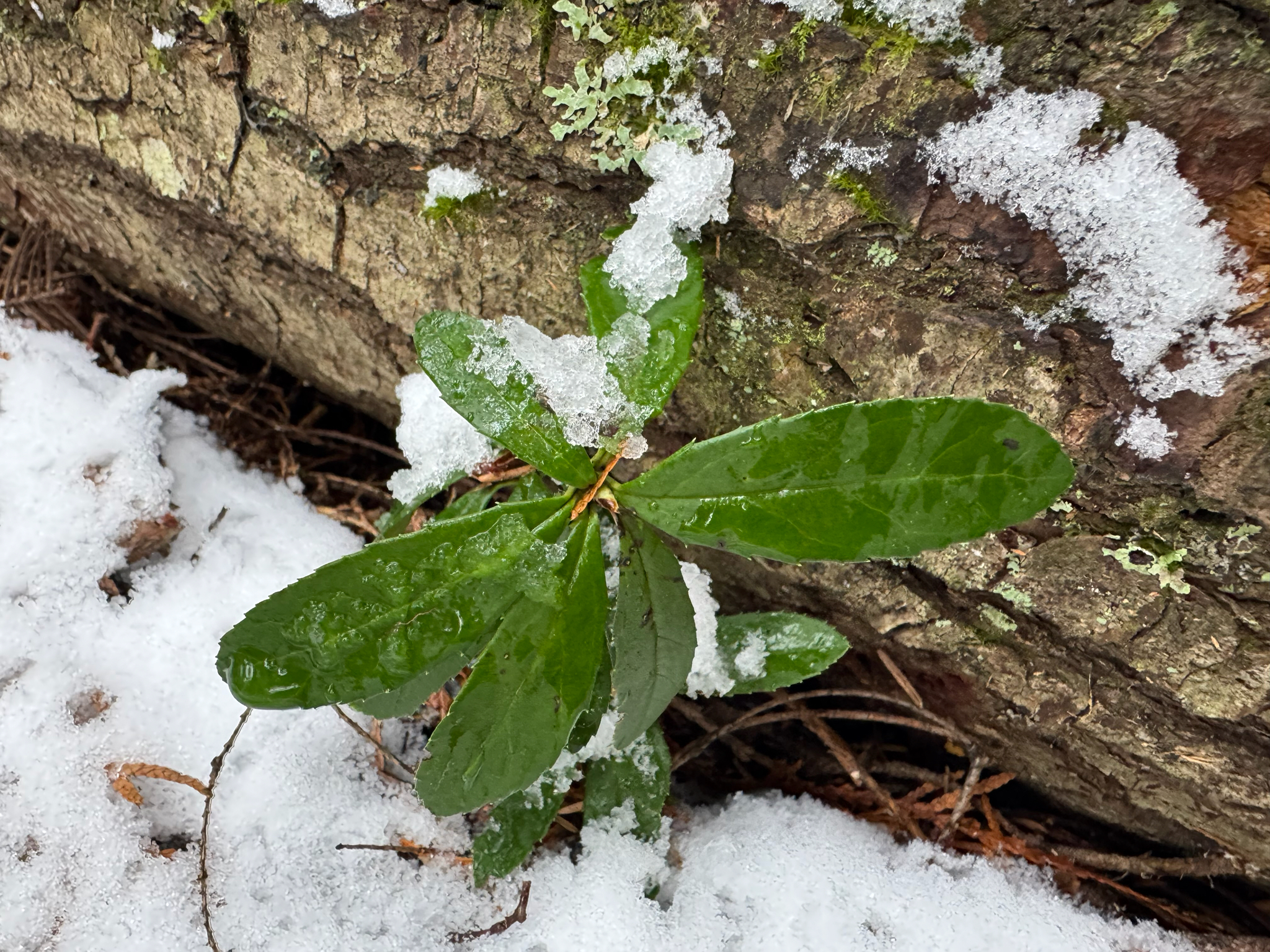
Pipsissewa (Chimaphila umbellata) is a small evergreen subshrub native to cool temperate pine and mixed forests across the Northern Hemisphere. It stands out on the forest floor with whorled, leathery, toothed leaves and nodding clusters of waxy pink flowers.
Because it relies on complex fungal networks in undisturbed forest duff, wild specimens fail when transplanted into garden soil and require mature forest canopy cover to survive.
Key Facts
- Plant Type: Evergreen perennial subshrub
- Native Habitat: Dry conifer and mixed woodland understories
- Height: 10–35 cm (4–14 in) tall
- Bloom Time: June to August depending on latitude
- Propagation: Extremely difficult; dependent on mycorrhizal fungi
- Toxicity: Contains irritating hydroquinones; not safe for consumption
Encountering Pipsissewa in the Wild
Pipsissewa is a low-growing forest native that thrives only within undisturbed, acid-soil woodlands. You will encounter it creeping across the needle-covered ground beneath pines, firs, and oaks, spreading slowly through shallow underground rhizomes.
This plant cannot be treated as a standard garden ornamental. It is partially mycoheterotrophic, obtaining a portion of its carbon and mineral nutrients through mutualistic partnerships with mycorrhizal forest fungi. Attempting to dig up wild colonies or transplant them into backyard borders almost always kills the plant within a single season.
Identifying Leaves, Stems, and Flowers
Pipsissewa grows 10 to 35 cm (4 to 14 in) high on semi-woody stems lined with distinct whorls of dark green foliage. The leaves are thick, lustrous, oblanceolate to wedge-shaped, measuring 3 to 7 cm (1.2 to 2.8 in) long, with sharply serrated margins along their upper halves.
Flowering occurs between June and August across its northern range.
- Flower cluster: An erect umbel-like corymb carrying 4 to 10 nodding flowers.
- Petals: Five rounded, waxy petals ranging in color from cream-white to pale rose-pink.
- Reproductive structures: Ten stamens with prominent violet anthers surrounding a broad, peltate green stigma.
- Capsule: A dry, five-valved erect seed capsule containing thousands of microscopic, dust-like seeds.
Pipsissewa Woodland Habitat and Soil
Pipsissewa demands well-drained, acidic sandy or rocky soils with a pH between 4.5 and 6.0. It occupies open conifer forests, dry pine barrens, and mixed hardwood ridges where leaf litter is thin and free moisture drains away rapidly.
The species avoids waterlogged ground, clay subsoils, and lime-rich substrates. It relies on the dry duff of eastern white pine (Pinus strobus), red pine (Pinus resinosa), and Douglas fir (Pseudotsuga menziesii), taking advantage of partial shade where filtered light reaches the forest floor.
Fungal Partnerships and Seed Ecology
Pipsissewa relies on partial mycoheterotrophy with forest fungi to survive beneath dense woodland canopies. While its dark green foliage carries out active photosynthesis, isotope studies demonstrate that adult plants draw significant amounts of fungal carbon from underground networks shared with neighboring trees.
Because its seeds are microscopic and contain virtually no endosperm reserves, they cannot germinate in sterile potting mixes. Germination requires precise fungal infection by specific basidiomycetes in native duff. These specialized ecological bonds explain why wild colonies vanish quickly after clear-cutting, intense soil compaction, or heavy forest floor disturbance.
Conservation Status and Forest Threats
While globally assessed as Least Concern, local populations of Pipsissewa face severe declines near urban edges. In parts of Central Europe and the southern margins of its North American range, habitat fragmentation and fire suppression have reduced the open woodland stands it requires.
Key threats impacting wild colonies include:
- Commercial harvesting of wild foliage for traditional or herbal markets.
- Clear-cut logging that eliminates both fungal partners and sheltering tree canopy.
- Dense invasion of forest floors by aggressive exotic species like garlic mustard (Alliaria petiolata).
- Soil compaction from off-road vehicle traffic and heavy recreational trail use.
Historical Medicinal Uses and Homeopathy Queries
Native North American tribes traditionally used Pipsissewa leaves as a bitter tonic and mild diuretic for urinary complaints. The Cree name for the plant translates roughly to ‘breaks into small pieces,’ referencing its historical use for bladder stones. It was also once used as a traditional flavoring agent in early root beer and tonic formulations.
In alternative traditions and homeopathy, the plant is processed into mother tinctures (often labeled Chimaphila umbellata Q) or diluted potencies such as 30C and 200C. Practitioners historically applied these preparations to symptoms of chronic cystitis and benign prostatic enlargement.
Modern clinical research evaluating these specific claims remains limited. Crude extracts contain chimaphilin and arbutin, which can cause gastrointestinal distress, nausea, or contact dermatitis when handled or ingested in unrefined forms.
Recognizing Similar Forest Plants
Pipsissewa is distinguished from related species by its whorled, solidly green leaves and umbel-like flower clusters. Several other Ericaceae family members share its acid-woodland niche and can be confused with it at first glance.
- Spotted wintergreen (Chimaphila maculata) displays distinct white variegation along the main leaf veins and has narrower foliage.
- Round-leaved wintergreen (Pyrola americana) bears basal, rounded leaves on long petioles rather than whorled leaves up a woody stem.
- Single delight (Moneses uniflora) produces only one solitary, terminal white flower per stem rather than an umbel.
- Wintergreen or teaberry (Gaultheria procumbens) produces solitary red berries, creeping ground-hugging stems, and oval leaves that smell strongly of methyl salicylate when crushed.
- Twinflower (Linnaea borealis) forms creeping mats with tiny paired pink bells instead of five-parted waxy umbels.
Frequently Asked Questions
Can you grow Chimaphila umbellata from seeds?
Growing Pipsissewa from seed at home is almost impossible because the dust-like seeds lack food reserves and require specific mycorrhizal fungi from native forest soils to germinate.
What is Chimaphila umbellata used for in homeopathy?
In homeopathic systems, remedies such as mother tincture (Q) or 30C and 200C dilutions were historically formulated to address urinary tract inflammation, painful urination, and enlarged prostate symptoms. Robust clinical trials confirming therapeutic efficacy in modern medicine are lacking.
Are there side effects from Chimaphila umbellata extracts?
Unrefined extracts contain hydroquinone compounds like chimaphilin and arbutin, which can trigger stomach irritation, nausea, diarrhea, and allergic skin rashes in sensitive individuals.
Where does Pipsissewa grow naturally?
It grows across the cool temperate regions of North America, Europe, and northern Asia, primarily on dry, acidic, sandy soils in conifer and mixed pine-oak forests.
Is Pipsissewa evergreen?
Yes, Pipsissewa retains its leathery, dark green leaves throughout the winter beneath snow cover.
Information about traditional or historical uses is provided for educational interest only and is not medical advice. Do not use any plant to treat a condition without speaking to a qualified professional.
Sources & Verification
Taxonomy and distribution are checked against the databases below. Care guidance is written for cultivated species only and reviewed by our editor. How We Build Plant Profiles →
- Kew Plants of the World OnlineTaxonomy, distribution, and native status verification.
- USDA PLANTS DatabaseNative habitat and distribution data.
- IUCN Red List of Threatened SpeciesGlobal conservation assessment.
- GBIF — Global Biodiversity Information Facilitytaxonomy, synonyms, occurrence records
- Wikipediageneral reference
