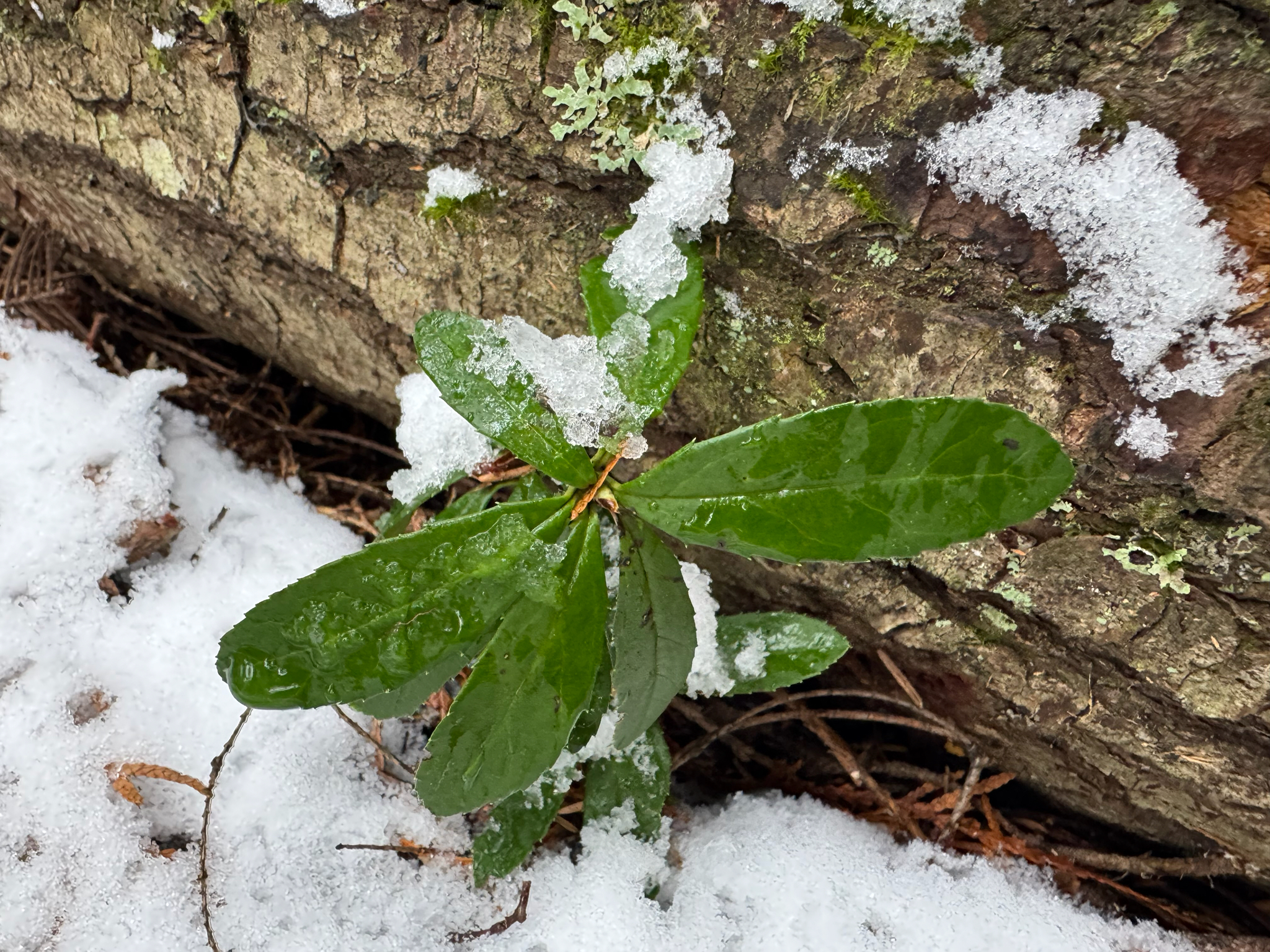
Spotted pipsissewa (Chimaphila maculata), also called spotted wintergreen, is a small perennial subshrub native to acidic forests across eastern North America, Mexico, and Central America. Reaching 10-25 cm (4-10 in) in height, the plant features dark green, leathery leaves marked with bold white mottling along the midrib and primary veins.
This wild species depends on specialized soil fungi for survival and growth, which prevents it from establishing in standard garden beds or nursery containers. It grows naturally in well-drained pine-oak woods under a canopy of fallen needles and leaves.
Key Facts
- Plant Type: Native evergreen perennial herb
- Mature Height: 10-25 cm (4-10 in)
- Native Range: Quebec west to Illinois, south to Florida and Panama
- Light Need: Partial shade to deep woodland shade
- Soil Preference: Dry, acidic, sandy or rocky forest floor
- Toxicity: Mildly toxic if consumed in large amounts
Wild Landscape Fit: Can You Grow Spotted Pipsissewa?
Spotted pipsissewa cannot be reliably cultivated in home gardens because it requires mycorrhizal fungi found only in undisturbed acidic forest soils. Wild specimens extracted from woodland habitats routinely die within months when potted or planted in garden soil.
Instead of attempting garden propagation, wild plant enthusiasts observe this native species in natural habitats or establish dedicated native woodland preserves where canopy trees like white oak (Quercus alba) and eastern white pine (Pinus strobus) provide the necessary leaf litter layer and fungal networks.
- Cultivation Feasibility: Extremely poor outside wild habitat
- Best Environment: Undisturbed pine-oak forest floor
- Fungal Reliance: High dependency on wild Russulaceae fungi
- Protection Strategy: Preserve existing native forest colonies
How to Identify Spotted Wintergreen
Spotted pipsissewa grows 10-25 cm (4-10 in) tall with thick, dark green leaves featuring prominent white broad stripes along the main vein network. Leaves are arranged in whorls or opposite pairs along short reddish stems, measuring 3-7 cm (1.2-2.8 in) long and 1-2.5 cm (0.4-1.0 in) wide with sharp teeth along the margins.
In early summer, mature stems produce terminal clusters of 2-5 nodding, fragrant flowers. Each flower spans 1.5 cm (0.6 in) across, featuring 5 rounded white to pale pink petals surrounding a dark green central ovary and 10 stamens with violet-colored anthers. In autumn, the blooms form erect, dry, 5-celled seed capsules that persist through winter.
- Foliage: Evergreen, lanceolate, white central mottling
- Stems: Woody base, creeping underground rhizomes
- Flowers: Nodding white or pink bell-like blooms in June and July
- Fruit: Round, dry brown capsules opening from top to bottom
Native Range and Preferred Forest Habitat
The native range of Chimaphila maculata spans from southern Quebec to Florida, extending west to Illinois and Texas, and continuing south through mountainous regions of Mexico to Panama. It grows at elevations ranging from near sea level up to 2,000 m (6,560 ft) in southern mountain ridges.
The species occupies dry, upland forest floors characterized by thin, sandy, or gravelly soils with a pH of 4.5-6.0. It thrives in dense shade under mixed hardwood and coniferous canopies where decaying oak leaves and pine needles build an insulating organic layer over well-drained subsoil.
- Geographic Extent: Eastern North America and Central America
- Soil Type: Dry, coarse, acidic humus over sand or granite
- Canopy Association: Oak, hickory, pine, and mountain laurel
- Elevation Range: 0-2,000 m (0-6,560 ft)
Ecology, Fungal Symbiosis, and Seed Propagation
Spotted pipsissewa utilizes partial mycoheterotrophy, extracting organic carbon and minerals from surrounding fungal networks while simultaneously photosynthesizing through its green foliage. This dual nutritional strategy allows the plant to persist in deep shade where light levels fall below 10% of full sunlight.
The seeds of Chimaphila maculata (L.) Pursh are dust-like and produced in quantities of thousands per capsule. Microscopic seeds lack stored endosperm and can only germinate when infected by compatible soil fungi that supply initial nutrients to the developing seedling.
- Nutritional Mode: Mixotrophic (photosynthesis and fungal parasitism)
- Fungal Partners: Soil ectomycorrhizal species, including Russula
- Dispersal: Wind-dispersed dust seeds in late autumn
- Rhizome Spread: Underground stems form small clonal patches
Conservation Status and Forest Threats
Spotted pipsissewa holds a global conservation status of Least Concern, maintaining stable wild populations throughout the Appalachian region and Southeastern United States. However, it is listed as endangered or threatened at the northern edge of its range in Quebec, Ontario, and parts of New England.
Habitat destruction from urban development, forest fragmentation, and clear-cutting poses the primary threat to local colonies. Removal of tree canopy alters soil moisture and disrupts the delicate fungal soil webs required for plant survival.
- Global Status: Secure across central core range
- Regional Threats: Soil compaction, forest clearance, invasive weeds
- Sensitivity: Fails to return following heavy soil tillage
- Management: Preserve intact canopy and undisturbed leaf litter
Traditional Uses and Historical Materia Medica
Native American tribes traditionally used spotted pipsissewa leaves to prepare astringent teas and poultices for treating fever, rheumatism, and kidney ailments. The common name pipsissewa derives from a Cree word meaning breaks into small pieces, referencing historical use to treat kidney stones.
In 19th-century American materia medica records, extracts of the herb were documented as mild diuretics, astringents, and tonics. Chemical analyses show the foliage contains arbutin, methyl salicylate, tannins, and the quinone compound chimaphilin.
- Active Constituents: Arbutin, chimaphilin, flavonoids, tannins
- Historical Preparations: Infusions, leaf poultices, herbal tonics
- Traditional Applications: Urinary tract irritation, rheumatism, skin sores
- Safety Note: Large doses cause gastrointestinal distress and irritation
Similar Woodland Species and Look-Alikes
Spotted pipsissewa is distinguished from pipsissewa (Chimaphila umbellata) by its white leaf mottling and lance-shaped leaf outline. While both share similar woodland habitats, Chimaphila umbellata features solid green, wedge-shaped leaves without white markings along the veins.
Other evergreen forest plants in eastern North America present similar leaf patterns or growth forms. Downy rattlesnake plantain (Goodyera pubescens) has variegated leaves but forms a flat basal rosette of net-veined orchids. American wintergreen (Gaultheria procumbens) has oval leaves with a strong wintergreen aroma when crushed, whereas spotted pipsissewa foliage lacks a minty scent.
- Pipsissewa (Chimaphila umbellata): Solid dark green leaves, unstriped
- Downy Rattlesnake Plantain (Goodyera pubescens): Net-veined orchid, ground rosette
- American Wintergreen (Gaultheria procumbens): Oval leaves, red berries, mint scent
- Shinleaf (Pyrola elliptica): Basal oval leaves, greenish-white un-striped foliage
Frequently Asked Questions
Is Chimaphila maculata edible?
Spotted pipsissewa is not edible as a food crop and contains compounds like arbutin and chimaphilin that cause stomach upset if consumed in quantity. Native Americans historically used small amounts of dried leaves to flavor beverages, but raw consumption is discouraged.
What are the historical medicinal uses of Chimaphila maculata?
Historical materia medica lists spotted pipsissewa extracts as a diuretic, astringent, and tonic used traditionally for urinary tract ailments and skin conditions. Modern medical authorities do not recommend harvesting or consuming wild specimens for self-treatment.
Can you grow Chimaphila maculata from seeds?
Growing spotted pipsissewa from seed in a garden setting is almost impossible because the dust-like seeds require infection by specific wild forest mycorrhizal fungi to germinate. Seedlings cannot produce their own nutrients without these symbiotic fungal partners.
What is the native range of Chimaphila maculata?
The native range of spotted pipsissewa extends across eastern North America from southern Quebec and Ontario west to Illinois, south through Florida, Texas, Mexico, and Central America down to Panama.
Is spotted pipsissewa related to spotted lanternflies or spotted lady beetles?
Spotted pipsissewa is an evergreen woodland plant and has no biological relationship to insects like the spotted lanternfly (Lycorma delicatula) or the spotted lady beetle. The shared word spotted merely describes the white pattern on the plant's green leaves.
Information about traditional or historical uses is provided for educational interest only and is not medical advice. Do not use any plant to treat a condition without speaking to a qualified professional.
Sources & Verification
Taxonomy and distribution are checked against the databases below. Care guidance is written for cultivated species only and reviewed by our editor. How We Build Plant Profiles →
- Kew Plants of the World OnlineTaxonomic information and global native range for Chimaphila maculata
- USDA PLANTS DatabaseUS distribution map and botanical classification
- NC State Extension Plant ToolboxPlant characteristics and wildlife value
- Flora of North AmericaDetailed morphological description and habitat notes
- GBIF — Global Biodiversity Information Facilitytaxonomy, synonyms, occurrence records
- Wikipediageneral reference