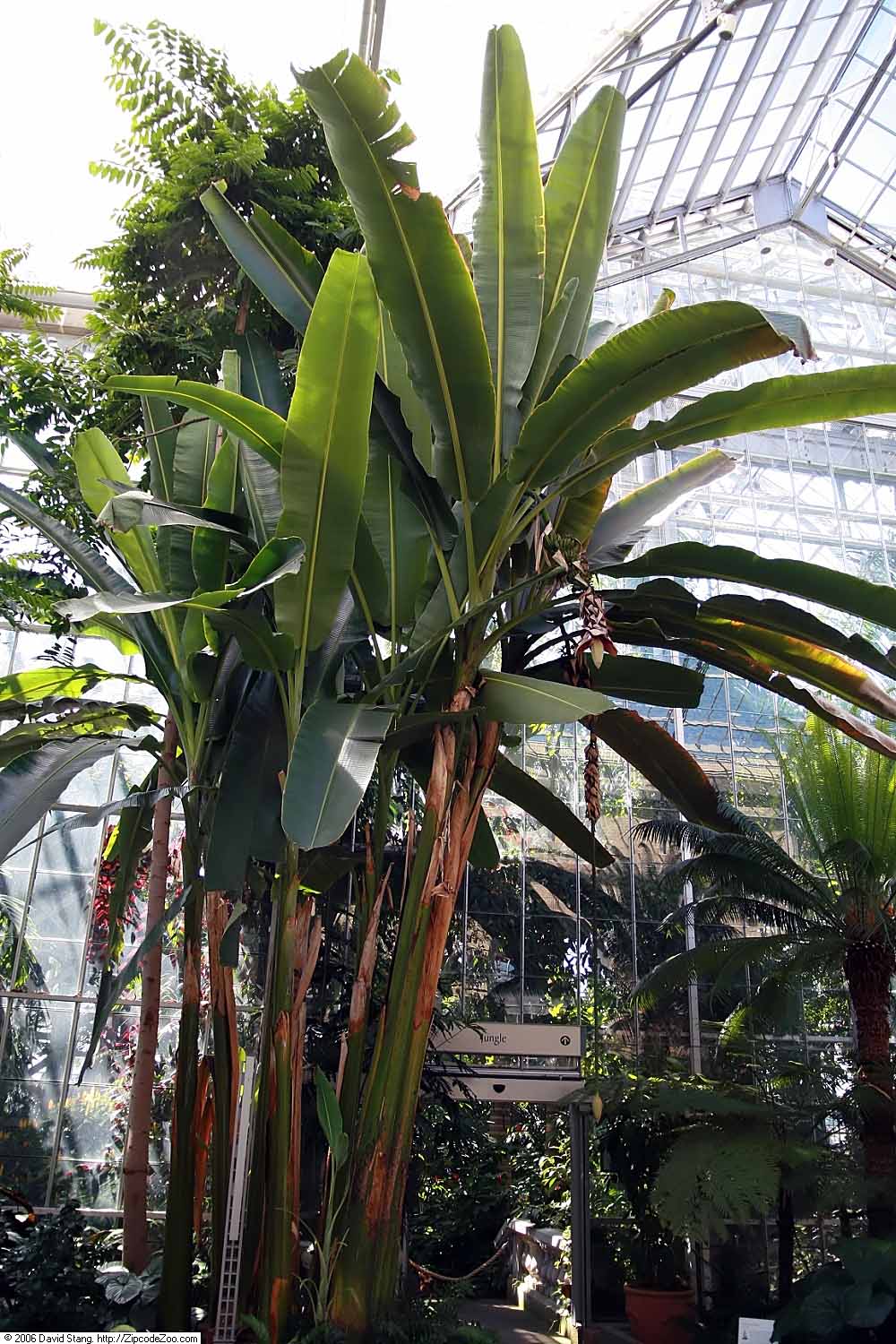
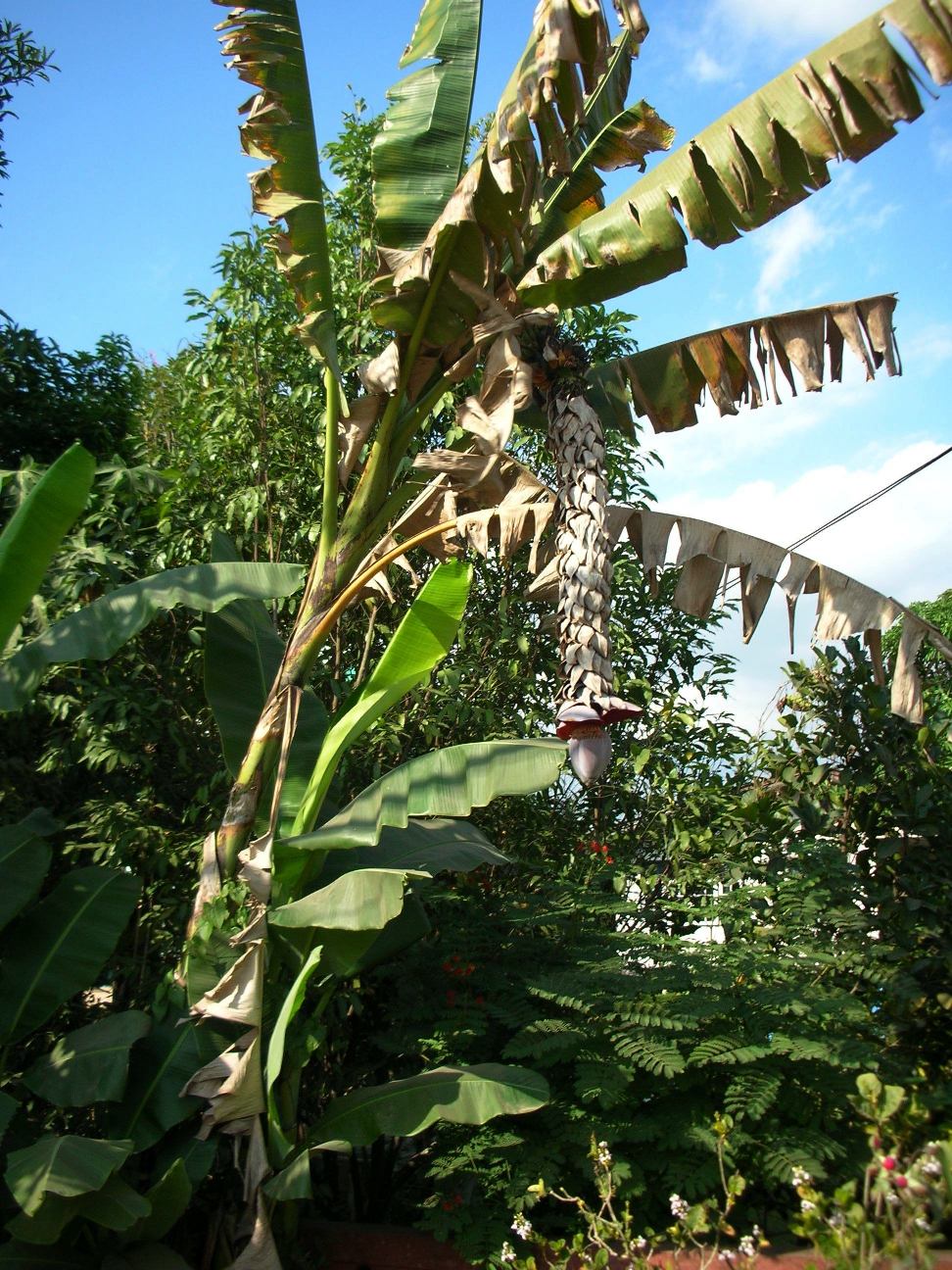
Plantain (Musa paradisiaca) is a massive, fast-growing herbaceous perennial native to tropical Southeast Asia, known for its towering pseudostems and dense bunches of firm, starchy cooking bananas. It arose as an ancient sterile hybrid between Musa acuminata and Musa balbisiana.
Unlike sweet dessert bananas, cooking plantains remain starchy when mature and require cooking before eating. A single pseudostem takes 10 to 18 months of tropical warmth to yield a fruit bunch, after which the main stem dies and leaves behind suckers.
Key Facts
- Water: 50 to 100 mm (2 to 4 in) of water per week
- Sunlight: 6 to 8 hours of direct, unfiltered sun daily
- Soil: deep, compost-rich, well-draining loam with a pH of 5.5 to 6.5
- Temperature: growth halts below 14 °C (57 °F); foliage dies at freezing
- Fruit Harvest: mature bunches cut 75 to 100 days after flowering
Growing Plantain Trees in the Landscape
Plantain thrives in sheltered, tropical garden beds where constant heat and generous moisture can support rapid vegetative growth. While botanically a giant monocot herb rather than a true woody tree, its architectural stature gives it the footprint of an open canopy shrub or small shade tree.
The plant suits warm, sheltered microclimates in USDA zones 9b through 11. Strong winds easily tear its paddle-shaped foliage along the lateral veins, reducing photosynthetic capacity and stalling fruit production.
You must reserve a dedicated space of at least 3 m (10 ft) in diameter for a single clump. Because the primary trunk produces offsets continually, establish your planting bed away from foundations and property boundaries.
How to Identify the Plantain Tree
A mature plantain forms a smooth, columnar pseudostem measuring 3 to 6 m (10 to 20 ft) tall, composed of overlapping, tightly rolled leaf sheaths. Its spirally arranged leaves emerge from the center of the stem and spread into a graceful arching crown.
The foliage consists of large, oblong blades measuring 1.5 to 3 m (5 to 10 ft) long and 50 to 60 cm (20 to 24 in) wide, supported by a stiff, grooved petiole. The upper surface is a uniform deep green, while the lower surface displays a pale, slightly waxy bloom.
The terminal inflorescence pushes upward through the pseudostem before nodding downward under its own weight. Features include:
- Deep purple to maroon external bracts that lift to reveal rows of yellowish flowers.
- Basal female flowers that set fruit without pollination.
- Angular, cylindrical fruits measuring 20 to 35 cm (8 to 14 in) in length.
- Thick, fibrous green rinds that transition to speckled yellow and finally black as starches convert to sugars.
Plantain Height, Spread, and Growth Habit
Plantains reach their full mature height of 3 to 5 m (10 to 16 ft) within 9 to 12 months under continuous tropical temperatures. A single pseudostem spreads its foliage outward across a canopy radius of 2 to 3.5 m (6.5 to 11.5 ft).
The root system develops from a solid underground rhizome or corm, producing fibrous feeder roots that occupy the top 30 to 45 cm (12 to 18 in) of the soil column. These surface roots extend laterally up to 5 m (16 ft) away from the central corm to pull water and nutrients.
Because each main stem produces a dense ring of offsets (known as suckers or pups), an untended planting develops into a crowded multi-stemmed thicket within two growing seasons.
Best Location and Soil for Plantain Trees
Plantain requires at least 6 hours of full sun daily and deep, friable soil with excellent natural drainage. Situate the clump against a south-facing wall or windbreak to protect the heavy, vulnerable leaves from tearing winds.
The soil profile must balance extreme water retention with fast internal drainage; standing water quickly rots the delicate corm. Avoid heavy, unamended clay sites.
Ideal site conditions feature:
- Soil pH maintained between 5.5 and 6.8.
- At least 40 cm (16 in) of loose, friable topsoil packed with decomposed organic matter.
- Protection from cold drafts and frost pockets located in low-lying land.
- Adequate spacing from neighboring trees like mango (Mangifera indica) to prevent root competition.
How to Plant Plantain Suckers
Plant dormant corms or sword suckers into a hole twice as wide and deep as the root ball, amended heavily with well-rotted manure or compost. The best time to plant is in late spring once soil temperatures consistently exceed 20 °C (68 °F).
Select healthy “sword suckers” measuring 1 to 1.5 m (3 to 5 ft) tall with narrow, tapered leaves, as these establish faster than broad-leaved “water suckers.” Sever the sucker cleanly from the parent corm using a sharpened spade.
Follow these steps to establish a healthy planting:
- Trim dead roots and prune the foliage back to roughly 30 cm (12 in) to reduce water loss.
- Set the corm so that the original soil level sits flush with the surrounding garden grade.
- Backfill the hole with half native soil and half mature compost, tamping down gently.
- Saturate the root zone with 20 L (5 gal) of water immediately after backfilling.
- Apply a 10 cm (4 in) layer of wood chip mulch, keeping the mulch 15 cm (6 in) away from the pseudostem.
Watering and Feeding Requirements
Provide plantains with 50 to 75 mm (2 to 3 in) of water weekly during warm weather, increasing the volume during heatwaves. Because the massive leaves transpire rapidly, the top 5 cm (2 in) of soil must never dry out completely.
Plantain is a heavy nutrient feeder that demands continuous supplies of nitrogen and potassium to build its giant pseudostem and fill fruit bunches. Monthly feeding throughout the active growing period ensures thick stems and heavy clusters.
Follow this feeding schedule during the warm season:
- Apply a balanced organic fertilizer high in potassium (such as an 8-10-8 or 6-2-12 blend) every 4 to 6 weeks.
- Scatter the fertilizer around the drip line rather than directly against the trunk.
- Supplement every two months with a potassium source such as potassium sulfate or organic wood ashes.
- Cease nitrogen heavy applications if daytime temperatures drop below 18 °C (64 °F).
Pruning and Sucker Management
Maintain only one fruiting stem and two follower suckers per planting clump to ensure maximum fruit size and quality. Thinning excess shoots directs the corm’s energy into the main stalk rather than dividing reserves among crowded foliage.
Select one tall “daughter” sucker and one small “granddaughter” sucker, then slice all additional emerging shoots flush at soil level using a sharp knife. Remove any yellowing, shredded, or brown lower leaves every few weeks.
Once the main stalk finishes fruiting and the bunch is cut down, cut that pseudostem down to the base in stages over several weeks. Chop the spent fibrous trunk and leave it around the base as nutrient-rich green mulch.
Common Pests and Plantain Diseases
The most devastating threat to plantain is Black Sigatoka (Pseudocercospora fijiensis), a fungal leaf pathogen that causes dark streaks and leaf death. Wet weather and poor air circulation accelerate fungal spore dispersal.
Insect pests include the banana weevil borer (Cosmopolites sordidus), whose larvae tunnel through the subterranean corm and weaken the plant, causing pseudostems to topple during heavy rains.
Watch for these common issues:
- Aphids (Pentalonia nigronervosa): vectors of the destructive Banana Bunchy Top Virus; wash them off with insecticidal soap.
- Corm rot: triggered by standing water and cold soils; prevent by planting in raised beds or berms.
- Wind shredding: torn leaves reduce surface area; construct shelterbelts using wind-tolerant shrubs like wax myrtle (Morella cerifera).
- Root-knot nematodes: cause stunted growth and root galling; enrich the soil with organic compost to boost beneficial microorganisms.
Winter Care and Frost Protection
Plantain foliage suffers severe damage at 0 °C (32 °F), but the subterranean corm can survive brief dips to -2 °C (28 °F) if heavily protected. Active growth stops completely when temperatures dip below 14 °C (57 °F).
In zone 9, prepare plants for winter by wrapping the primary pseudostem in several layers of horticultural fleece, burlap, or bubble wrap before the first light frost. Pile 30 cm (12 in) of dry straw, pine needles, or shredded leaves directly over the root corm.
In colder zones (8 and below), cut the pseudostem down to 60 cm (24 in) in late autumn, dig up the central corm, shake loose excess soil, and store it dry in a frost-free basement between 10 and 15 °C (50 and 59 °F) until spring.
Culinary Uses and Harvest of Plantains
Harvest plantain bunches when the fruit reaches maximum plumpness but remains completely green, usually 75 to 100 days after flower emergence. Sever the entire stalk using a sharp machete, leaving a handle on the peduncle for carrying.
Unlike dessert bananas, plantains are treated as a staple starch in West African, Caribbean, and Latin American cuisines. At the firm green stage, the fruit is high in starch and low in sugar, making it ideal for boiling, mashing, or slicing into thin rounds to fry as plantain chips.
As the skin turns yellow with black spots, the starches convert to natural sugars, producing the sweet, caramelized fried plantains known as maduros. The broad green leaves are harvested fresh to wrap, steam, and bake meats, fish, and tamales.
Frequently Asked Questions
What is the difference between plantain vs banana?
Plantains are larger, thicker-skinned hybrid cooking bananas that contain high levels of starch and lower levels of sugar than common dessert bananas (Musa acuminata). You must cook plantains at the green or yellow stage, whereas dessert bananas are eaten raw when fully yellow.
Is the plantain tree related to the common yard weed plantain?
No, cooking plantain (Musa paradisiaca) is a giant tropical monocot in the family Musaceae, while the common garden weed broadleaf plantain (Plantago major) is a small herbaceous flowering plant in the family Plantaginaceae. They share a common name but have no botanical connection.
How long does a plantain tree take to produce fruit?
A plantain tree takes 10 to 18 months from planting a sucker to harvesting mature fruit in tropical conditions. Once the large purple flower bell emerges, the fruit bunch takes an additional 75 to 100 days to fill out.
Does a plantain tree die after producing fruit?
Yes, each individual pseudostem is monocarpic and naturally dies after it bears one bunch of fruit. However, the underground corm remains alive and continually sends up new suckers to perpetuate the clump.
What does plantain mean symbolically?
Plantain often symbolizes fertility, resilience, and sustenance in tropical cultures due to its rapid suckering habit and reliable production of calorie-rich staple food.
Information about traditional or historical uses is provided for educational interest only and is not medical advice. Do not use any plant to treat a condition without speaking to a qualified professional.
Sources & Verification
Taxonomy and distribution are checked against the databases below. Care guidance is written for cultivated species only and reviewed by our editor. How We Build Plant Profiles →