
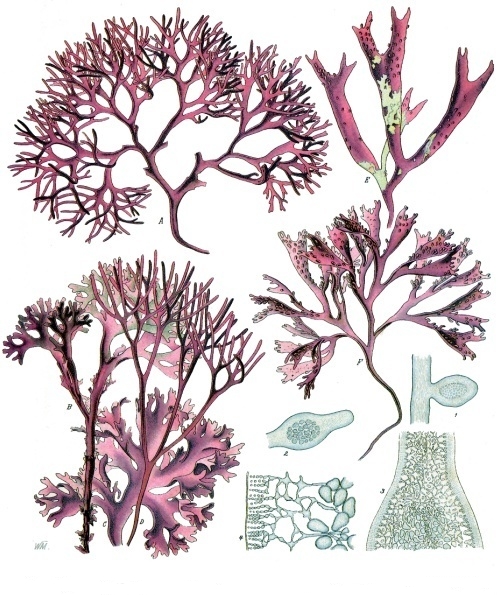
Irish moss (Chondrus crispus) is a marine red alga native to rocky shorelines throughout the cold-temperate North Atlantic Ocean. It is the botanical origin of carrageenan, a gelling polysaccharide that constitutes up to 55% of its dried weight.
Submerged fronds exhibit a distinct blue iridescence under direct sunlight, while harvested batches bleach naturally to pale yellow when dried. Simmering the cleaned fronds in liquid releases gelling agents that firm up puddings, stocks, and craft beer without animal gelatin.
Key Facts
- Habitat: Lower intertidal and shallow subtidal rocky ocean shores
- Native range: Cold Atlantic coasts of Europe and North America
- Key compound: Carrageenan polysaccharide, 55% of dry weight
- Gelling capacity: Binds 20 to 100 times its dry weight in water
- Harvest window: Late spring through autumn during extreme low tides
Encountering Irish Moss in the Wild
Irish moss grows attached to bedrock and stable boulders in the lower intertidal to shallow subtidal zones, revealed only during the lowest spring tides. You encounter it along exposed and moderately sheltered ocean coastlines, forming dense, slippery turf across wave-washed rocks.
Unlike free-floating sargassum or shore drift, healthy colonies are anchored firmly to the stone by disc-shaped holdfasts. The alga endures heavy wave action that would detach larger brown kelps.
How to Identify Irish Moss
Irish moss forms a bushy, fan-like clump measuring 10 to 20 cm (4 to 8 in) in length with flattened fronds that divide dichotomously into narrow lobes. The texture in fresh condition is cartilaginous, pliable, and rubbery rather than slimy.
Key botanical identification markers include:
- Frond morphology: Flattened, smooth branches measuring 2-15 mm (0.1-0.6 in) wide, dividing four or five times in two-pronged forks.
- Living colour: Deep purplish-red to reddish-brown in shaded tide pools, shifting to yellow-green in sun-exposed surface pools.
- Optical iridescence: Structural blue-violet sheen visible on tips underwater in daylight.
- Holdfast: Small, solid discoid base firmly cemented to stone, lacking aerial root-like runners.
Where Irish Moss Grows
Irish moss thrives across temperate Atlantic shorelines from Iceland and northern Russia south to the Iberian Peninsula, as well as from Newfoundland down to New Jersey. It occurs from the low-water mark down to depths of 24 m (79 ft) in clear oceanic waters.
Cold marine temperatures below 18 °C (64 °F) support the fastest growth rates. Large natural concentrations anchor to granitic and basaltic ledges along the western coast of Ireland, the Brittany coast of France, and the maritime provinces of Canada.
Ecological Role on Rocky Reefs
Dense mats of Irish moss form perennial understory canopies that reduce temperature and moisture loss on rocky platforms during low tide. These algae banks protect fragile marine organisms from desiccating wind and direct sun exposure.
The fronds provide microhabitats and grazing grounds for juvenile marine species:
- Common periwinkles (Littorina littorea) browse epiphytic diatoms on the frond surface.
- Amphipods and isopods shelter within the dense branching forks to avoid predatory fish.
- Blue mussels (Mytilus edulis) anchor their byssal threads around mature holdfast clusters.
What Is Carrageenan and Is It Bad for You?
Food-grade carrageenan is a safe, non-digestible soluble polysaccharide extracted from red seaweeds to thicken dairy, plant milks, and processed foods. International food regulators, including the US FDA and EFSA, approve it as a dietary food additive.
Confusion around health risks stems from distinct chemical forms:
- Food-grade carrageenan: High-molecular-weight carbohydrate that passes intact through the human digestive tract without degrading into bloodstream-absorbed fragments.
- Poligeenan (degraded carrageenan): Low-molecular-weight chemical used exclusively in medical laboratories to trigger acute inflammation in animal models; never permitted in food.
- Toothpaste and cosmetics: Acts as an inert binder to retain moisture and prevent ingredient separation on store shelves.
- Alpha-gal allergy: Contains galactose-based carbohydrate structures; individuals diagnosed with the tick-borne mammalian meat carbohydrate allergy should consult an allergist before consuming carrageenan.
How to Harvest and Cook Carrageen Moss
Foragers gather Irish moss by cutting the upper fronds at least 3 cm (1.2 in) above the holdfast using shears, leaving the base anchored to generate new growth. Pulling the alga off the rock destroys the colony entirely.
Rinse fresh fronds in clean seawater to dislodge sand and small invertebrates, then dry them in direct sunlight for 7 to 14 days until they fade to a pale straw color. In traditional cooking, simmering 10 g (0.35 oz) of dried carrageen in 500 ml (1 pint) of warm whole milk for 20 minutes releases the polysaccharides; strain the solids out, sweeten with sugar, and chill to set a firm carrageen moss pudding. Papermakers also boil the seaweed into a viscous size bath for water marbling.
Environmental Status and Shoreline Protection
Populations of Irish moss remain abundant and classified as Least Concern, although local shores can become depleted through aggressive commercial raking. Mechanical rakes scrape holdfasts off the bedrock, requiring several seasons for bare rock to recolonize.
Hand-cutting fronds above the disc ensures full canopy recovery within 4 to 8 months. Climate-driven marine heatwaves in the southern Atlantic range have shifted optimal growth zones northward into colder subpolar waters.
Similar Seaweeds and How to Tell Them Apart
Irish moss is most commonly confused with false Irish moss (Mastocarpus stellatus), which frequently shares the exact same lower intertidal rock ledges.
Compare these species to confirm identification:
- False Irish moss (Mastocarpus stellatus) – has channeled, rolled leaf edges rather than flat fronds, and bears distinct raised bumps (papillae) across female blades.
- Dulse (Palmaria palmata) – displays broad, paper-thin, deep crimson blades up to 40 cm (16 in) long with no thick cartilaginous branching.
- Gutweed (Ulva intestinalis) – bright emerald-green, hollow tubular alga common in high tide pools with low salinity runoff.
Frequently Asked Questions
What is carrageenan and what does it do in food?
Carrageenan is a naturally occurring soluble polysaccharide extracted from red algae like Irish moss. In food production, it acts as a thickening, stabilizing, and gelling agent that keeps ingredients suspended in plant milks, cottage cheese, and ice cream.
Is carrageenan bad for human health?
Food-grade carrageenan is recognized as safe by global food safety authorities when consumed in normal dietary amounts. Research showing digestive tract inflammation used poligeenan, an artificially degraded low-molecular-weight compound that is not permitted in human food products.
Can people with alpha-gal syndrome eat carrageenan?
People with alpha-gal syndrome should proceed with caution because carrageenan molecules contain galactose-alpha-1,3-galactose bonds. While some individuals tolerate it without symptoms, clinical reports indicate carrageenan can trigger allergic reactions in sensitive alpha-gal patients.
Why is carrageenan included in commercial toothpaste?
Carrageenan serves as a natural binder and viscosity regulator in toothpaste. It prevents the paste from separating into liquid and solid phases in the tube and gives the product a smooth, uniform texture on the toothbrush.
How do you make traditional carrageen moss pudding?
Simmer 10 g (0.35 oz) of dried, rinsed Irish moss in 500 ml (1 pint) of whole milk with lemon peel for 20 minutes on low heat. Strain out the fronds, whisk an egg yolk and sugar into the warm liquid, fold in whipped egg whites, and refrigerate for two hours until firmly set.
Information about traditional or historical uses is provided for educational interest only and is not medical advice. Do not use any plant to treat a condition without speaking to a qualified professional.
Sources & Verification
Taxonomy and distribution are checked against the databases below. Care guidance is written for cultivated species only and reviewed by our editor. How We Build Plant Profiles →