
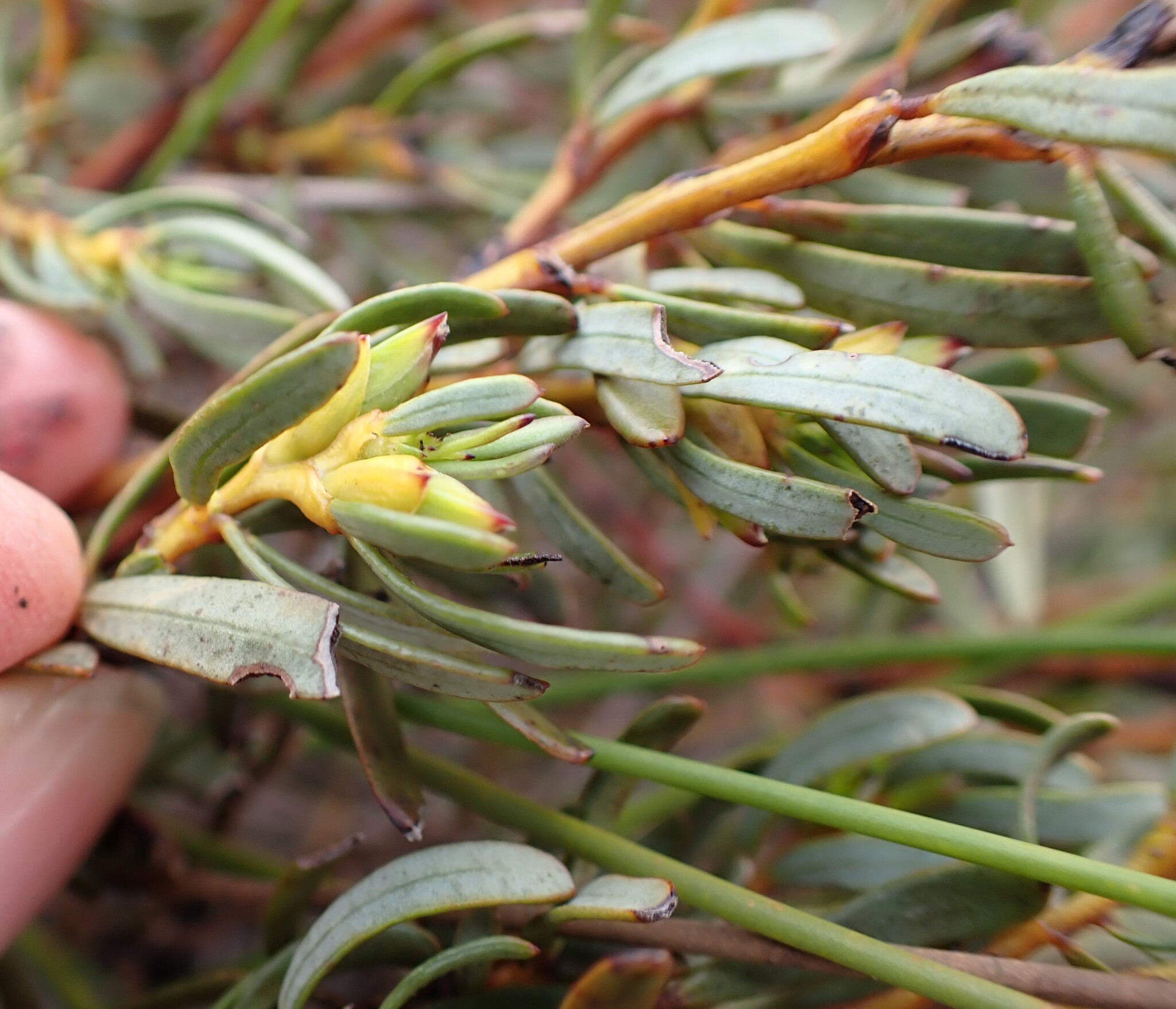
Mountain Honeybush (Cyclopia intermedia) is a woody evergreen shrub endemic to the mountain slopes of the Western and Eastern Cape in South Africa. Its sweet yellow flowers and trifoliate leaves yield the traditional caffeine-free honeybush tea.
Wild plants regenerate after veld fires from a thick underground rootstock, but over-harvesting has placed wild stands under conservation pressure. Seeds require heat scarification to break dormancy before germination will occur.
Key Facts
- Plant type: Perennial fynbos shrub
- Native range: Western and Eastern Cape, South Africa
- Height: 1 m (3.3 ft) to 3 m (9.8 ft)
- Soil pH: Strongly acidic (pH 4.0 to 5.5)
- Conservation status: Vulnerable (VU) in the wild
Mountain Honeybush in the Fynbos Landscape
Mountain Honeybush is a perennial leguminous shrub adapted to the nutrient-poor, fire-prone slopes of South Africa’s fynbos biome. It grows as a multi-stemmed woody bush reaching 1 m (3.3 ft) to 3 m (9.8 ft) in height. Unlike cultivated annual crops, it forms a deep taproot and woody underground swelling that secures water from cracked sandstone bedrock.
The plant grows predominantly on cold, south-facing mountain slopes at altitudes between 300 m and 1,200 m (980–3,940 ft) above sea level. It forms part of the mountain fynbos vegetation network, intermingling with proteas, heaths, and restios.
- Habit: Dense, erect woody shrub
- Mature height: 1 m (3.3 ft) to 3 m (9.8 ft)
- Root system: Deep taproot with nitrogen-fixing nodules
- Ecological niche: Montane sandstone slopes
How to Identify Cyclopia intermedia
You can identify Cyclopia intermedia by its trifoliate leaves with narrow, leather-like leaflets and sweet, honey-scented yellow flowers that bloom in early spring. The compound leaves consist of 3 leaflets measuring 10–25 mm (0.4–1.0 in) long and 2–4 mm (0.08–0.16 in) wide, arranged alternately along reddish-brown branches.
Bright yellow pea-like flowers, measuring 12–15 mm (0.47–0.59 in) long, open during September and October in the Southern Hemisphere. The fruit is a flat, oblong brown seed pod containing 3–6 hard seeds with a thick, water-impermeable seed coat.
- Leaf structure: Trifoliate with narrow, linear-lanceolate leaflets
- Flower color: Bright yellow with a honey aroma
- Bloom period: Spring (September to October)
- Fruit: Flattened legume carrying dark, hard-shelled seeds
Native Range and Mountain Habitat
Cyclopia intermedia is endemic to South Africa, restricted to the mountain ranges of the Western Cape and Eastern Cape provinces. Major wild populations occupy the Kouga, Tsitsikamma, Langeberg, and Outeniqua ranges. The species grows in soils derived from Table Mountain Sandstone, which are characteristically acidic with a pH between 4.0 and 5.5.
Annual precipitation across its native range ranges from 600 mm to 1,200 mm (24–47 in), distributed throughout the year with winter peaks. Temperatures in this montane environment vary from winter lows of 4 °C (39 °F) to summer highs near 30 °C (86 °F).
- Distribution: Western and Eastern Cape, South Africa
- Elevation: 300 m to 1,200 m (980–3,940 ft)
- Soil chemistry: Strongly acidic, low in phosphorus and nitrogen
- Climate: Cool, misty montane conditions with moderate rainfall
Ecological Role and Fire Adaptations
Mountain Honeybush survives natural fynbos wildfires by resprouting from a thick subterranean rootstock known as a lignotuber. Wildfires occur naturally in fynbos ecosystems every 10 to 15 years. While re-seeder shrubs die in fires, Mountain Honeybush retains dormant buds under the soil surface that push up fresh stems within weeks after a burn.
The yellow flowers attract native carpenter bees (Xylocopa species) and Cape honeybees (Apis mellifera capensis), which act as primary pollinators. The heavy seeds fall near the parent plant and are buried by ants (myrmecochory), protecting them from seed predators until the next fire triggers germination.
- Fire response: Obligate resprouter from a woody rootstock
- Primary pollinators: Carpenter bees and Cape honeybees
- Dispersal mechanism: Ant-mediated seed transport and burial
- Symbiosis: Symbiotic Rhizobium root nodules fix atmospheric nitrogen
Conservation Status and Wild Harvest Practices
Wild populations of Cyclopia intermedia are classified as Vulnerable (VU) on the Red List of South African Plants due to over-harvesting and habitat loss. Historically, over 80% of commercial honeybush tea was harvested directly from wild mountain stands. Repeated cutting before plants reach reproductive maturity weakens the lignotuber and reduces natural seed set.
Sustainable harvesting protocols require a 2-year to 3-year rotational cycle, leaving at least 30% of the foliage intact during harvest. Invasive alien trees such as black wattle (Acacia mearnsii) also threaten wild stands by crowding out native fynbos vegetation and altering soil nitrogen balances.
- Conservation status: Vulnerable (VU)
- Primary threats: Unsustainable wild harvesting, invasive alien plants
- Harvest interval: 24 to 36 months between prunings
- Management goal: Establishing cultivated plantations to reduce wild pressure
Honeybush Tea Preparation and Traditional Uses
Traditionally harvested by the indigenous Khoisan people, honeybush tea is produced by shredding and fermenting the leaves and stems of Cyclopia intermedia. Stems are cut during late summer and autumn when compound concentrations are highest. The chopped material is moistened and fermented in curing heaps or ovens at 60 °C to 70 °C (140–158 °F) for 24 to 36 hours until it develops a sweet, reddish-brown color.
Mountain Honeybush leaf extract contains high levels of phenolic compounds, notably mangiferin, hesperidin, and isoswertisin. The finished tea is naturally caffeine-free and low in tannins compared to black tea (Camellia sinensis).
- Fermentation temperature: 60 °C to 70 °C (140–158 °F)
- Fermentation time: 24 to 36 hours
- Key compounds: Mangiferin, hesperidin, pinitol
- Infusion traits: Naturally caffeine-free, low tannin content
Similar Honeybush Species
Cyclopia intermedia is distinguished from related species by its resprouting habit, medium leaflet size, and specific mountain range distribution. Coastal honeybush (Cyclopia subternata) grows taller up to 3.5 m (11.5 ft), has wider leaflets, and acts as a re-seeder that dies completely after wildfires.
Needle honeybush (Cyclopia genistoides) possesses very narrow, needle-like leaflets under 1.5 mm (0.06 in) wide and grows in coastal lowland sands. Marsh honeybush (Cyclopia sessiliflora) is restricted to wet seepages with stem-clasping leaves, while Heidelberg honeybush (Cyclopia maculata) occurs in western ranges with broader, flat leaflets.
- Cyclopia subternata (Coastal Honeybush): Re-seeder shrub with longer, broader leaves
- Cyclopia genistoides (Needle Honeybush): Needle-like leaflets, coastal sand plain habitat
- Cyclopia sessiliflora (Marsh Honeybush): Sessile leaves in permanently moist soils
- Cyclopia maculata (Heidelberg Honeybush): Broader leaflets on western mountain slopes
Frequently Asked Questions
What is Cyclopia intermedia?
Cyclopia intermedia, commonly known as Mountain Honeybush, is a wild leguminous shrub native to the fynbos mountain ranges of South Africa's Western and Eastern Cape. Its leaves and twigs are fermented to produce caffeine-free honeybush tea.
How do you germinate Cyclopia intermedia seeds?
Seeds of Cyclopia intermedia require heat scarification, such as soaking in hot water at 80 °C (176 °F) for 5 minutes, to break their hard, fire-adapted seed coats. Sowing should take place in well-draining acidic sand (pH 4.5–5.5) kept at 18–22 °C (64–72 °F).
What are the traditional benefits of Cyclopia intermedia leaf extract?
Mountain Honeybush leaf extract was traditionally consumed as a soothing herbal tea for upper respiratory coughs and mild digestive complaints. Modern chemical testing demonstrates that the extract contains antioxidant polyphenols such as mangiferin and hesperidin.
Is honeybush tea made from Cyclopia intermedia caffeine-free?
Yes, honeybush tea made from Cyclopia intermedia is naturally 100% caffeine-free. It also contains significantly lower tannin levels than black or green tea (Camellia sinensis), giving it a sweet flavor without astringency.
Where can you buy Cyclopia intermedia seeds or tea (kaufen)?
Seeds and dried herbal tea of Cyclopia intermedia can be purchased through specialized wild seed suppliers, botanical conservatories, and commercial tea importers. Buyers should ensure wild-harvested tea products carry sustainable wild-harvest certification to protect threatened wild populations.
Information about traditional or historical uses is provided for educational interest only and is not medical advice. Do not use any plant to treat a condition without speaking to a qualified professional.
Sources & Verification
Taxonomy and distribution are checked against the databases below. Care guidance is written for cultivated species only and reviewed by our editor. How We Build Plant Profiles →