
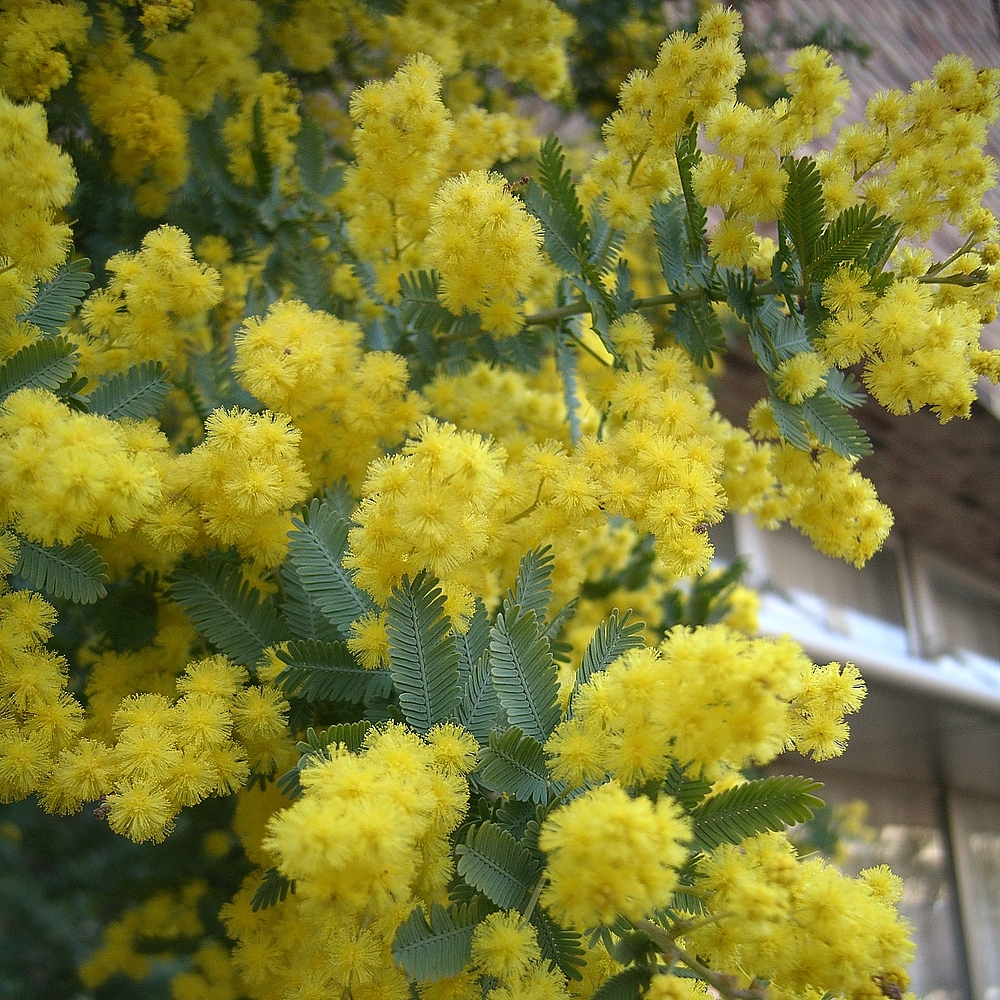
Black wattle (Acacia mearnsii) is a fast-growing, nitrogen-fixing evergreen tree native to southeastern Australia and Tasmania. It features feathery, bipinnate dark green leaves and pale yellow spherical flower heads that bloom in late spring.
While cultivated globally for wood fuel and high-tannin bark, black wattle spreads rapidly via root suckers and seed reserves, requiring active management outside its native habitat. Plant it only where root spread and self-seeding can be controlled.
Key Facts
- Height: 6 to 15 m (20 to 50 ft)
- Light: Full sun with at least 6 hours daily
- Soil: Well-drained acidic to neutral soil
- Hardiness: USDA zones 9 to 11
- Bloom time: Late spring to early summer
Fitting Black Wattle into the Landscape
Black wattle thrives in large landscapes receiving full sun exposure and deep, free-draining soil.
This species functions as a quick-growing shelterbelt or windbreak on rural properties. Symbiotic root nodule bacteria allow it to fix atmospheric nitrogen, improving soil conditions in disturbed locations.
- Nitrogen fixation: converts atmospheric nitrogen via root nodule bacteria
- Windbreak capability: forms a dense canopy canopy reaching 10 m (33 ft) wide
- Wildfire risk: resinous wood and dry leaf litter increase wildfire fuel loads
Leaf Botany and Australian Acacia Identification
Australian acacia species identification relies on observing that Acacia mearnsii retains true bipinnate leaves throughout its lifespan rather than developing broad, flattened leaf stems called phyllodes.
In many related wattles, such as golden wattle (Acacia pycnantha) or Cootamundra wattle (Acacia baileyana), mature leaves drop and are replaced by flattened petioles known as phyllodes (which are modified petioles, not stem-derived phylloclades). Black wattle keeps dark green bipinnate fronds with 8-25 pairs of pinnae, each holding 30-70 pairs of tiny leaflets 1.5-4 mm (0.06-0.16 in) long.
Spherical flower heads measure 5-8 mm (0.2-0.3 in) across and contain 20-40 pale yellow to cream blossoms. Bark turns dark brown to black and develops deep vertical ridges as the tree reaches maturity.
- Leaf structure: persistent bipinnate foliage with small glands along the primary ridge
- Petiole status: petiole functions as a normal leaf stalk, not a widened phyllode
- Flower heads: fragrant pale yellow globose clusters arranged in axillary racemes
- Bark texture: smooth brownish-grey bark turning dark and ridged on mature trunks
Height and Growth Rate of Black Wattle
Black wattle grows at a rapid rate of 1.5 to 2.5 m (5 to 8 ft) per year under favorable growing conditions.
Mature specimens reach heights of 6 to 15 m (20 to 50 ft) with a spreading crown up to 10 m (33 ft) wide. Young saplings establish deep taproots during their first 12 months, allowing them to compete with surrounding vegetation.
Tree longevity is relatively short, usually lasting 15 to 25 years before natural senescence begins.
- Height range: 6 to 15 m (20 to 50 ft) at maturity
- Annual growth: 1.5 to 2.5 m (5 to 8 ft) per year during early growth
- Trunk diameter: 10 to 35 cm (4 to 14 in) near the base
Site Selection and Soil Requirements
Select a planting site receiving at least 6 full hours of direct sunlight daily.
The tree prefers acidic to neutral soils with a pH between 5.0 and 7.0. Soil must drain freely, as standing water leads to root rot within 14 days.
Avoid planting near building foundations, septic lines, or paved walkways because lateral root suckers spread up to 8 m (26 ft) from the main trunk.
- Light requirement: full sun (6-8 hours direct light)
- Soil pH range: 5.0 to 7.0 (tolerates mild acidity)
- Soil texture: loamy, sandy, or gravelly soils with free drainage
- Proximity margin: keep 10 m (33 ft) away from underground utilities and walls
How to Plant the Australian Wattle Plant
Plant young wattle saplings in early spring after the final frost when soil temperatures reach 15 °C (59 °F).
Dig a hole twice as wide as the root container and equal in depth. Seeds require hot water scarification at 80 °C (176 °F) for 15 minutes before sowing to break hard seed coat dormancy.
Backfill with excavated native soil without adding synthetic fertilizers, as excess nitrogen hinders natural root nodule development. Apply a 5 to 7 cm (2 to 3 in) layer of wood chip mulch around the base, keeping mulch 10 cm (4 in) clear of the bark.
- Planting season: early spring or early autumn in frost-free regions
- Seed treatment: soak hard seeds in hot water at 80 °C (176 °F) for 15 minutes
- Hole size: 2 times wider than container root ball width
- Mulch depth: apply 5 to 7 cm (2 to 3 in) organic mulch around root zone
Watering and Fertilization Needs
Provide newly planted saplings with 15 to 20 liters (4 to 5 gallons) of water weekly during their first growing season.
Once established after 12 to 18 months, black wattle demonstrates strong drought tolerance and requires supplemental water only when dry spells exceed 4 weeks. Overwatering encourages fungal pathogens such as Phytophthora root rot.
Avoid applying high-nitrogen fertilizers. If grown in nutrient-depleted soil, apply a low-phosphorus fertilizer once in early spring.
- Initial watering: 15 to 20 L (4 to 5 gal) weekly during the first 12 months
- Established watering: deep soak every 3 to 4 weeks during severe drought
- Fertilizer choice: low-phosphorus blend only if soil tests show deficiency
Pruning and Canopy Management
Prune black wattle during late summer immediately after flowering ends to shape the canopy and clear dead branches.
Remove root suckers emerging near the base of the trunk every 8 to 12 weeks to maintain a single central trunk. Thin crowded inner branches to improve airflow and reduce fungal leaf rust.
Never remove more than 25 percent of the active foliage canopy during a single pruning session.
- Pruning timing: late summer after pale yellow blooms finish
- Sucker control: cut root sprouts at ground level every 8 to 12 weeks
- Canopy limit: remove maximum 25% of living canopy per year
Pests, Diseases, and Invasive Control
Inspect trees regularly for wattle bagworms, wood-boring beetles, and gummosis infection on main branches.
Gummosis causes amber sap to ooze from bark cracks, often triggered by mechanical injury or fungal disease. Outside native Australian habitats—such as in South Africa, Southern Europe, and California—black wattle is an aggressive invasive weed that forms dense thickets and consumes ground water reserves.
Control volunteer seedlings by hand-pulling root systems when soil is moist or treating cut stumps with suitable herbicides.
- Bagworm control: manually pick silken bags or apply biological bacterial sprays
- Wood borers: prune infested dead limbs promptly to prevent trunk damage
- Gummosis prevention: avoid trunk mechanical wounds to stop pathogen entry
- Seedling management: pull wild saplings before taproots exceed 30 cm (12 in) depth
Cold Hardiness and Winter Care
Established trees endure short winter frosts down to -7 °C (19 °F) in USDA zones 9 through 11.
Young saplings under 2 years old suffer foliage damage when temperatures drop below -3 °C (27 °F). Protect young trunks with burlap wraps when unexpected hard freezes occur.
In areas prone to heavy wet snow, gently shake accumulated snow from lower branches to prevent limb breakage.
- Hardiness zone: USDA zones 9a to 11b (-7 to 10 °C / 19 to 50 °F)
- Young tree frost threshold: protect saplings when temperature drops below -3 °C (27 °F)
- Winter irrigation: reduce watering in late autumn to help wood harden
Traditional and Commercial Uses
Black wattle bark contains 30 to 40 percent condensed tannins, making it a valuable source of commercial vegetable tanning extracts.
In traditional Indigenous Australian practices, bark decoctions were applied topically for skin ailments or used as astringent rinses. The heavy wood, weighing approximately 750 kg/m³, is harvested for firewood, charcoal production, and paper pulp.
Bee keepers utilize the spring flower blooms as a pollen source, producing light amber honey.
- Tannin extraction: bark yields concentrated vegetable tannins for leather processing
- Wood density: 750 kg/m³ density suitable for high-heat firewood and charcoal
- Forage value: yellow flowers supply early spring pollen for honeybee hives
Frequently Asked Questions
Is Australian acacia leaf modified into a phyllode?
In black wattle, the leaf is not modified into a phyllode; it retains true bipinnate fronds throughout its lifetime. Many other species, such as golden wattle (Acacia pycnantha) and silver wattle (Acacia dealbata), develop flattened petioles called phyllodes, but Acacia mearnsii keeps finely divided leaflets.
What is the scientific name for black wattle?
The scientific name for black wattle is Acacia mearnsii. The term Australian acacia refers broadly to native Australian species in the genus Acacia.
What is the Australian acacia crossword clue answer?
The answer to the Australian acacia tree crossword clue is usually WATTLE or ACACIA, depending on letter count. Black wattle is one specific Australian tree species within this group.
Is Australian acacia toxic to pets and livestock?
Black wattle foliage, raw seeds, and bark contain astringent tannins and antinutrients that cause stomach upset in dogs, cats, and livestock if consumed in quantity. Keep domestic animals away from fallen seed pods and stripped bark.
How do you pronounce Australian acacia?
Australian acacia is pronounced 'uh-STRAY-lee-un uh-KAY-shuh'. The botanical genus name Acacia derives from the Greek word 'akakia', referring to thorny trees.
Is Australian acacia a phylloclade?
Australian acacia leaf structures are not phylloclades, because phylloclades are modified photosynthetic stems. In wattle species that lack true mature leaves, the expanded structure is a modified petiole called a phyllode, though black wattle retains true bipinnate leaves rather than phyllodes.
Information about traditional or historical uses is provided for educational interest only and is not medical advice. Do not use any plant to treat a condition without speaking to a qualified professional.
Sources & Verification
Taxonomy and distribution are checked against the databases below. Care guidance is written for cultivated species only and reviewed by our editor. How We Build Plant Profiles →
More in Acacia

Earleaf Acacia
Acacia auriculiformis
☀️ Full Sun 💧 Low

Australian Blackwood
Acacia melanoxylon
☀️ Full Sun 💧 Moderate
Cootamundra Wattle
Acacia baileyana
☀️ Full Sun 💧 Low

Silver Wattle
Acacia dealbata
☀️ Full Sun 💧 Moderate

Shoestring Acacia
Acacia stenophylla
☀️ Full Sun 💧 Low

Golden Wattle
Acacia pycnantha
☀️ Full Sun 💧 Low