
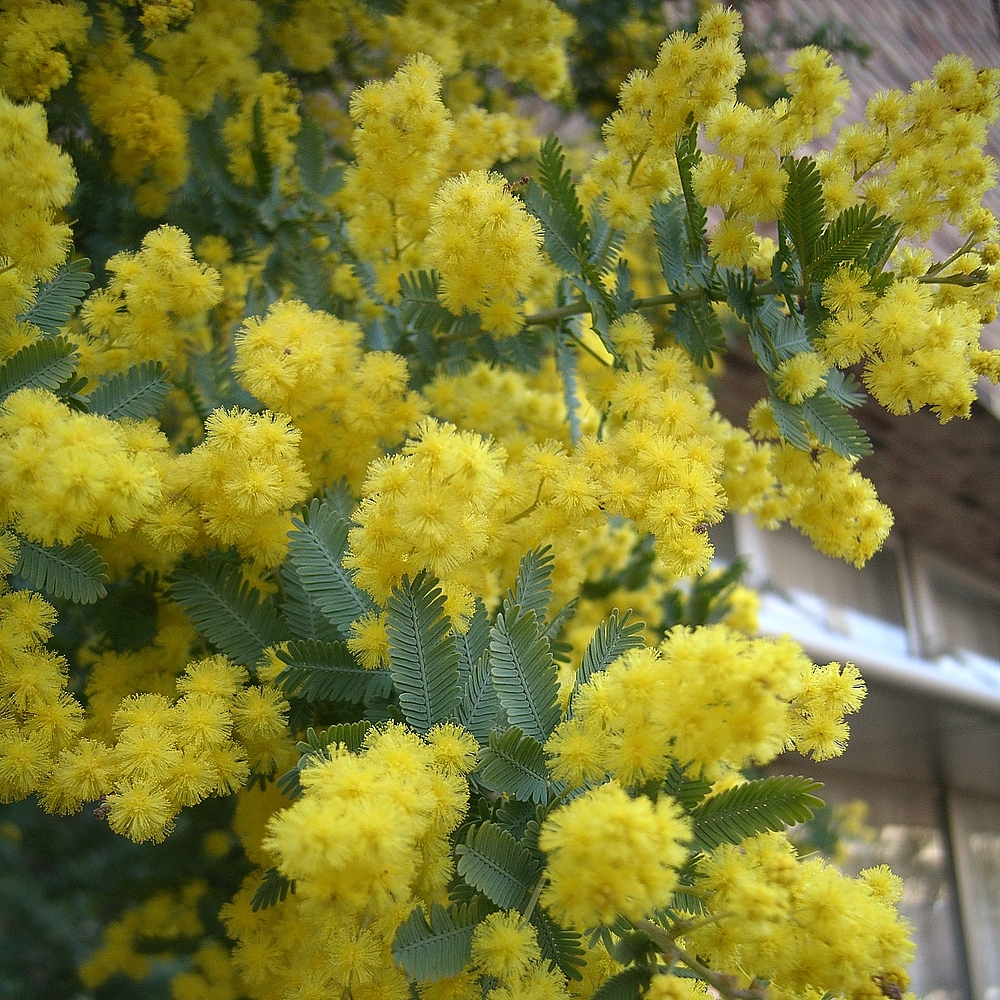
Cootamundra wattle is a fast-growing evergreen tree native to a small region of New South Wales. Acacia baileyana is recognized by its silvery-blue fern-like leaves and bright yellow, spherical flower clusters that appear in late winter.
This species reaches maturity within a few years but typically lives for only 10 to 20 years. It is often used for quick screening or as a winter focal point in temperate gardens where frost is minimal.
Key Facts
- Growth Rate: fast, often 1 m (3.3 ft) per year
- Hardiness: down to -7 °C (20 °F)
- Lifespan: short-lived, typically 10-20 years
- Soil: well-drained, acidic to neutral
- Flowering: late winter to early spring
Is Cootamundra Wattle Right for Your Garden
Cootamundra wattle is a fast-growing, short-lived tree that typically lasts 10 to 20 years in a garden setting. It is ideal for new gardens where you need a screen or a focal point within 2 to 3 years. Because it matures so quickly, it often starts to decline or become woody after its first decade.
You should choose this species if you want a winter-flowering tree that requires minimal maintenance once established. It is particularly suited to Mediterranean or temperate climates. It is not suitable for small courtyards where its wide spread and self-seeding habit might become a nuisance.
How to Identify Acacia baileyana
This species features silver-grey, bipinnate leaves with 2 to 4 pairs of pinnae. The foliage is evergreen and has a soft, fern-like texture that contrasts with the smooth, greyish-green bark. In late winter, the tree is covered in spherical, bright yellow flower heads about 5 mm (0.2 in) in diameter.
The fruit is a flat, leathery brown pod that can reach 100 mm (4 in) in length. These pods persist on the tree after the seeds have been released. Unlike the silver wattle (Acacia dealbata), which has 10 to 20 pairs of pinnae, the Cootamundra wattle has much shorter leaves with fewer divisions.
Mature Size and Growth Habits
A mature Cootamundra wattle usually reaches a height of 4 to 8 m (13 to 26 ft). The canopy spread is often wider than the height, sometimes reaching 10 m (33 ft) in older specimens. This wide-spreading habit makes it an effective shade provider for medium-sized gardens.
Growth is rapid, often exceeding 1 m (3.3 ft) per year in the first five years. Because of this speed, the wood can be somewhat brittle. It is important to site the tree away from structures where falling branches might cause damage during high winds.
Choosing the Best Planting Site
Select a position in full sun with well-draining soil to ensure healthy growth and maximum flower production. While it prefers acidic to neutral soils, it can tolerate slightly alkaline conditions if the drainage is sufficient. Avoid low-lying areas where water collects, as the roots are prone to rot in boggy ground.
The tree is moderately wind-tolerant but can suffer branch breakage in severe gales. In the northern hemisphere, planting against a south-facing wall can provide extra warmth. This protection helps the tree survive colder winters and encourages earlier blooming in January or February.
How to Plant Cootamundra Wattle
Plant your tree in autumn or early spring to allow the root system to establish before extreme temperatures arrive. This species has a sensitive root system and does not tolerate being moved once planted. Always select a permanent location from the start.
- Dig a hole twice as wide as the pot but no deeper.
- Place the tree in the hole without disturbing the root ball or teasing the roots.
- Backfill with native soil without adding heavy compost or manure.
- Stake the tree for the first year to protect it from wind-rock.
- Water thoroughly immediately after planting to settle the soil.
Watering and Feeding Requirements
Provide regular water for the first 12 months, after which the tree becomes highly drought-tolerant. Established trees rarely need additional watering in temperate climates unless there is an exceptional drought. Overwatering is a common cause of death, as it leads to root fungal diseases.
If you choose to fertilize, use a low-phosphorus formula specifically designed for Australian native plants in early spring. High-phosphorus fertilizers can be toxic to many Acacia species. Mulching with organic matter like wood chips helps retain moisture and suppress weeds around the base, but keep the mulch 10 cm (4 in) away from the trunk.
When and How to Prune
Prune the canopy by one-third immediately after the flowering season ends in late spring. Regular pruning prevents the tree from becoming top-heavy and encourages the growth of new, silver foliage. If left unpruned, the center of the tree will become sparse and woody over time.
- Remove spent flower racemes to prevent excessive seed set.
- Thin out crossing or rubbing branches to improve airflow.
- Reduce the height of overextended limbs to prevent wind damage.
- Clear out dead or diseased wood as soon as it is spotted.
- Do not prune back into old wood that has no leaves, as it may not regrow.
Common Pests and Diseases
The most common issue for this species is the Acacia longicorn beetle, which bores into the wood and weakens the structure. You may notice sawdust-like frass on the bark or at the base of the tree. Scale insects may also appear, which excrete honeydew and lead to the growth of black sooty mold on the leaves.
Check for these common symptoms:
- Sawdust-like frass or small holes in the trunk.
- Scale insects appearing as small, waxy bumps on stems.
- Black sooty mold covering the silver foliage.
- Dieback of individual branches or yellowing leaves.
- Root rot symptoms if the soil remains waterlogged for too long.
Winter Care and Hardiness
Cootamundra wattle can withstand temperatures down to -7 °C (20 °F) once it is established. Young saplings are more sensitive to frost and may need protection with a frost cloth during their first two winters. If the temperature drops significantly below its limit, the foliage will turn brown and drop.
In colder regions, the tree is often grown in large containers and moved to a cool, bright greenhouse for the winter. Ensure the container has excellent drainage and use a potting mix designed for Mediterranean plants. Winter is the primary season for flower development, so do not allow the plant to dry out completely during this time.
Landscape Uses and Benefits
This tree is primarily used as an ornamental focal point or a fast-growing privacy screen in large gardens. Its silvery foliage provides a distinct color contrast against darker green plants like common box (Buxus sempervirens) or Italian cypress (Cupressus sempervirens).
- Provides early-season pollen for honeybees and native pollinators.
- Offers nesting sites for small birds within its dense canopy.
- Material for the cut flower industry, especially for winter bouquets.
- Effective erosion control on sloping sites due to its vigorous roots.
- Fixes nitrogen in the soil, which can benefit neighboring plants.
Year-Round Care for Cootamundra Wattle
| Spring | Prune back by one-third immediately after flowers fade. Apply a low-phosphorus fertilizer to young trees if growth is slow. |
|---|---|
| Summer | Monitor for borer holes in the trunk. Provide deep watering once every 2 weeks for trees in their first year of growth. |
| Autumn | Apply a fresh layer of mulch 5-10 cm (2-4 in) thick around the base. Check for self-sown seedlings in unwanted areas. |
| Winter | Enjoy the peak flowering period. Protect young saplings with frost cloth if temperatures are forecast to drop below -5 °C (23 °F). |
Why Is My Acacia baileyana Dying? Quick Diagnosis
| What you see | Likely cause | What to do |
|---|---|---|
| Sawdust on bark | Longicorn beetle borers | Prune out affected branches and maintain tree health to deter further attacks. |
| Black film on leaves | Sooty mold from scale insects | Treat the underlying scale insect infestation with neem oil or horticultural soap. |
| Yellowing leaves | Poor drainage or root rot | Reduce watering and ensure the soil is not compacted or waterlogged. |
| Sudden branch death | Fungal infection or age | Remove the dead limb and check the trunk for signs of decay or borer exit holes. |
Popular Acacia baileyana Cultivars
- ‘Purpurea’ – features purple-tinged new growth that matures to silver
- ‘Prostrate’ – a low-growing form used as a groundcover
- ‘Rainbow’ – a variegated form with cream and yellow leaf margins
- ‘Rubra’ – intense reddish-purple new foliage in spring
Frequently Asked Questions
How long does Acacia baileyana live?
It is a short-lived tree, typically surviving for 10 to 20 years before it begins to decline.
Is Cootamundra wattle invasive?
Yes, it is considered invasive in parts of Western Australia, Victoria, and South Africa due to its prolific seed production.
Why is my Acacia baileyana turning purple?
New growth on the 'Purpurea' variety is naturally purple, though cold winter temperatures can also cause a temporary purple tint.
What is the difference between Cootamundra wattle and Silver wattle?
Cootamundra wattle has only 2-4 pairs of pinnae per leaf, whereas Silver wattle (Acacia dealbata) has 10-20 pairs.
Can you grow Acacia baileyana in a pot?
Yes, especially the 'Prostrate' variety, provided the container is large and has excellent drainage.
Sources & Verification
Taxonomy and distribution are checked against the databases below. Care guidance is written for cultivated species only and reviewed by our editor. How We Build Plant Profiles →
More in Acacia

Golden Wattle
Acacia pycnantha
☀️ Full Sun 💧 Low

Earleaf Acacia
Acacia auriculiformis
☀️ Full Sun 💧 Low

Australian Blackwood
Acacia melanoxylon
☀️ Full Sun 💧 Moderate

Shoestring Acacia
Acacia stenophylla
☀️ Full Sun 💧 Low
Black Wattle
Acacia mearnsii
☀️ Full Sun 💧 Low

Silver Wattle
Acacia dealbata
☀️ Full Sun 💧 Moderate