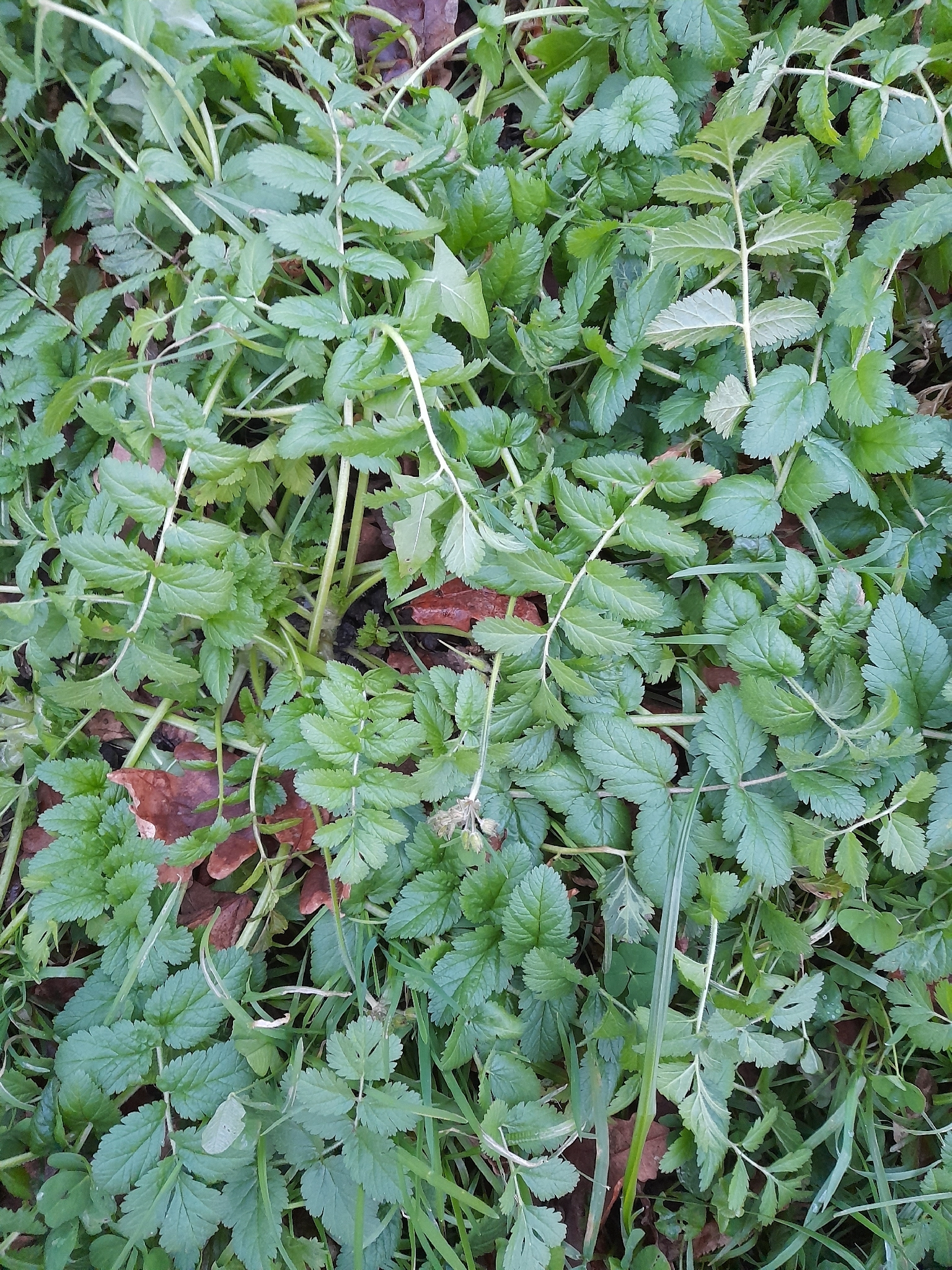
Common stork’s-bill (Erodium cicutarium) is a prostrate annual or biennial herb in the geranium family, native to temperate Eurasia, Macaronesia, and North Africa. It spreads across open ground with fern-like divided foliage and reddish, gland-tipped stems.
Outside its native range, the plant colonizes dry grasslands and disturbed ground rapidly, germinating within 48 hours after autumn rains. Its sharp, corkscrewing seed pods readily embed into passing livestock, dog fur, and cracked soil.
Key Facts
- Botanical name: Erodium cicutarium (L.) L’Hér.
- Native range: Temperate Eurasia and North Africa
- Life cycle: Winter annual or biennial
- Seed mechanism: Hygroscopic awn drills into soil
- Bloom period: February to September depending on rain
Encountering Redstem Filaree in Pastures and Open Land
Common stork’s-bill establishes fastest in open, sunny sites with bare or disturbed soil where dense perennial sod has not formed. The plant forms a low basal rosette hugging the earth before launching flowering stalks outward and upward. Ranchers, walkers, and field botanists encounter it carpeting semi-arid pastures, road verges, and gravel paths across spring months.
Its reddish stems give rise to the common name redstem filaree across western North America. In arid valleys, the plant avoids terminal drought by flowering and completing its lifecycle before summer heat exceeds 35 °C (95 °F).
How to Identify Erodium cicutarium
You can identify Erodium cicutarium by its finely divided, fern-like pinnate leaves paired with reddish, hairy stems. Unlike round-leaved wild geraniums, each rosette leaf is split into discrete, deeply lobed leaflets arranged along a central stalk. The entire plant is covered in fine, gland-tipped white hairs that release a faint, herbaceous scent when bruised.
Look for these distinct botanical structures when identifying specimens in the field:
- Basal leaves: 3 to 15 cm (1.2 to 6 in) long, pinnately divided with toothed segments.
- Flowers: Five pink to lilac petals measuring 5 to 10 mm (0.2 to 0.4 in), often bearing darker basal veins.
- Stamens: Five fertile stamens alternating with five sterile, scale-like staminodes.
- Stems: Sprawling or semi-erect, ranging from 5 to 50 cm (2 to 20 in) in length, distinctly flushed with red.
The Spiralling Stork’s-Bill Seed Pod
The developing seed capsule forms an erect, slender beak measuring 2 to 5 cm (0.8 to 2 in) in length, giving the plant its common names ‘stork’s-bill’ and ‘pinweed’. This structure is not a simple pod, but an elaborate mechanical delivery system composed of five one-seeded carpels attached to a central axis.
When the fruit matures and dries, tension forces each carpel to split away from the base while remaining attached to a long awn. The dispersal process follows a precise sequence:
- Separation: The five carpels detach explosively from the central column when fully dry.
- Coiling: The hygroscopic awn winds into a tight spiral spring as environmental moisture drops below 30% humidity.
- Self-drilling: Nightly dew or precipitation causes the spiral to uncoil, pushing the sharp seed point directly downward into soil crevices.
- Attachment: Backward-pointing hairs along the carpel lock the seed into dirt or animal coats, preventing backward movement.
Native Habitat and Global Range
The species is indigenous to temperate Eurasia, North Africa, and the Mediterranean Basin, where it occupies dry pastures, coastal dunes, and rocky screes. Introduced to the Americas by early Spanish expeditions in the eighteenth century, it rapidly naturalized across the Great Basin, the Sonoran Desert, and southern California grasslands.
Botanical databases like Calflora document extensive distributions across Mediterranean-climate zones worldwide, including South America, southern Africa, and Australia. The plant thrives in areas receiving between 150 and 800 mm (6 and 31 in) of annual rainfall, showing exceptional tolerance for lean, alkaline, or sandy substrates.
Ecological Role and Wildlife Interactions
Emerging winter rosettes provide an early nutritional forage source for desert tortoises, granivorous rodents, and kangaroo rats during arid late winters. Pocket mice and harvester ants actively collect the high-protein seeds, occasionally caching them in underground chambers that promote future germination.
Small solitary bees, hoverflies, and honey bees visit the blooms for nectar and pollen throughout cool spring days. While beneficial to select desert fauna, dense blankets of common stork’s-bill outcompete slower native ephemeral wildflowers for light, surface moisture, and shallow soil nitrogen.
Is Common Stork’s-Bill an Invasive Weed?
Agricultural authorities classify Erodium cicutarium as a widespread non-native naturalized weed across rangelands and grain fields. In grazing operations, it presents a mixed legacy: early spring foliage provides palatable livestock forage, but drying awns cause fleece contamination and animal discomfort.
Land managers focus suppression efforts on targeted interventions:
- Intense early grazing: Stocking cattle or sheep heavily while rosettes are leafy and tender, before flowering stalks develop.
- Hand roguing: Severing taproots at least 3 cm (1.2 in) beneath the soil surface prior to fruit development.
- Mowing: Timed strictly at early bloom to remove floral shoots before viable seeds set.
- Seed mitigation: Inspecting sheep fleeces and working dog coats to prevent movement of sharp awns between paddocks.
Traditional Medicinal Uses and Forage Benefits
Indigenous communities and historical European herbalists traditionally utilized Erodium cicutarium as a topical styptic and astringent wash. The aerial parts contain condensed tannins and gallic acid, which supported its historical application to minor surface bleeding and irritated tissues.
Foragers historically gathered young, tender rosette leaves in early spring to cook as potherbs or consume raw in wild salads before the fibrous flowering stems elongated. Pastoral systems in low-rainfall environments continue to utilize the vegetative flush as high-protein spring pasture, noting crude protein levels often exceed 15% in young leaves.
Similar Wild Geraniums and How to Tell Them Apart
Common stork’s-bill is distinguished from look-alike wild cranesbills by its fully pinnate leaves rather than palmately lobed foliage. When separating wild species in open ground, cross-reference these botanical relatives:
- Musky stork’s-bill (Erodium moschatum): broader, less-divided leaflets with coarse serrations and a distinct musky smell when crushed.
- Cut-leaved crane’s-bill (Geranium dissectum): palmately lobed leaves split into narrow segments, producing short-beaked fruits lacking spiral awns.
- Herb Robert (Geranium robertianum): reddish, fern-like leaves emitting a pungent, rubbery aroma with pink petals bearing white stripes.
- Dove’s-foot crane’s-bill (Geranium molle): circular, shallowly lobed leaves covered in soft, velvety hairs with notched pink petals.
Frequently Asked Questions
What is the common name of Erodium cicutarium?
Common stork's-bill, redstem filaree, pinweed, and alfileria are all widely used English common names for Erodium cicutarium. In western North America, 'redstem filaree' is the most frequent agricultural and botanical reference.
How does the Erodium cicutarium seed drill into the ground?
The seed features a hygroscopic awn that twists into a tight spiral as it dries and uncoils when rehydrated by dew or rain. This mechanical twisting action physically drives the pointed, barbed seed head downward into soil fissures.
What are the traditional medicinal uses of Erodium cicutarium?
Traditional herbal medicine used infusions of the aerial parts as an astringent and styptic to address minor bleeding and skin abrasions. The plant was valued historically for its high tannin content, though modern clinical validation is limited.
Is redstem filaree dangerous to dogs and livestock?
The foliage is non-toxic if consumed, but the dry seed awns present serious mechanical hazards. The rigid, needle-tipped seeds drill directly into paws, ears, eyes, and skin, often causing painful foreign-body abscesses in dogs and livestock.
Why is Erodium cicutarium listed on Calflora as invasive?
Calflora lists the plant as a naturalized invasive weed because it rapidly colonizes open arid land following winter precipitation, forming dense carpets that outcompete native desert ephemerals for moisture and space.
Information about traditional or historical uses is provided for educational interest only and is not medical advice. Do not use any plant to treat a condition without speaking to a qualified professional.
Sources & Verification
Taxonomy and distribution are checked against the databases below. Care guidance is written for cultivated species only and reviewed by our editor. How We Build Plant Profiles →