
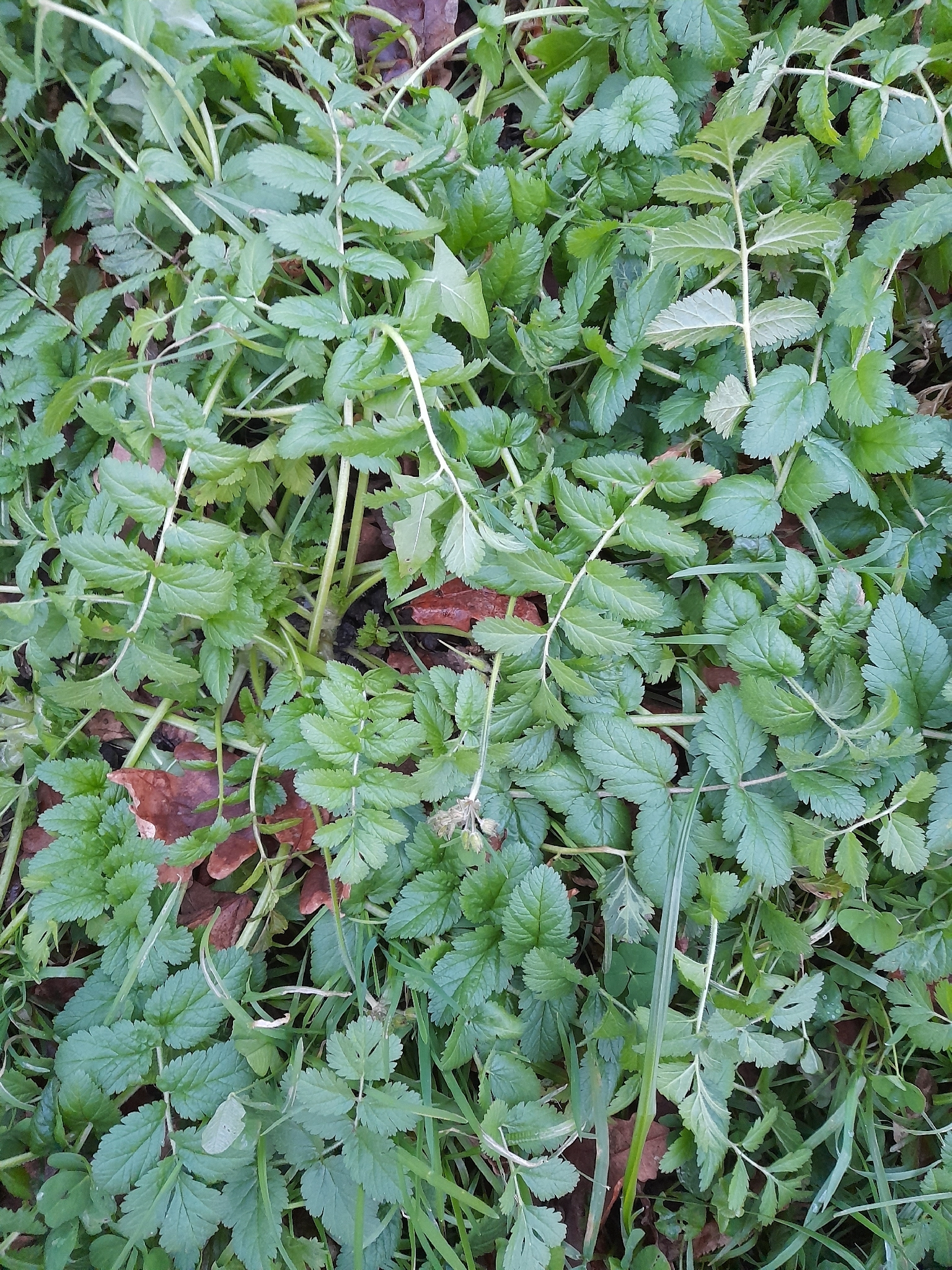
Musk heron’s bill (Erodium moschatum) is an annual or biennial wild herb native to the Mediterranean basin, North Africa, and Western Asia. It forms low rosettes of pinnate leaves and small pink to lavender five-petaled flowers.
This species colonizes pastures, lawns, and disturbed soils across North America, South America, and Australia. Its hygroscopic seed awns uncoil and twist to drill individual seeds directly into bare ground.
Key Facts
- Plant Type: Annual or biennial wild herb
- Family: Geraniaceae
- Native Range: Eurasia and North Africa
- Height: 10–60 cm (4–24 in)
- Bloom Season: Spring to early summer
- Dog Safety: Non-toxic foliage; sharp seeds cause mechanical injury
Where Musk Heron’s Bill Grows and Its Habit
Musk heron’s bill thrives in open, disturbed ground, agricultural pastures, orchards, and urban vacant lots. It grows as a cool-season winter annual in warm climates or a spring annual in cold regions, starting life as a flattened vegetative rosette.
As winter turns to spring, the plant elongates into spreading, branched stems that reach 10–60 cm (4–24 in) in height. It establishes dense ground cover in nitrogen-rich soil before flowering and setting seed before summer droughts.
How to Identify Musk Heron’s Bill
You can identify musk heron’s bill by its strong musky aroma, thick glandular stems, and rosettes of pinnate foliage. The leaves measure 5–20 cm (2–8 in) long and consist of 9–13 oval, coarsely toothed leaflets attached along a main central stalk.
Key diagnostic features include:
- Stems: Green to reddish, fleshy, covered in sticky white glandular hairs.
- Flowers: 5-petaled pink to violet-purple blossoms, 10–15 mm (0.4–0.6 in) across, arranged in clusters of 4–12.
- Fruit Beak: Slender, needle-like beak measuring 3–5 cm (1.2–2.0 in) long that splits into five pointed seed cases upon drying.
- Scent: Crushed leaves release a distinct musky odor absent in related wild geraniums.
Native Range and Global Distribution
Musk heron’s bill is native to the Mediterranean coast of Southern Europe, North Africa, and Western Asia. Through agricultural trade and livestock transport, it naturalized across South America, South Africa, Australia, and North America.
In California, botanical databases such as Calflora record Erodium moschatum across coastal ranges, valley grasslands, and desert margins up to 1,500 m (4,900 ft) elevation. It prefers full sun exposure and dry to moderately moist sandy loams.
How Musk Heron’s Bill Seeds Disperse
The seeds of musk heron’s bill use a spring-loaded, moisture-sensitive awn mechanism to self-bury into soil. When the fruit matures, it dries and splits into five single-seeded units called mericarps, each attached to a long, tail-like awn.
Changes in atmospheric humidity cause the awn to coil tightly into a spiral when dry and uncoil when wet. This twisting movement drives the pointed, barbed seed tail-first into soil crevices or animal fur, ensuring deep seed establishment without human intervention.
Weed Impact in Agriculture and Pastures
Musk heron’s bill functions as a persistent weed in sheep pasture, cereal crops, and residential turf. Early spring rosette growth smothers emerging forage seedlings and competes heavily for soil moisture.
While young vegetative growth provides moderate feed value for livestock, mature plant stems turn fibrous. The sharp seed awns tangle in sheep wool, lower fleece value, and can puncture animal skin or mucous membranes.
Edibility and Traditional Medicinal Uses
The young tender leaves of musk heron’s bill were traditionally harvested as wild edible greens prior to flower stem emergence. Historical foraging records document boiled rosettes used as pot-herbs or mixed into spring salads.
In historical European folk medicine, whole-plant decoctions were used for their astringent properties to manage minor external wounds and dysentery. Modern clinical efficacy data remains unproven, and foraging in areas treated with agricultural herbicides poses contamination risks.
Musk Heron’s Bill vs Similar Stork’s-Bills
Musk heron’s bill is distinguished from closely related species by its wide, oval leaflets and musky foliage scent. Several common members of the Geraniaceae family share overlapping habitats and beaked fruit structures:
- Redstem filaree (Erodium cicutarium): Leaves are finely dissected and fern-like (bipinnatifid); lacks a musky scent.
- Broadleaf filaree (Erodium botrys): Leaf lobes are shallower; fruit beaks are significantly longer at 7–12 cm (2.8–4.7 in).
- Sea stork’s-bill (Erodium maritimum): Leaves are small, oval, and unlobed; plant stems remain prostrate under 15 cm (6 in).
- Meadow crane’s-bill (Geranium pratense): Possesses palmately divided leaves rather than pinnate foliage, with seed pods that launch seeds rather than spiraling.
Frequently Asked Questions
Is Erodium moschatum edible?
Yes, young leaves gathered before flowering are edible raw or cooked as wild pot-herbs. Older leaves become tough and bitter.
Is Erodium moschatum dangerous for dogs?
The plant tissue is non-toxic to dogs, but the sharp, spiraling seed awns pose a mechanical hazard. The seeds can burrow into paws, ears, skin, and nostrils, causing painful skin infections.
What is the family and botanical authority for Erodium moschatum?
It belongs to the geranium family (Geraniaceae). The formal botanical citation is Erodium moschatum (L.) L'Hér., reflecting its original description by Carl Linnaeus and reclassification by Charles Louis L'Héritier de Brutelle.
What were the traditional medicinal benefits of Erodium moschatum?
In traditional herbalism, aerial parts were used as an astringent and wash for minor cuts, bleeding, and digestive distress. These uses are based on historical folk practice rather than modern medicine.
What is the common name of Erodium moschatum?
The primary English common names are musk heron's bill, musk stork's-bill, and whitestem filaree.
Information about traditional or historical uses is provided for educational interest only and is not medical advice. Do not use any plant to treat a condition without speaking to a qualified professional.
Sources & Verification
Taxonomy and distribution are checked against the databases below. Care guidance is written for cultivated species only and reviewed by our editor. How We Build Plant Profiles →