
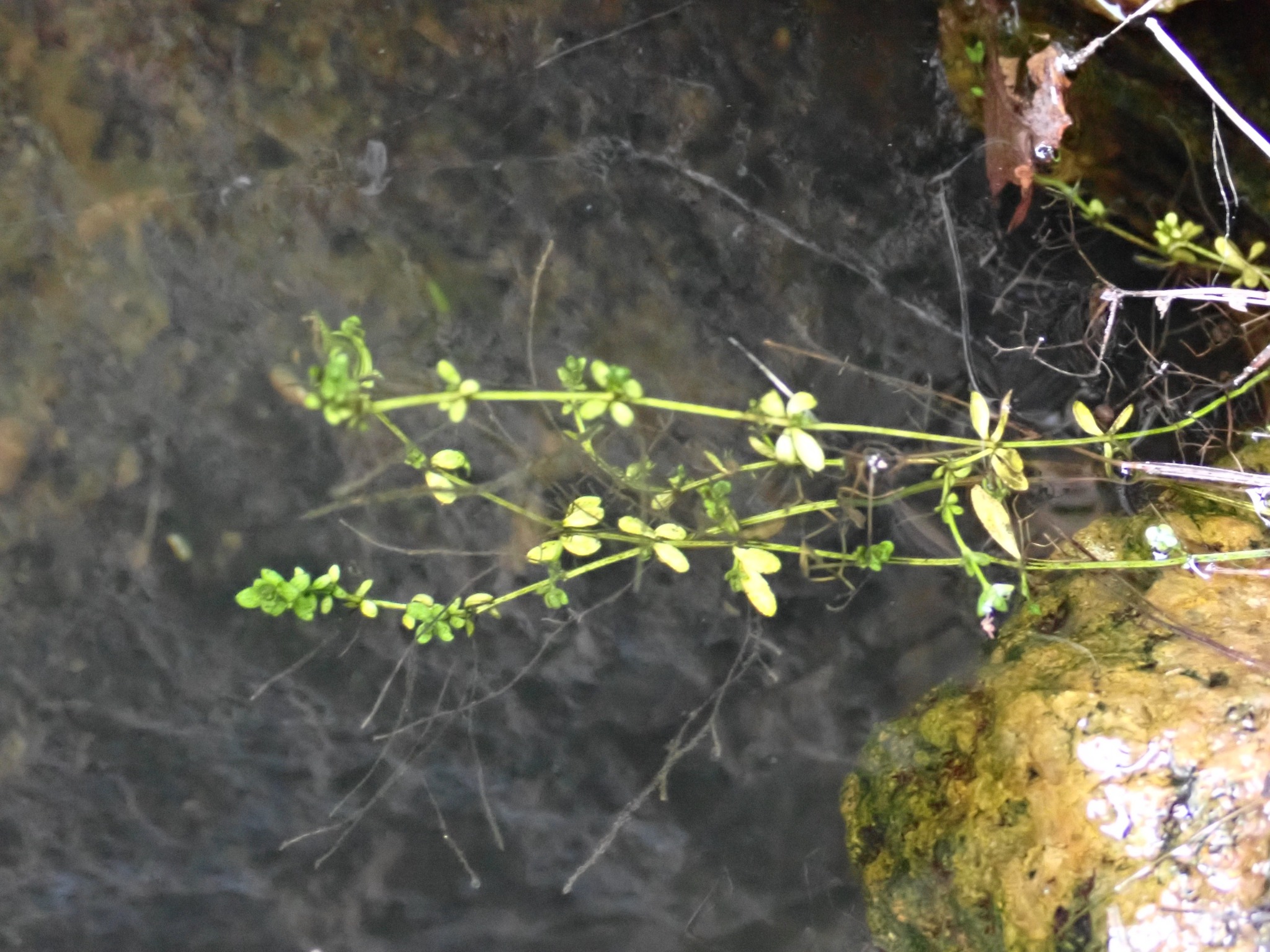
Common marsh-bedstraw, or Galium palustre, is a slender herbaceous plant found in wetlands across Europe, North Africa, and North America. It belongs to the coffee family (Rubiaceae) and is characterized by its whorled leaves and tiny white flowers.
This species thrives in saturated soils where other plants struggle. It often forms tangled mats in ditches and fens, using surrounding vegetation for support to reach the light.
Key Facts
- Water: High (wetland specialist)
- Light: Full sun to partial shade
- Flowers: Tiny, 4-petaled, white
- Leaves: Whorls of 4 to 6
- Stem: Smooth or slightly rough, not clingy
What Is It Like to Encounter Common Marsh-Bedstraw?
Common marsh-bedstraw is a low-profile wetland resident that you are most likely to encounter while walking near water or damp ditches. It is not a plant for those seeking a garden centerpiece, as its stems are weak and prone to collapsing into a tangled heap. If you find it on your property, it indicates a high water table or poor drainage that stays saturated year-round.
Because it lacks the hooked hairs of some of its relatives, it does not cling to your clothing when you brush past it. Instead, it forms soft, airy masses of foliage that blend into the surrounding grasses and sedges. It is a quiet presence in the landscape, easily overlooked until its white flowers appear in midsummer.
How to Identify Galium palustre
You can identify common marsh-bedstraw by its smooth, weak stems and whorls of 4 to 6 narrow leaves. The stems reach 20-60 cm (8-24 in) and are mostly glabrous, meaning they lack the hairs found on many other bedstraws. The leaves are linear-oblong, typically measuring 5-15 mm (0.2-0.6 in) in length and arranged in distinct circles around the stem nodes.
This species is part of the Galium palustre aggregate, a group of closely related plants that can be difficult to distinguish. One notable variety is Galium palustre subsp. elongatum, which is significantly larger and more robust than the standard form. The flowers are tiny, only 3 mm (0.1 in) wide, with four white petals that form a cross shape.
Where Does Marsh-Bedstraw Grow?
This species is found exclusively in permanently damp or flooded habitats such as marshes, fens, and riverbanks. It prefers neutral to slightly acidic soils with high organic matter. You will often find it growing alongside rushes (Juncus spp.) and sedges (Carex spp.) in areas that remain wet even during the height of summer.
It is highly tolerant of seasonal flooding and can survive with its roots submerged for extended periods. In North America, it is particularly common in the northeastern United States and eastern Canada. It avoids dry, sandy soils and is rarely found in upland meadows or forests.
Ecological Role and Insects
Common marsh-bedstraw provides essential nectar for small hoverflies and habitat for various wetland invertebrates. The tiny flowers are accessible to short-tongued insects that cannot reach nectar in deeper blooms. It also serves as a larval host for several specialized moth species that rely on the Rubiaceae family for survival.
The tangled mats of stems offer cover for amphibians and small fish in shallow water margins. Because it grows in damp areas, it is often found in the same environments where biting insects like mosquitoes and black flies breed. This association sometimes leads people to incorrectly link the plant itself to bug bites.
Is Common Marsh-Bedstraw Invasive or Protected?
Common marsh-bedstraw is considered a noxious weed in six US states, including New York, Pennsylvania, and Massachusetts. In these regions, it can aggressively outcompete native wetland flora by forming dense, suffocating mats that block light from reaching smaller species. It was likely introduced to these areas through contaminated seed mixes or ballast water.
Conversely, in its native European range, it is a stable and non-threatening component of healthy fen ecosystems. It is currently listed as “Least Concern” on the IUCN Red List due to its vast global distribution. In the UK and Europe, it is viewed as a beneficial native wildflower rather than a pest.
Traditional and Medicinal Uses of Marsh-Bedstraw
Historically, common marsh-bedstraw was used as a stuffing for mattresses and in folk remedies for skin conditions. The name “bedstraw” refers to the practice of using the dried, aromatic foliage to fill bedding, as the scent was thought to repel fleas. Traditionally, extracts were applied to minor cuts or used as a cooling wash for inflammatory skin issues.
In some cultures, the plant was used to curdle milk for cheese making, a property shared by several members of the Galium genus. There is no modern clinical evidence to support these medicinal uses, and the plant is rarely used in contemporary herbalism. It is not considered a primary edible herb, as the foliage is quite thin and lacks significant nutritional value.
Identifying the Fruit and Seeds
The fruit of common marsh-bedstraw consists of small, smooth nutlets that disperse primarily through water movement. Each fruit is about 1.5 mm (0.06 in) in diameter and turns from green to dark brown or black as it matures. Unlike other members of the genus, these seeds lack the hooks or hairs that would allow them to hitch a ride on animal fur.
Instead, the seeds are buoyant and can travel long distances along watercourses to colonize new marshy areas. This water-based dispersal method is highly effective in the flooded environments where the plant thrives. Seed production occurs in late summer, shortly after the flowering period ends.
Native Range and Distribution
This species is native to nearly every country in Europe and extends into parts of North Africa and Western Siberia. It is also native to eastern Canada and parts of the northern United States, from Maine to Minnesota. Its presence in Greenland highlights its significant tolerance for cold, temperate climates.
It has naturalized in several parts of the Southern Hemisphere, including Australia, New Zealand, and Argentina. In these regions, it often behaves more aggressively than in its native range. Its ability to adapt to various wetland types has allowed it to become a cosmopolitan species with a very high occurrence record globally.
Common Marsh-Bedstraw vs Similar Species
It is most often confused with fen bedstraw (Galium uliginosum), which has much rougher stems that feel like sandpaper. Unlike cleavers (Galium aparine), common marsh-bedstraw does not “stick” to clothing because it lacks hooked prickles. Lady’s bedstraw (Galium verum) is easily distinguished by its bright yellow flowers and much finer, needle-like leaves.
Hedge bedstraw (Galium album) grows in much drier sites and has larger, more robust flowers in dense clusters. Another relative, small bedstraw (Galium trifidum), typically has leaves in whorls of four and flowers with only three petals instead of four. Checking the number of petals and the texture of the stem is the most reliable way to tell them apart.
Frequently Asked Questions
Is common marsh-bedstraw edible?
Technically yes, but it is not considered a choice edible plant. The foliage is thin and lacks flavor, though some related species were historically used to curdle milk or as a coffee substitute.
Why is common marsh-bedstraw associated with bug bites?
The plant itself does not bite, but it grows in the damp, marshy habitats where mosquitoes and black flies are most active. People often notice the plant while being bitten by insects living in the same environment.
How can I tell the difference between Galium palustre and cleavers?
Common marsh-bedstraw has smooth stems and grows in wet areas, whereas cleavers (Galium aparine) has hooked hairs that stick to clothing and typically grows in drier, disturbed soils.
Is it toxic to dogs or cats?
No, common marsh-bedstraw is not known to be toxic to pets. However, it is always best to prevent animals from grazing on wild plants to avoid digestive upset.
Does common marsh-bedstraw have a scent?
It has a faint, hay-like scent when dried, which is why it was historically used as mattress stuffing. The fresh flowers have a very mild, sweet fragrance that attracts small pollinators.
Information about traditional or historical uses is provided for educational interest only and is not medical advice. Do not use any plant to treat a condition without speaking to a qualified professional.
Sources & Verification
Taxonomy and distribution are checked against the databases below. Care guidance is written for cultivated species only and reviewed by our editor. How We Build Plant Profiles →