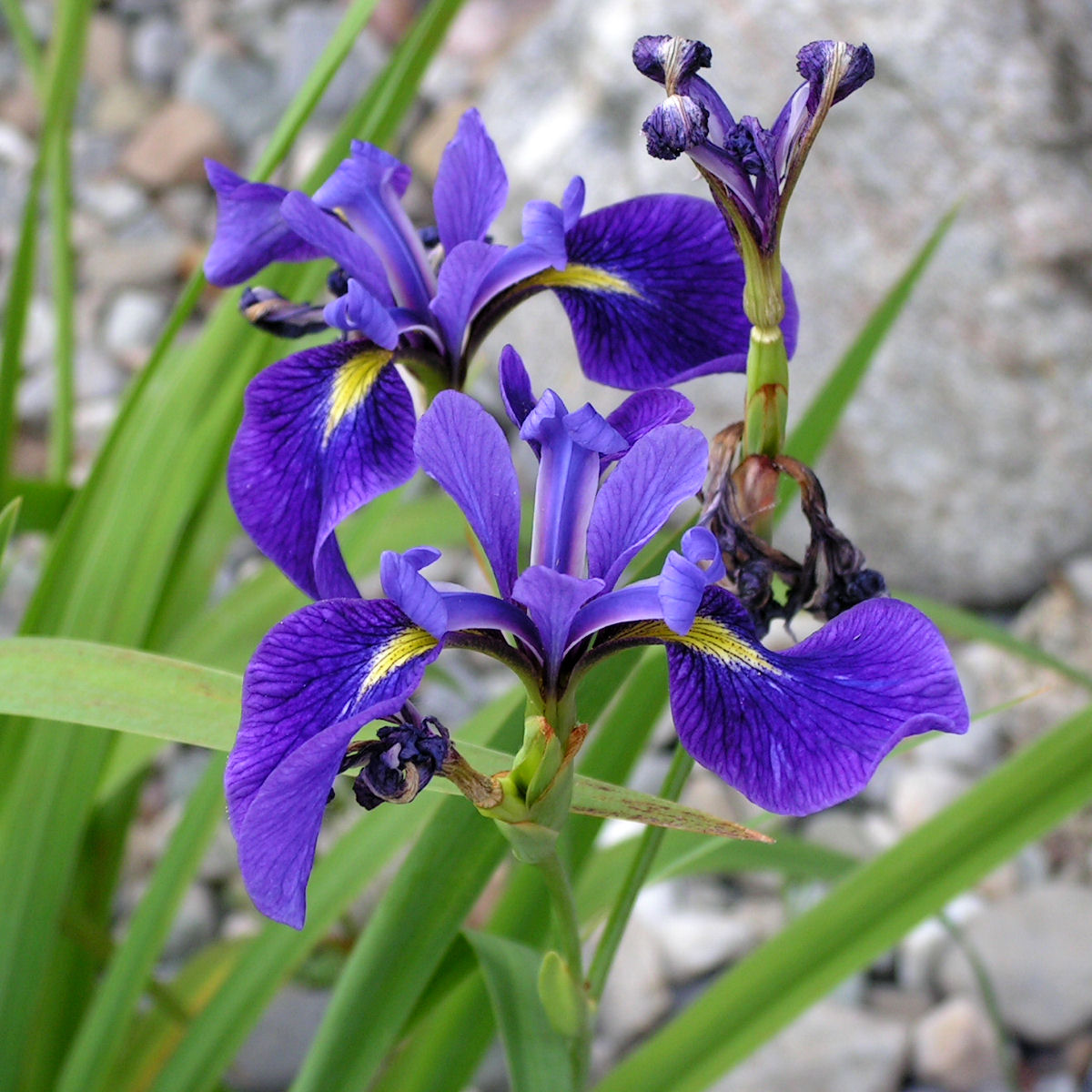
Leafless Iris (Iris aphylla) is a rhizomatous perennial native to Central and Eastern Europe, extending east into Russia and Azerbaijan. It reaches 15 to 30 cm (6 to 12 in) tall and produces deep purple, violet, or dark blue flowers in spring.
Unlike many bearded irises, this species loses its foliage entirely during winter dormancy, leaving rhizomes exposed until new shoots emerge in April. It thrives in USDA hardiness zones 4 through 8, making it suitable for temperate rock gardens and sunny borders.
Key Facts
- Light: Full sun (6+ hours daily)
- Water: Low to moderate
- Height: 15–30 cm (6–12 in)
- Bloom Time: May to June
- Hardiness: USDA Zones 4–8
- Foliage: Deciduous (dies back completely in winter)
Where Leafless Iris Fits in the Garden
Leafless iris thrives in sunny rock gardens, gravel beds, and front borders where soil drains rapidly. Its low growth habit of 15–30 cm (6–12 in) makes it suitable for edging walkways, planting on sunny slopes, or filling elevated stone beds.
This plant is ideal for cold-climate gardeners in USDA zones 4 through 8 who need drought-tolerant perennials. Because the leaves decay completely in November, position it near spring bulbs or low evergreen groundcovers to fill the winter gap.
- Garden Placement: Raised beds, rock gardens, gravel borders
- Container Growing: Shallow terracotta pots with coarse gritty soil
- Companion Style: Alpine planting schemes with exposed limestone rocks
Identifying Leafless Iris Leaves, Stems, and Flowers
Iris aphylla grows 15 to 30 cm (6 to 12 in) tall with dark purple flowers and foliage that drops completely in winter. In Poland, where it grows natively in dry grasslands, it is known as kosaciec bezlistny.
The sword-shaped leaves grow 10 to 25 cm (4 to 10 in) long and 1 to 2 cm (0.4 to 0.8 in) wide, forming dense fans in spring. Slender branched stems carry green and purplish spathes that enclose 3 to 5 blooms measuring 5 to 7 cm (2 to 2.8 in) across in shades of violet, deep blue, or bright purple.
The root system consists of creeping horizontal rhizomes 1.5 to 2.5 cm (0.6 to 1 in) thick that anchor into stony, calcareous ground.
Sun and Soil Conditions for Iris aphylla
Plant leafless iris in full sun with at least 6 hours of direct sunlight daily and well-draining soil. Shaded locations reduce flower production and make rhizomes vulnerable to fungal rot.
Soil must be lean to moderately fertile with a pH between 6.0 and 7.5. Heavy clay soil must be amended with sharp sand and fine gravel, or raised 15 cm (6 in) above ground level to ensure moisture drains freely away from the root crown.
- Sun Exposure: Full sun (6 to 8 hours)
- Soil Structure: Gritty, loamy, or limestone-rich soil
- Drainage Requirement: Excellent; never waterlogged in winter
How to Plant Leafless Iris Rhizomes
Set rhizomes shallowly into the soil with the top third of the root structure exposed to direct sunlight. Planting rhizomes too deep prevents flowering and causes tissue decay during rain spells.
Space individual plants 25 to 30 cm (10 to 12 in) apart to allow horizontal expansion over 3 to 4 years. Dig a shallow trench, construct a small mound of soil in the center, spread the fibrous roots over the ridge, and pack soil firmly around the sides.
- Planting Depth: Upper 33% of rhizome left exposed
- Spacing: 25–30 cm (10–12 in) between rhizomes
- Planting Window: Late July to September after flowering
- Initial Water: Soak thoroughly once at planting, then water sparingly
Watering and Fertilizer Schedule for Stool Iris
Water newly planted rhizomes weekly with 2.5 cm (1 in) of water until established, then rely on natural rainfall. Established plants are adapted to dry summers in Central Europe and require no supplemental water except during severe droughts exceeding 3 weeks.
Apply a single application of low-nitrogen fertilizer such as 5-10-10 at a rate of 30 g per square meter (1 oz per 10 sq ft) in early April as new leaves break ground. Avoid high-nitrogen fertilizers, which cause soft foliage growth and invite bacterial rot.
Pruning and Maintenance for Leafless Iris
Cut back spent flower stalks to 5 cm (2 in) above the rhizome after spring blooming completes in June. Removing seed pods preserves energy in the rhizome for next season’s foliage and potential autumn reblooming.
In autumn, leaves naturally turn brown, shrivel, and detach clean from the rhizome base. Pull away dead leaves in November to remove overwintering sites for pest eggs and fungal spores.
How to Divide and Propagate Iris aphylla
Divide overcrowded rhizome clumps every 3 to 4 years in late summer after flowering finishes. Division maintains plant vigor and prevents the center of the clump from dying out.
- Step 1: Lift the entire root clump using a garden fork in August.
- Step 2: Wash away excess soil to inspect the rhizome network.
- Step 3: Cut young, firm rhizomes with leaf fans using a clean knife; discard old, soft, or leafless center sections.
- Step 4: Trim foliage fans back to a 10 cm (4 in) fan shape to reduce water loss.
- Step 5: Replant division tops exposed to sun in fresh, well-drained soil.
Iris aphylla Pests and Disease Management
Prevent iris borer infestations and rhizome rot by providing full sunlight and keeping mulch away from rhizome tops. Excess shade and heavy organic mulches trap moisture that fosters fungal decay.
- Bacterial Soft Rot (Pectobacterium carotovorum): Foul-smelling mushy rhizomes; scoop out soft tissue and sanitize with 10% bleach solution.
- Iris Borer (Macronoctua onusta): Water-soaked streaks on leaves in spring; crush larvae inside leaves or remove infected foliage.
- Leaf Spot (Heterosporium iridis): Brown spots with yellow halos; cut off affected foliage and discard in trash, not compost.
Winter Dormancy and Cold Hardiness
Leafless iris survives winter temperatures down to -30 °C (-22 °F) without artificial protection in USDA zones 4 through 8. The plant naturally drops all green foliage in late autumn, entering absolute dormancy below 0 °C (32 °F).
Do not cover rhizomes with thick bark mulch or fallen leaves during winter. Direct frost and air circulation keep rhizomes dry and firm, preventing fungal infections before spring shoot emergence in April.
Encouraging Spring and Autumn Reblooming
Provide 6 hours of summer sun and refrain from over-fertilizing to promote robust May blooms and occasional September reblooming. Primary flowering occurs between mid-May and early June, lasting 2 to 3 weeks.
In warm, sunny summers with moderate late-summer rainfall, up to 30% of established plants produce a second, smaller flush of flower stalks in late September. Snagging spent spring stalks early increases the likelihood of autumn buds forming.
Year-Round Care for Leafless Iris
| Spring | Apply low-nitrogen 5-10-10 fertilizer around rhizomes in April. Keep weeds away from exposed rhizome tops. Monitor emerging leaves for iris borer trails. |
|---|---|
| Summer | Cut flower stems to 5 cm (2 in) above the rhizome after June blooming. Divide dense clumps in late July or August. Water only during droughts exceeding 21 days. |
| Autumn | Pull away brown, withered foliage in November as plants enter winter dormancy. Ensure drainage channels around rhizomes are clear of fallen tree leaves. |
| Winter | Leave rhizomes exposed to winter chill and cold air. Do not cover rhizome tops with organic mulch or soil. |
Leafless Iris Problems and Quick Solutions
| What you see | Likely cause | What to do |
|---|---|---|
| Soft, foul-smelling rhizomes | Bacterial soft rot from excess moisture or deep planting | Dig up rhizome, cut away mushy tissue, disinfect cut surface with 10% bleach, and replant with top third exposed. |
| Vertical water-soaked streaks on spring leaves | Iris borer larvae feeding inside leaf sheath | Squeeze leaf blades to crush larvae or trim off and destroy infested leaves in spring. |
| Brown circular spots with yellow borders on foliage | Fungal leaf spot caused by wet foliage | Cut back infected leaves to sound tissue and avoid overhead watering. |
| Lack of spring flowers | Excessive shade, buried rhizomes, or high-nitrogen fertilizer | Move plant to a full sun location and elevate rhizome top above soil line. |
Notable Subspecies and Cultivars
- Iris aphylla subsp. hungarica – native to Hungary and Slovakia with intense violet blooms
- Iris aphylla ‘Wine-Red’ – deep magenta-purple flowers with bright beard accents
- Iris aphylla ‘Coelestis’ – light sky-blue flowers on 20 cm stems
Best Companion Plants for Leafless Iris
Pair leafless iris with low-growing, drought-tolerant perennials that share its preference for sunny, well-drained rock gardens. Selecting plants with consistent winter foliage hides the bare ground when iris leaves die back in autumn.
Ideal companion species include dwarf bearded iris (Iris pumila), Hungarian iris (Iris variegata), rock soapwort (Saponaria ocymoides), rock cress (Aubrieta deltoidea), and woolly thyme (Thymus pseudolanuginosus).
Frequently Asked Questions
Why is it called leafless iris?
It is called leafless iris because its sword-shaped foliage dies back completely in autumn, leaving the plant completely bare of leaves throughout the winter months until spring growth begins in April.
What is Iris aphylla subsp. hungarica?
Iris aphylla subsp. hungarica is a recognized wild subspecies native to Central Europe, notably Hungary, Romania, and Slovakia. It features dark blue-violet blossoms and is protected under nature conservation laws in several European countries.
Where can you buy Iris aphylla (iris aphylla kaufen)?
You can purchase Iris aphylla rhizomes from specialized alpine plant nurseries, iris growers, and rock garden society seed exchanges, typically sold in late summer or spring.
Is Iris aphylla toxic to dogs and cats?
Yes, Iris aphylla is mildly toxic to dogs and cats because its rhizomes contain irisin compounds that cause drooling, vomiting, and lethargy if chewed or ingested.
What does Iris aphylla L. stand for?
The 'L.' stands for Carl Linnaeus, the Swedish botanist who formally named and published the botanical description of Iris aphylla in 1753.
Sources & Verification
Taxonomy and distribution are checked against the databases below. Care guidance is written for cultivated species only and reviewed by our editor. How We Build Plant Profiles →