
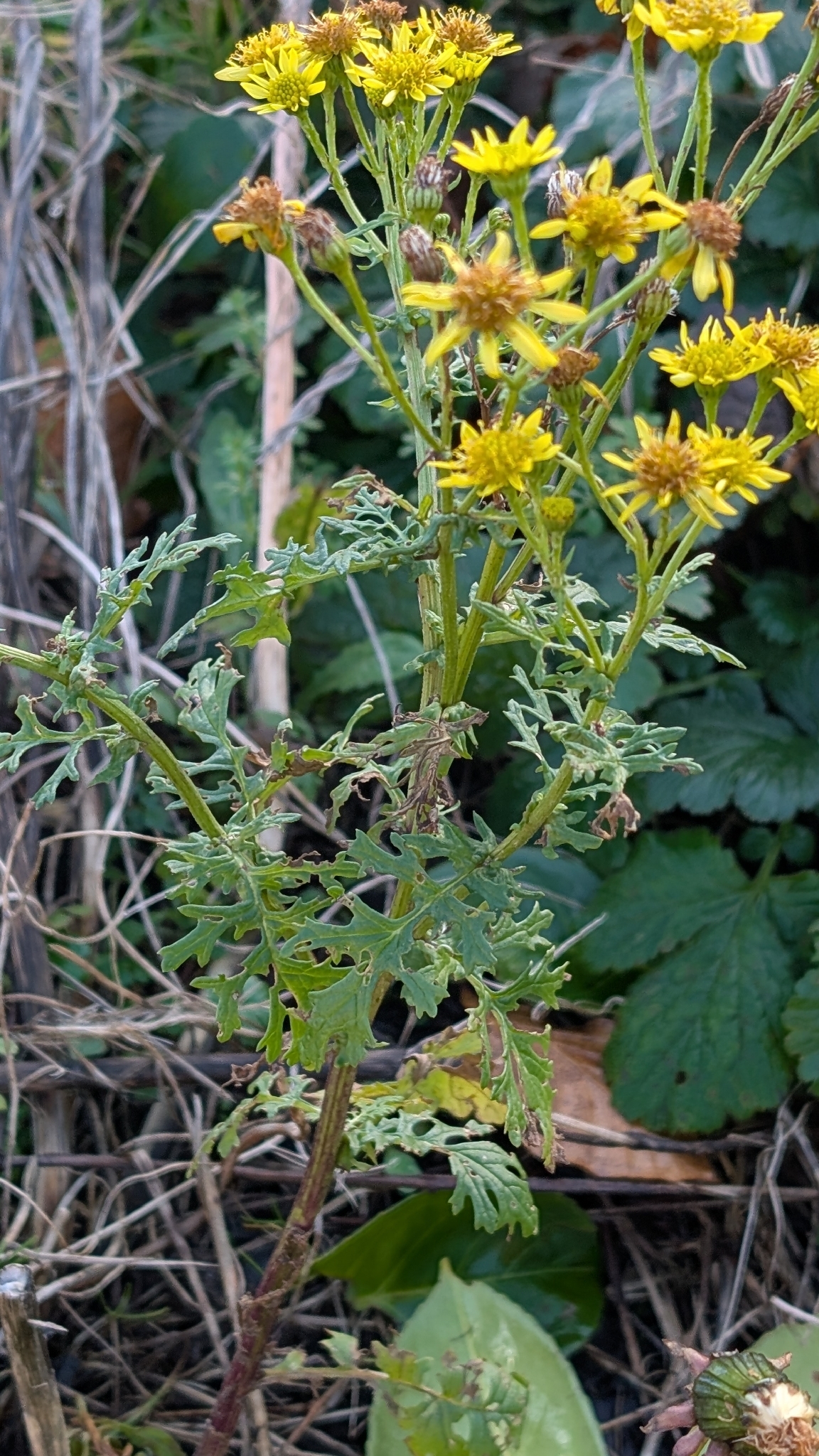
Common ragwort (Jacobaea vulgaris) is a biennial or short-lived perennial wildflower native across Europe and northern Asia, known for its dense heads of vivid yellow, daisy-like flowers and deeply lobed foliage. While it provides a vital nectar source for native invertebrates, it contains toxic pyrrolizidine alkaloids that cause irreversible liver damage in grazing livestock.
The plant poses its greatest hazard when cut, dried, and incorporated into hay or silage, where it loses its bitter deterrent scent but retains full toxicity.
Key Facts
- Plant type: Biennial or short-lived perennial wildflower
- Toxicity: Deadly to horses and cattle via cumulative liver damage
- Height: 30–100 cm (12–40 in), rarely up to 150 cm (60 in)
- Flowering period: June to October
- Legal status: Injurious weed under the UK Weeds Act 1959
- Ecological role: Sole primary foodplant of the cinnabar moth caterpillar
Living with Common Ragwort: Pasture Risk and Ecological Balance
Managing common ragwort requires balancing strict pasture biosecurity for livestock with its significant role in supporting native insect biodiversity. In open pastures, horses and cattle generally avoid the living plant due to bitter volatile oils. However, heavy infestations, overgrazed paddocks with scarce forage, or dried stems inadvertently baled into winter feed create fatal poisoning hazards.
Under the UK Weeds Act 1959 and the Ragwort Control Act 2003, land occupiers can be required to prevent the plant from spreading onto agricultural land, grazing areas, and land used for producing forage. Complete eradication from non-agricultural land is neither legally mandated nor ecologically desirable, as the plant supports dozens of specialized insect species.
How to Identify Common Ragwort
You can identify common ragwort by its flat-topped clusters of bright yellow daisy-like flower heads and deeply dissected, ruffled foliage. In its first year, the plant exists solely as a dense, low-growing ground rosette before sending up grooved, erect flowering stems in its second summer.
Key botanical identification markers include:
- Stems: Stiff, erect, ribbed, often tinged with purple or red near the base, reaching 30–100 cm (12–40 in) in height.
- Leaves: Dark green, 7–20 cm (3–8 in) long, deeply pinnatifid with irregular, blunt-toothed lobes that give a ragged appearance; base leaves have stalks, while upper leaves clasp the stem.
- Flowers: Dense flat-topped corymbs carrying dozens of flower heads, each 15–25 mm (0.6–1.0 in) across with 12–15 spreading ray florets surrounding a darker yellow central disc.
- Crushed scent: Stems and leaves release a sharp, rank, unpleasant medicinal odor when bruised.
- Seeds: Central disc florets produce tiny ribbed achenes topped with a silky white downy pappus that drifts on the wind.
Natural Habitat and Distribution
Common ragwort establishes primarily on disturbed, open ground with free-draining soil and full sunlight exposure. It thrives across roadside verges, neglected pastures, railway embankments, sand dunes, and wasteland throughout its native Eurasian range.
The species rapidly colonizes bare patches created by rabbit activity, heavy livestock hooves, or vehicle wear. While native and widespread across the British Isles and temperate Europe, it has become a problematic non-native invasive weed across North America, southeastern Australia, and New Zealand, where introduced populations crowd out pastoral land without their native insect checks.
Wildlife Value and Ecology
Common ragwort is one of the top nectar-yielding wildflowers in the United Kingdom, supporting more than 170 species of flower-visiting insects. It acts as the exclusive or primary larval host for over 30 invertebrate species that have evolved resistance to its poisonous chemical defenses.
- Cinnabar moth: Black-and-yellow banded caterpillars of the cinnabar moth (Tyria jacobaeae) feed gregariously on the foliage and flower heads, sequestering the plant’s alkaloids to become poisonous to predatory birds.
- Solitary bees and hoverflies: The accessible disc florets provide high volumes of amino-acid-rich nectar and pollen during midsummer when other floral resources dip.
- Flies and beetles: Specialist seed-head flies like Sphenella marginata and the ragwort flea beetle (Longitarsus jacobaeae) rely entirely on its stems and seeds for reproduction.
Why Common Ragwort Poisoning Threatens Livestock
Toxicity is caused by cumulative, irreversible liver damage from pyrrolizidine alkaloids including jacobine, jacozine, and senecionine. These compounds pass through the digestive system and are metabolized by liver enzymes into toxic pyrroles, which cross-link DNA and kill hepatocytes, gradually replacing functioning liver tissue with non-functional scar tissue.
Typical signs of chronic poisoning develop over weeks or months after ingestion:
- Weight loss and dullness: Rapid loss of body condition and poor appetite despite access to food.
- Jaundice: Yellow discoloration of mucous membranes, gums, and the whites of the eyes.
- Photosensitization: Severe, painful sunburn and blistering on unpigmented or white skin patches.
- Neurological signs: “Walking disease” characterized by aimless wandering, head pressing against walls, blindness, and uncoordinated gait.
How to Get Rid of Common Ragwort Safely
The standard mechanical control method is complete manual pulling before seed dispersal, removing the entire root crown to prevent regrowth. Pulling is most effective in early summer when the ground is soft and flower buds have formed but not yet opened.
Follow these management rules to clear pasture safely:
- Wear barrier gloves: Thick, waterproof gloves protect skin from absorbing small quantities of pyrrolizidine alkaloids and sap-induced contact dermatitis.
- Use a ragfork: A purpose-built ragwort fork levers the central taproot cleanly out of hard or clay soil.
- Bag and incinerate: Never leave pulled plants on the ground; as they wilt, they turn palatable to livestock while keeping their full toxin load.
- Maintain dense sward: Sound pasture management, including liming, aeration, and overseeding with perennial ryegrass (Lolium perenne), prevents the bare ground required for seed germination.
Historical and Traditional Uses
Common ragwort was traditionally used in folk medicine as a topical poultice for aching joints, ulcers, and inflammatory skin conditions, though modern clinical medicine rejects all internal and external use due to systemic alkaloid toxicity. Past herbalists also applied leaf extracts as a gargle for throat infections, a practice that carried substantial health hazards.
Beyond folk remedies, the flowers traditionally yielded a deep yellow textile dye when mordanted with alum, while the leaves produced dull green dyes. Today, the plant holds no safe edible, cosmetic, or therapeutic applications; it is strictly an ecological entity and a pasture weed.
Common Ragwort Look-Alikes and Similar Species
Common ragwort is frequently confused with common tansy, marsh ragwort, and Oxford ragwort, but several clear botanical traits separate them. Examining flower structure, leaf divisions, and habitat clarifies the distinction.
- Common tansy (Tanacetum vulgare): Lacks outer petal-like ray florets entirely, showing dense, button-shaped yellow flower heads, and produces a strong camphor scent rather than a rank smell.
- Marsh ragwort (Jacobaea aquatica): Features less divided, broader basal leaves, fewer ray florets per head, and grows exclusively in waterlogged meadows, marshes, and ditch banks.
- Oxford ragwort (Senecio squalidus): A looser, bushier plant with fewer, larger flower heads and narrower leaf lobes, commonly found on urban masonry, railway ballast, and dry stone walls.
- Common fleabane (Pulicaria dysenterica): Features wavy-edged, undivided leaves with woolly undersides that clasp the stem, and flatter flower heads with far more numerous, narrow ray florets.
Frequently Asked Questions
Is common ragwort poisonous to horses and dogs?
Yes, common ragwort is lethal to horses and toxic to dogs if eaten. Horses suffer irreversible liver failure from cumulative exposure to its pyrrolizidine alkaloids, while dogs face similar hepatic necrosis, though canine ingestion is rare due to the plant's bitter taste.
Is common ragwort poisonous to humans?
Yes, common ragwort is poisonous to humans if consumed, and prolonged skin handling can cause dermatitis. Its alkaloids damage the liver and are classified as potential carcinogens, so you should always wear impervious gloves when pulling it.
What is the difference between common ragwort and tansy ragwort?
Common ragwort and tansy ragwort are two common names for the exact same botanical species, Jacobaea vulgaris. In the UK it is universally called common ragwort, whereas in the US, Canada, and New Zealand it is usually referred to as tansy ragwort.
Is common ragwort native to the UK?
Yes, common ragwort is fully native to the United Kingdom, where it has grown since the last ice age. It is not an invasive non-native plant in Britain, though it is legally declared an injurious weed under the Weeds Act 1959 to protect grazing animals.
Is common ragwort edible?
No, common ragwort is completely inedible and dangerously toxic. Ingesting any part of the plant introduces hepatotoxic pyrrolizidine alkaloids that can cause permanent, fatal liver cirrhosis.
What is common ragwort called po polsku?
In Polish, common ragwort is called starzec jakubek. The name translates botanically to St. James's groundsel, mirroring its old Latin synonym Senecio jacobaea.
Information about traditional or historical uses is provided for educational interest only and is not medical advice. Do not use any plant to treat a condition without speaking to a qualified professional.
Sources & Verification
Taxonomy and distribution are checked against the databases below. Care guidance is written for cultivated species only and reviewed by our editor. How We Build Plant Profiles →