
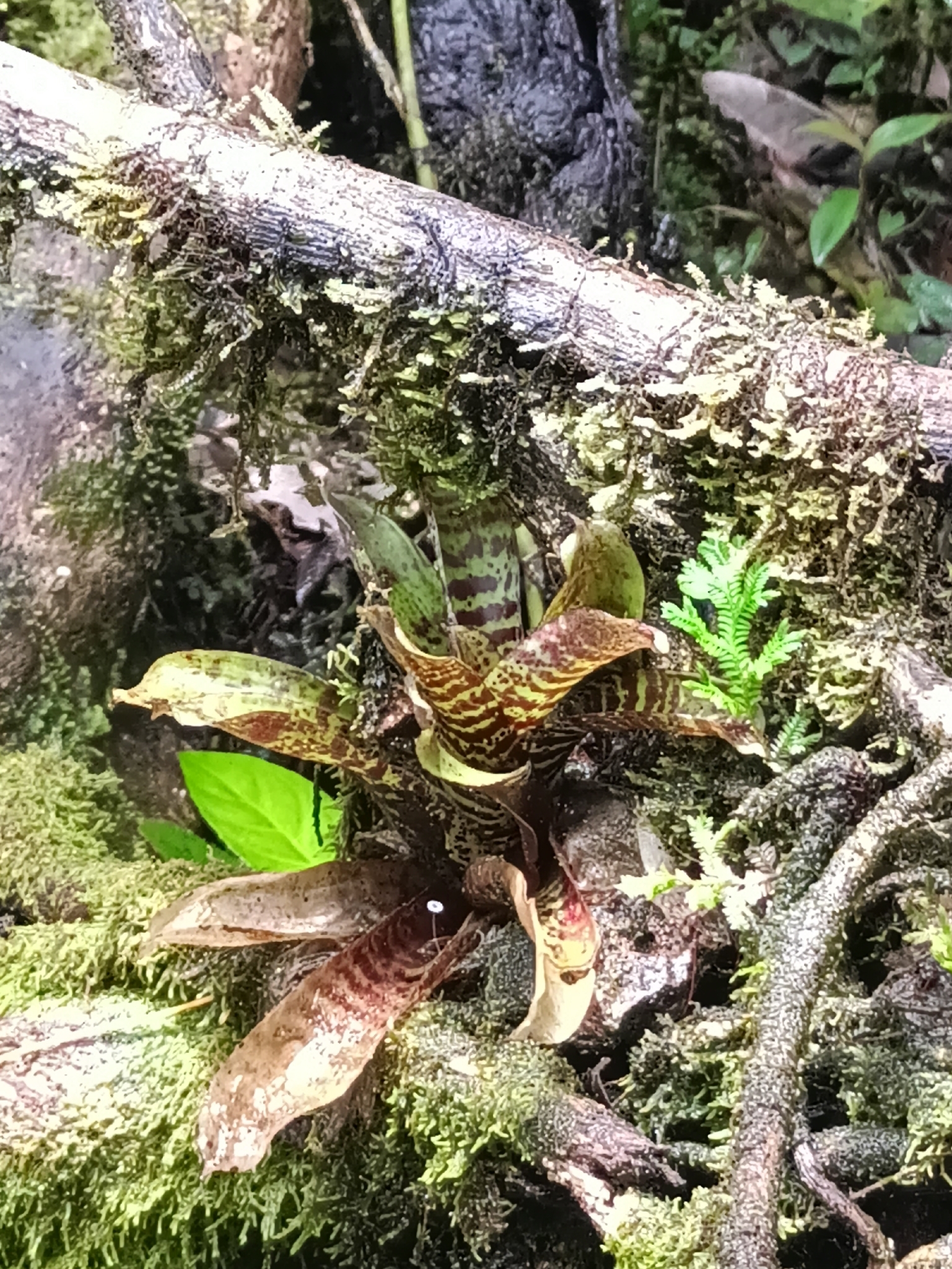
Flaming sword (Lutheria splendens, formerly Vriesea splendens) is an epiphytic bromeliad native to the rainforests of Trinidad, Venezuela, and the Guianas, marked by horizontal dark-purple bands on arching leaves and an upright, sword-shaped red inflorescence.
A single rosette flowers once in its multi-year life cycle, holding its colorful bract for three to six months before dying back and leaving behind baseline offsets for propagation.
Key Facts
- Light: Bright indirect light away from direct noon sun
- Water: Keep central leaf cup filled with clean rainwater
- Soil: Loose mix of orchid bark, perlite, and peat
- Temperature: 18–27 °C (65–80 °F) year-round
- Toxicity: Non-toxic to cats, dogs, and humans
- Lifespan: Monocarpic rosette that produces offsets after flowering
Living with Flaming Sword Indoors
Flaming sword adapts cleanly to indoor living as long as you maintain warm room temperatures above 16 °C (60 °F) and flush its central cup on a regular schedule.
Unlike thirsty terrestrial foliage plants, this bromeliad drinks primarily through its central foliar vase rather than its root system. It suits indoor gardeners who want structured, architectural foliage that tolerates brief lapses in soil moisture.
Because the roots serve primarily as physical anchors on forest tree limbs in nature, the plant stays compact and rarely requires potting up into containers larger than 12–15 cm (5–6 in) in diameter.
Flaming Sword Appearance and Identification
Flaming sword forms a stiff rosette of 15 to 25 strap-shaped leaves measuring 30–50 cm (12–20 in) long, marked with broad, dark brown-purple crossbands against a deep green background.
The leaf margins are smooth and spineless, separating it immediately from spiny bromeliads like the silver vase plant (Aechmea fasciata). The central foliar vase holds water directly in the junction where the leaf bases overlap.
The inflorescence rises on a central scape 40–80 cm (16–31 in) tall:
- Spike: A flattened, spear-shaped blade of tightly overlapping, bright scarlet bracts.
- Florets: Short-lived, tubular yellow flowers that emerge sequentially from between the red bracts.
- Foliage: Broadly arching leaves with dark banding that persists through the plant’s entire life.
How Much Light Does Flaming Sword Need?
Position your flaming sword in bright, filtered daylight for 10 to 14 hours each day to preserve the dark contrast of its foliage bands and support spike formation.
An unobstructed east-facing windowsill provides gentle morning sun without midday heat. South- or west-facing windows require a sheer curtain to diffuse harsh rays, which bleach the foliage and scorch wet central tanks.
Under deep shade or low light, the purple transverse bands fade into solid, dull green, and mature rosettes fail to produce a flower spike.
How to Water a Flaming Sword
Keep the central leaf tank one-quarter to one-half full of water at all times, refreshing it completely every two to three weeks to prevent stagnation.
Use rainwater, distilled water, or reverse-osmosis water whenever possible. Dissolved tap water minerals, fluoride, and chlorine leave unsightly white chalk rings on the foliage and cause necrotic leaf tips.
Follow these specific steps for watering:
- Fill the central vase with room-temperature water.
- Tip the pot sideways every two to three weeks over a sink to drain old water and clear out debris.
- Moisten the potting mix lightly only when the top 2.5 cm (1 in) of substrate feels completely dry.
- Never let the base of the pot sit in standing drainage water.
The Best Potting Mix for Flaming Sword
Pot flaming sword in a coarse, free-draining epiphytic substrate that allows air to circulate freely around the root system.
Standard garden soil or dense peat-based mixes retain excess moisture and induce rapid basal rot on bromeliad roots. A reliable mix combines:
- Two parts fine-grade fir orchid bark or coconut husk chips.
- One part perlite or pumice for aeration.
- One part coarse peat moss or coco coir to retain faint background moisture.
Choose shallow plastic or unglazed terracotta containers with drainage holes. A heavy terracotta pot provides ballast against the weight of the tall flower spike without trapping water.
Temperature and Humidity Requirements
Maintain consistent indoor temperatures between 18 and 27 °C (65 and 80 °F) with ambient relative humidity levels above 50 percent.
Cold drafts from exterior doors, single-glazed windows, or air conditioning vents below 13 °C (55 °F) cause sudden leaf collapse and fungal leaf spotting. If indoor air drops below 40 percent relative humidity during winter heating cycles, the leaf tips curl and brown.
Place the container over a wide tray filled with pebbles and water—ensuring the pot base rests above the water line—or operate an ultrasonic room humidifier nearby to maintain foliage hydration.
How to Fertilise Flaming Sword
Feed flaming sword by misting the foliage with a quarter-strength balanced fertiliser once every four weeks during spring and summer.
Epiphytic bromeliads absorb nutrients through specialised microscopic scales (trichomes) situated on their leaf surfaces. Avoid placing dry granular fertilisers or concentrated liquid feeds directly into the central water tank, as mineral salt buildup burns young emerging bract tissue.
Cease feeding entirely in late autumn and winter when cooler temperatures and lower light levels slow metabolic activity.
Propagating Bromeliad Pups
Propagate flaming sword by removing baseline pups (offsets) once they reach one-third to one-half the height of the mother plant.
As the primary flowering rosette concludes its bloom cycle, it channels energy into producing two to four basal offsets from between the lowest leaves. Follow these steps:
- Slide the parent plant out of its pot to reveal the offset attachment points.
- Sever the pup from the mother stem using a sterilized, sharp utility knife, ensuring you keep any developing root nubs intact.
- Dust the cut surface with ground cinnamon or sulfur to deter fungal rot.
- Pot the pup into a small 10 cm (4 in) pot filled with damp orchid bark mix.
- Secure the pup with a small bamboo stake until its own roots establish after 6–8 weeks.
Common Flaming Sword Problems and Pests
The primary cause of plant collapse is crown rot resulting from stagnant water combined with low temperatures or dense soil.
Monitor for these specific cultural issues:
- Black, mushy leaf bases: Caused by fungal crown rot. Dump the tank water, remove rotting leaves, and allow the plant to dry out completely in a warm room.
- Brown, crispy leaf tips: Caused by low humidity or tap water minerals. Switch to distilled water and mist ambient air.
- Loss of horizontal leaf striping: Caused by insufficient light levels. Move the pot closer to an east-facing window.
- Scale insects and mealybugs: These sap-suckers settle at the leaf bases. Remove them manually using a cotton swab dipped in 70 percent isopropyl alcohol.
Is Flaming Sword Toxic to Cats and Dogs?
Flaming sword is entirely non-toxic to domestic pets and humans according to veterinary poison control records.
The plant contains no calcium oxalate raphides, toxic saponins, or irritating alkaloids found in many other common tropical houseplants like peace lilies (Spathiphyllum wallisii) or dumb cane (Dieffenbachia seguine).
If a cat or dog chews on the fibrous leaves, minor mechanical stomach irritation and vomiting may occasionally occur due to undigested plant fiber, but no chemical toxicity will develop.
The Flaming Sword Flower Spike and Life Cycle
A flaming sword rosette is monocarpic, flowering exactly once in its lifetime before slowly dying back over a period of 12 to 24 months.
The central sword-like spike emerges over several weeks and maintains its vivid red coloration for 12 to 20 weeks. Small yellow florets open sequentially from the bottom to the top of the flattened blade, lasting only a couple of days each.
To induce flowering on a stubborn, mature offset that is at least three years old, enclose the plant inside a clear plastic bag with a ripe apple for 10 days; ethylene gas released by the apple triggers floral initiation within 8 to 14 weeks.
Seasonal Care for Flaming Sword
| Spring | Flush the central cup with fresh rainwater every two weeks. Apply a quarter-strength foliar fertiliser once a month and separate established pups that have reached half the mother plant’s height. |
|---|---|
| Summer | Maintain water in the leaf tank and monitor ambient humidity during hot spells. Shield foliage from direct mid-afternoon sun to prevent bleached spots and leaf burn. |
| Autumn | Reduce substrate watering as indoor temperatures drop and growth rates slow. Discontinue all fertiliser applications and inspect leaf bases for mealybugs. |
| Winter | Keep indoor ambient temperatures strictly above 16 °C (60 °F). Keep the central tank only one-quarter full to prevent rot during cold nights and run a humidifier if central heating dries the air. |
Flaming Sword Leaf and Flower Problems Explained
| What you see | Likely cause | What to do |
|---|---|---|
| Brown, foul-smelling mush at the leaf base | Heart rot from stagnant water and cold temperatures | Empty the central tank immediately, place the plant in a warm, ventilated location, and allow the potting mix to dry out. |
| Crispy brown tips across upper foliage | Low ambient humidity or tap water salts | Switch exclusively to rainwater or distilled water and raise room humidity above 50 percent using a pebble tray. |
| Leaves fading to uniform green without bands | Inadequate light levels | Relocate the plant to a spot receiving bright, indirect sunlight, such as an east-facing window. |
| White cottony tufts tucked inside leaf axils | Mealybug infestation | Dab the pests directly with a cotton swab soaked in 70 percent isopropyl alcohol. |
| Flower spike drying out and turning brown | Natural end of the bloom cycle | Cut the dried scape off at the base with sterile shears and shift care focus to nurturing emerging basal pups. |
Cultivars of Flaming Sword
- ‘Splenriet’ – wider leaves with intense dark banding and a taller, deeper crimson bract
- ‘Era’ – compact habit with an exceptionally broad, bright scarlet inflorescence
- ‘Favorite’ – slender leaves with high-contrast, nearly black crossbands
- ‘Chantrieri’ – historic hybrid form selected for broad, arching foliage and dense flowering
Frequently Asked Questions
How often should I water a flaming sword plant?
Keep the central leaf tank one-quarter to one-half full of fresh rainwater, emptying and refilling it every two to three weeks. Only water the potting substrate when the top 2.5 cm (1 in) is dry.
Why is my flaming sword dying after blooming?
Flaming sword is monocarpic, meaning each rosette naturally dies after flowering. The parent rosette declines gradually over 12 to 24 months while producing basal pups that you can separate and grow into new plants.
Is Lutheria splendens the same as Vriesea splendens?
Yes, Lutheria splendens is the current botanical name for the plant historically classified and sold as Vriesea splendens. Botanical taxonomists reclassified the species into the genus Lutheria based on DNA and morphological studies.
Can I use tap water in my flaming sword tank?
Avoid tap water if possible because flaming sword is sensitive to chlorine, fluoride, and dissolved mineral salts. Use distilled water, reverse-osmosis water, or collected rainwater to prevent brown leaf margins.
How do I get my flaming sword bromeliad to rebloom?
Wait until a separated pup reaches mature size at roughly three years old, then seal the potted plant inside a clear plastic bag with a ripe apple for 7 to 10 days. The natural ethylene gas emitted by the apple initiates flower spike formation within two to three months.
Sources & Verification
Taxonomy and distribution are checked against the databases below. Care guidance is written for cultivated species only and reviewed by our editor. How We Build Plant Profiles →
- Kew Plants of the World OnlineTaxonomic status and native distribution of Lutheria splendens
- Global Biodiversity Information Facility (GBIF)Occurrence data and accepted nomenclature
- Missouri Botanical GardenCultural information listed under basionym Vriesea splendens
- ASPCA Animal Poison ControlNon-toxicity confirmation for Bromeliaceae
- Wikipediageneral reference