
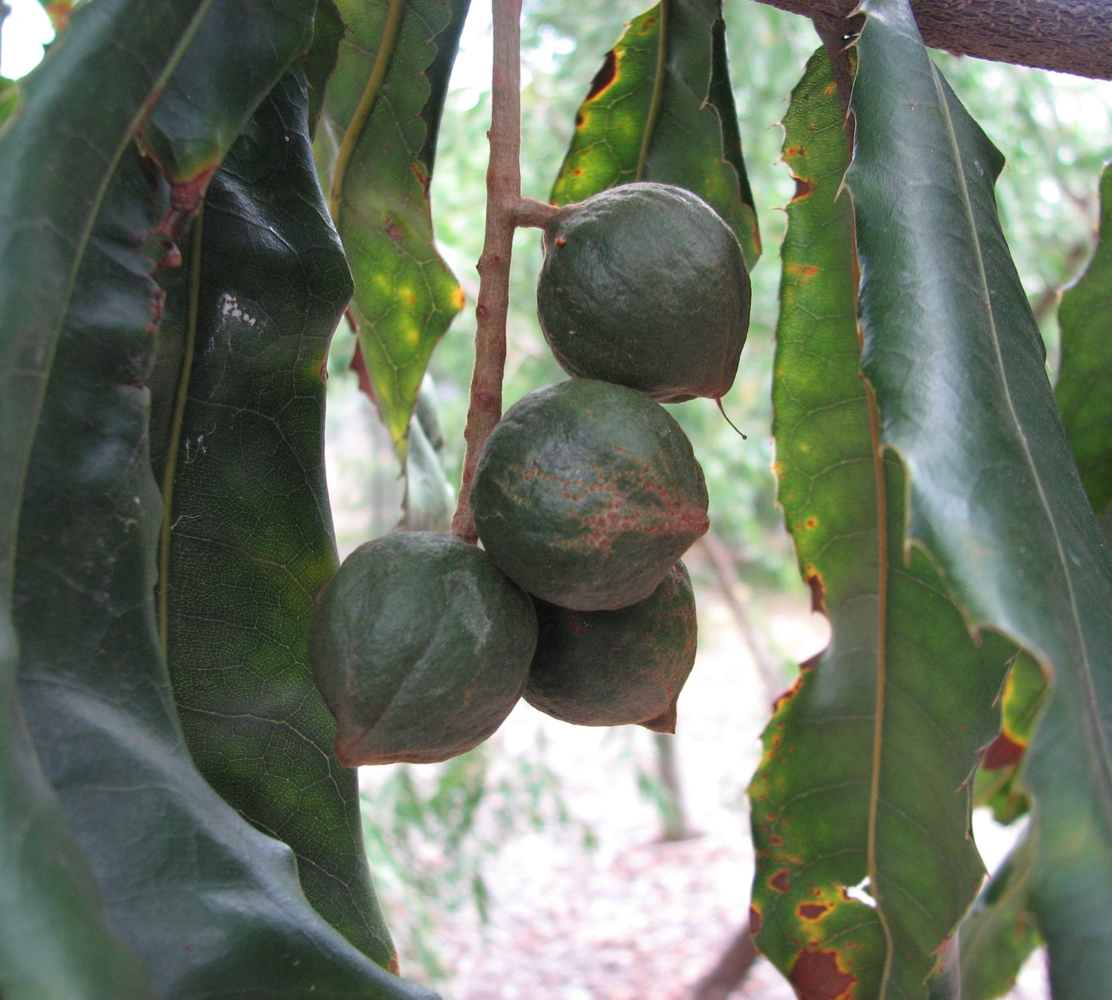
Rough-shelled Queensland nut (Macadamia tetraphylla) is a subtropical evergreen tree native to the coastal rainforests of northern New South Wales and south-eastern Queensland in Australia. It is distinguished by spiny leaf margins, pink-to-purple flowers, and pebbled, thick-shelled nuts containing edible white kernels.
Trees require 4 to 7 years from planting to yield their first crop of nuts. In home landscapes, this species functions as both an evergreen shade canopy and a home orchard crop in frost-free regions.
Key Facts
- Plant Type: Subtropical evergreen nut tree
- Native Range: Eastern coastal Australia
- Hardiness: USDA Zones 9 to 11
- Mature Height: 6 to 18 m (20 to 60 ft)
- Sun Needs: Full sun to partial shade
- Pet Toxicity: Toxic to dogs
Is Macadamia tetraphylla Suitable for Your Garden?
Rough-shelled Queensland nut grows best in frost-free regions within USDA Zones 9 through 11 where winter temperatures remain above -2 °C (28 °F). It suits large residential landscapes and small orchards that can accommodate its widespread branch canopy.
This tree requires deep, non-alkaline soil with low phosphorus levels, as its specialized Proteaceae root system absorbs nutrients aggressively. It offers consistent foliage cover year-round and produces nectar-rich flowers in early spring.
- Climate Match: Warm subtropical or mild Mediterranean climates
- Space Required: Minimum 6 m (20 ft) distance from structures
- Soil Preference: Well-drained sandy loams with pH 5.5 to 6.5
- Landscape Use: Windbreak, canopy shade, or crop specimen
How to Identify Macadamia tetraphylla
You can identify Macadamia tetraphylla by its whorls of four leaves per node and sharply serrated, prickly leaf margins. Leaves measure 7 to 25 cm (3 to 10 in) in length and have a stiff, leathery texture.
In late winter and spring, long dangling racemes measuring 10 to 30 cm (4 to 12 in) display 100 to 300 individual pink or purplish blossoms. The resulting fruit is a round green follicle containing a brown seed with a distinctive rough, pebbled shell surface.
- Foliage: Leaves arranged in whorls of 4, with 35-40 spiny teeth along each side
- Flowers: Pale pink to magenta pendant clusters
- Fruit Shell: Rough, pitted outer shell 2.5 to 3 cm (1 to 1.2 in) in diameter
- Kernel: Creamy white edible nut inside a thick woody seed coat
Mature Height and Spread of Macadamia Nut Trees
A mature rough-shelled Queensland nut reaches 6 to 18 m (20 to 60 ft) in height with a canopy spread of 4 to 8 m (13 to 26 ft). Vertical growth averages 30 to 60 cm (12 to 24 in) per year under optimal conditions.
Orchard specimens are frequently pruned to maintain a height of 4 to 5 m (13 to 16 ft) for easier nut harvesting and pest monitoring. Trees planted in shallow soils or exposed windy locations remain shorter and develop wider, shrubby branching habits.
Sunlight and Soil Needs for Macadamia Trees
Plant this tree in full sun receiving at least 6 hours of direct sunlight daily to maximize flower production and nut yield. Partial shade is tolerated in hot desert regions, though fruit set will be reduced.
Soils must be freely draining, as standing water causes root decay within days. The tree thrives in sandy loams, volcanic soils, and well-aerated clays with low native phosphorus content.
- Sun Exposure: Full sun for optimal nut production
- Soil Texture: Sandy loam or crushed basalt clay
- Drainage: High permeability; avoids waterlogged sites
- Ideal pH: 5.5 to 6.5
Planting a Macadamia Nut Tree
Plant saplings in early spring after the last threat of frost has passed. Dig a hole twice as wide as the root ball and equal in depth, ensuring the root collar sits level with the surrounding soil grade.
Avoid adding high-phosphorus synthetic fertilizers or heavy fresh manure into the planting hole. Water deeply at installation and apply a 7 to 10 cm (3 to 4 in) layer of coarse organic mulch around the base, keeping mulch 10 cm (4 in) away from the main trunk.
- Step 1: Select a sunny site with deep, free-draining soil
- Step 2: Dig a shallow, wide planting pit to encourage lateral root expansion
- Step 3: Settle the tree, fill with native soil, and water with 20 L (5 gal) of water
- Step 4: Mulch with wood chips to conserve moisture and suppress weeds
Macadamia Nut Tree Care and Water Needs
Provide 25 to 50 mm (1 to 2 in) of water per week during active growth from spring through autumn. Reduce watering in winter when natural rainfall is sufficient and growth slows.
Use low-phosphorus citrus or Proteaceae-formulated fertilizers twice yearly in early spring and mid-summer. Standard high-phosphorus garden fertilizers will burn the plant’s specialized cluster roots (proteoid roots) and cause leaf chlorosis.
- Irrigation: Deep weekly soakings during dry periods
- Fertilization: Formulations with less than 2% elemental phosphorus (P)
- Root Protection: Keep root zone free of turfgrass competing for nutrients
Pruning Macadamia Trees
Prune young trees in late winter to establish a single central leader with wide branch attachment angles. Remove low branches below 1 m (3.3 ft) to facilitate harvesting nuts from the ground.
Mature trees require minimal structural pruning except for removing dead wood, crossing interior branches, or water sprouts. Keep the inner canopy open to allow sunlight penetration and airflow, which reduces fungal foliage infections.
Macadamia Nut Tree Problems and Treatment
Watch for macadamia nut borer larvae and thrips, which damage flower spikes and young green husks. Clear fallen husks promptly to disrupt insect breeding cycles under the tree canopy.
Phytophthora trunk canker causes bark cracking and resin bleeding near the soil line. Prevent root rots by planting on raised mounds in heavy soils and keeping mulch clear of the bark.
- Nut Borer: Inspect developing husks for pinholes; clear fallen debris
- Thrips: Causes flower dropping; spray with horticultural oil in early spring
- Trunk Canker: Keep root flare dry and avoid trunk damage with lawnmowers
- Yellow Leaves: Sign of iron or magnesium deficiency caused by alkaline soil
Cold Tolerance and Winter Protection
Established trees tolerate brief temperature drops down to -2 °C (28 °F) without structural damage. Prolonged freezes below -4 °C (25 °F) kill young foliage, flowers, and thin branches.
Protect young trees during cold snaps by wrapping the lower trunk with frost cloth or burlap. Mature trees in marginal zones benefit from deep autumn watering, which helps retain heat in the surrounding soil mass.
Harvesting Nuts, Culinary Uses, and Oil
Harvest nuts from late autumn to spring when husks turn brown and drop naturally to the ground. Avoid picking green nuts off the tree, as immature kernels do not dry or roast properly.
De-husk harvested nuts within 24 hours to prevent mould development. Air-dry the hard-shelled nuts on wire trays in a warm, shaded area for 2 to 3 weeks before cracking. The oil extracted from kernels is used in cosmetics for hair and skin conditioning, while roasted nuts feature in cookies, nut butter, and nut milk.
- De-husking: Remove green outer hulls immediately after collection
- Drying: Air-dry in-shell nuts until moisture drops below 1.5%
- Nutrient Profile: High in monounsaturated fats, dietary fibre, and manganese
- Pet Warning: Keep all macadamia products completely out of reach of dogs
Frequently Asked Questions
How do macadamia nuts grow?
Macadamia nuts grow inside green fleshy husks on long dangling flower clusters attached to tree branches. As the fruit matures, the outer green husk dries, turns brown, and splits open, dropping the hard-shelled nut to the ground.
Are macadamia nuts toxic to dogs?
Yes, macadamia nuts are toxic to dogs. Ingestion causes weakness in the hind legs, vomiting, muscle tremors, hyperthermia, and depression within 12 hours of consumption.
What nut is closest to macadamia?
Hazelnut (Corylus avellana) is closest to macadamia in rich texture and mild buttery flavor, while pecan (Carya illinoinensis) matches its high monounsaturated fat content.
How long does a macadamia tree take to fruit?
Grafted macadamia trees produce their first crop in 4 to 5 years, while seedling-grown trees require 7 to 10 years to yield nuts.
What is the difference between Macadamia tetraphylla and Macadamia integrifolia?
Macadamia tetraphylla has four prickly-margined leaves per whorl and pink flowers, producing rough-shelled nuts. Macadamia integrifolia has three smooth-edged leaves per whorl, white flowers, and smooth-shelled nuts.
Sources & Verification
Taxonomy and distribution are checked against the databases below. Care guidance is written for cultivated species only and reviewed by our editor. How We Build Plant Profiles →