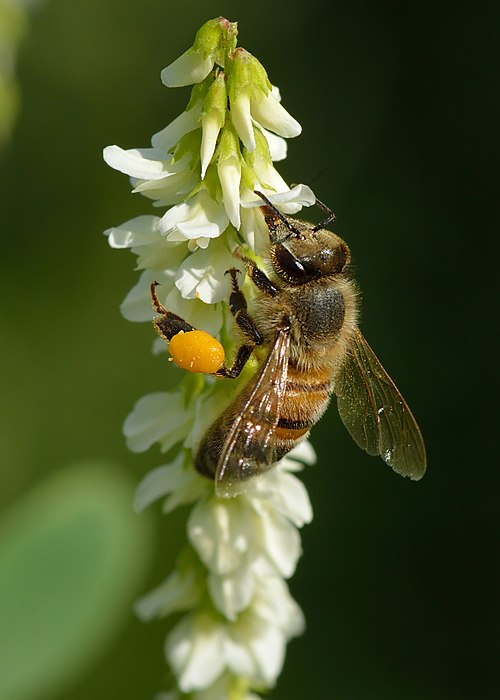
Annual Yellow Sweet Clover is a nitrogen-fixing herb from the Melilotus genus, native to the Mediterranean region, Northern Africa, and parts of Asia. You will likely encounter it as a coloniser of poor, alkaline soils where its tiny yellow flowers appear in dense, upright spikes.
It is strictly an annual species, completing its entire life cycle within a single growing season, which distinguishes it from its larger biennial relatives. While used for forage in some regions, it is frequently classified as a weed in disturbed habitats and agricultural fields.
Key Facts
- Type: Strictly annual herbaceous legume
- Flowers: Tiny yellow blooms only 2-3 mm long
- Soil: Prefers alkaline or saline conditions with pH 7.0-8.5
- Seeds: Can remain viable in soil for over 20 years
- Height: Reaches 10-60 cm (4-24 in) at maturity
Is Annual Yellow Sweet Clover Right for Your Land?
Annual Yellow Sweet Clover acts as a pioneer species that thrives on bare, neglected earth where other plants struggle. It is not a choice for manicured garden beds but is often used in land reclamation or as a green manure in specific agricultural rotations. Because it fixes nitrogen, it can improve the nutrient profile of exhausted soils, particularly those with high alkalinity or salinity.
If you are managing a pasture or a restoration site, this plant provides quick cover and prevents erosion. However, its prolific seeding habit means it can quickly dominate a site if not managed. It is best suited for dry, sunny locations where soil stabilization is required and where its deep taproot can break up compacted layers.
How to Identify Melilotus indicus in the Field
Identification relies on observing the tiny yellow flowers which are significantly smaller than those of most other clover-like species. Each flower measures only 2-3 mm (0.08-0.12 in) in length and they are arranged in dense, narrow racemes that can hold up to 60 individual blooms. The plant has a typical legume structure with trifoliate leaves, meaning each leaf is divided into three distinct leaflets.
- Leaflets are obovate to cuneate, roughly 1-2.5 cm (0.4-1 in) long.
- The leaf margins are serrated or toothed, particularly on the upper half of the leaflet.
- Seed pods are small, 1.5-3 mm long, turning brown or greyish-green when ripe.
- The entire plant emits a sweet, hay-like scent when crushed due to the presence of coumarin.
Where Does Indian Sweetclover Grow Best?
This species is most commonly found in disturbed habitats, including roadsides, waste ground, and the edges of cultivated fields. It has a high tolerance for salt, making it a frequent sight in coastal regions and salt marshes where few other legumes can survive. While native to the Mediterranean and Southwest Asia, it has naturalised across North America, Australia, and parts of South America.
It requires full sun to thrive and will rarely be found in shaded woodlands or under dense forest canopies. The plant is particularly adapted to Mediterranean climates with wet winters and dry summers. In agricultural contexts, it is often seen as a weed in cereal crops like wheat or barley, where it competes for light and nutrients during the spring growing season.
Ecological Role and Nitrogen Fixation
Like most members of the Fabaceae family, Annual Yellow Sweet Clover forms a symbiotic relationship with Rhizobium bacteria in its root nodules. This process allows the plant to convert atmospheric nitrogen into a form that plants can use, effectively fertilising the soil as it grows. This makes it a valuable component of early-succession plant communities on degraded land.
The flowers provide a significant nectar source for honeybees and small solitary bees during the spring. In some regions, it is a primary honey-producing plant, though the resulting honey can have a distinct flavour. Because it blooms early and profusely, it supports pollinator populations before many other meadow flowers have opened.
Is Annual Yellow Sweet Clover Invasive or Native?
In its native range of Eurasia and Africa, the plant is a natural component of the flora, but in the Americas and Australia, it is considered an introduced weed. It is not usually classified as a high-impact invasive species in natural ecosystems, but it is a major agricultural nuisance. In Australia, it earned the name “Hexham Scent” because it was so prevalent near Hexham that it tainted the flavour of local dairy products.
The plant’s ability to produce up to 200,000 seeds per square metre allows it to form dense monocultures in disturbed areas. These seeds have a hard coat that allows them to survive fire, drought, and long periods of burial. While it can be controlled through mowing before seed set, its persistence in the seed bank makes long-term eradication difficult.
Traditional Medicinal and Forage Uses
Historically, Annual Yellow Sweet Clover was used in traditional medicine as a poultice for swellings and inflammation. It contains coumarin, which gives it a sweet fragrance but also carries risks if the plant is consumed in large quantities. In the past, extracts were sometimes used as a mild sedative or to treat digestive issues, though modern herbalism generally avoids it due to toxicity concerns.
As a forage crop, it is known as “King Island Melilot” in parts of Tasmania where it is grown for sheep and cattle. However, farmers must be cautious; if the clover is harvested as hay and becomes moldy, the coumarin converts into dicoumarol. This compound is a potent anticoagulant that can cause internal bleeding and death in livestock, a condition known as “sweet clover disease.”
Annual vs Perennial Sweet Clover Differences
The primary difference is that Melilotus indicus is a strict annual, while the very similar yellow sweet clover (Melilotus officinalis) is a biennial. You can tell them apart by looking at the flower size; the annual species has flowers that are less than 3 mm long, whereas the biennial version has flowers measuring 4-7 mm. This size difference is the most reliable way to distinguish them in the field.
Furthermore, the biennial Melilotus officinalis typically grows much taller, often reaching 1.5-2 m (5-6.5 ft) in its second year. The annual variety remains much shorter and more branched from the base. While both have yellow flowers and trifoliate leaves, the annual species finishes its growth and dies off by mid-summer, while the biennial persists as a leafy rosette through its first winter.
Seed Germination and Persistence in Soil
Seeds of the Annual Yellow Sweet Clover are exceptionally hardy and can lie dormant for decades. They possess a thick, water-impermeable coat that requires mechanical abrasion or extreme temperature fluctuations to break. This allows the plant to “wait” for a disturbance, such as ploughing or a flood, before germinating in mass numbers.
- Germination typically occurs in autumn or early spring when moisture is available.
- Seedlings grow rapidly to outcompete other spring annuals.
- A single plant can produce several thousand seeds in a single season.
- Soil disturbance is the primary trigger for new infestations in previously clear areas.
Similar Species and Common Lookalikes
It is frequently confused with Black Medic (Medicago lupulina), which also has small yellow flowers and trifoliate leaves. However, Black Medic has flower heads that are more rounded or globe-like, rather than the elongated spikes seen in Melilotus. Additionally, the seed pods of Black Medic turn black and are kidney-shaped, whereas those of the annual melilot remain brown and are more rounded.
Other lookalikes include:
- Yellow Sweet Clover (Melilotus officinalis): larger flowers and biennial life cycle.
- White Sweet Clover (Melilotus albus): identical growth habit but with white flowers.
- Common Bird’s-foot Trefoil (Lotus corniculatus): much larger, pea-like yellow flowers and five leaflets.
- Burr Medic (Medicago polymorpha): distinguished by its prickly, coiled seed pods.
Frequently Asked Questions
Is annual yellow sweet clover a weed?
Yes, in most agricultural and garden contexts, it is considered a weed due to its rapid growth and prolific seeding. It is particularly troublesome in grain crops where it can compete for resources and contaminate the harvest.
Is Melilotus indicus toxic to dogs?
It is generally considered mildly toxic if ingested in large amounts because it contains coumarin. The greatest risk occurs if the plant material becomes moldy, which creates dicoumarol, a dangerous anticoagulant.
What are the benefits of annual yellow sweet clover?
It is a powerful nitrogen fixer that can improve poor soils and provide a significant nectar source for bees. It is also used in land reclamation to stabilize soil and prevent erosion on disturbed sites.
How do you tell the difference between Melilotus indicus and Melilotus officinalis?
The main difference is flower size; Melilotus indicus has tiny flowers (2-3 mm), while Melilotus officinalis has larger flowers (4-7 mm). Additionally, M. indicus is an annual, whereas M. officinalis is a biennial.
Can you eat annual yellow sweet clover?
While the leaves and flowers are sometimes used as a flavouring in very small quantities, it is not recommended as a food source. High levels of coumarin can be harmful, and there is a risk of toxicity if the plant has any fungal growth.
Information about traditional or historical uses is provided for educational interest only and is not medical advice. Do not use any plant to treat a condition without speaking to a qualified professional.
Sources & Verification
Taxonomy and distribution are checked against the databases below. Care guidance is written for cultivated species only and reviewed by our editor. How We Build Plant Profiles →