
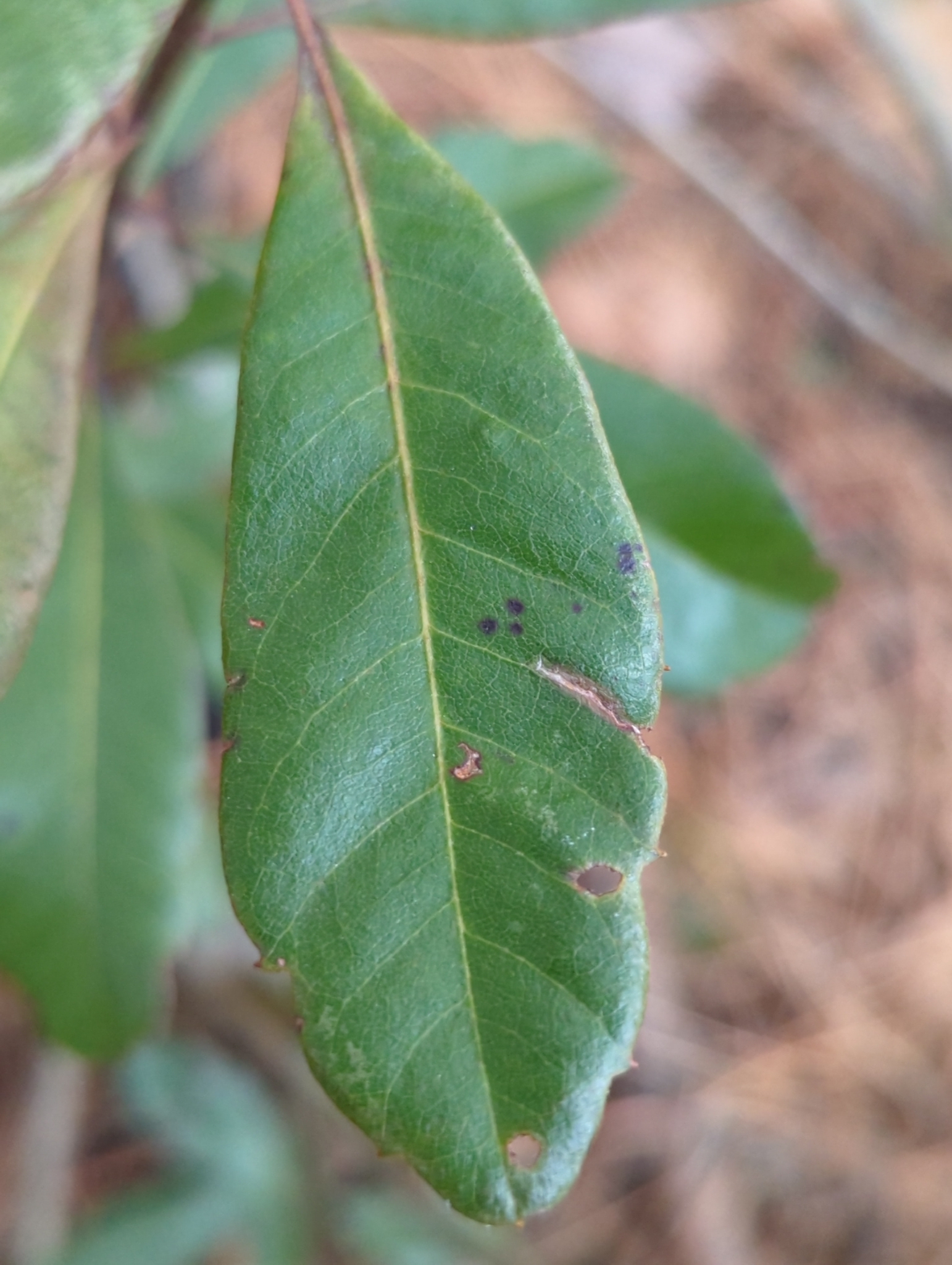
Southern Bayberry (Morella caroliniensis) is a multi-stemmed evergreen shrub or small tree native to the coastal plains of southeastern North America. It belongs to the Myricaceae family and is easily recognized by its aromatic, resin-dotted leaves and greyish-white waxy drupes.
This plant thrives in sandy, acidic soils and tolerates salt spray, making it a reliable hedge or screen near coastal environments. It fixes nitrogen in the soil, which helps it survive in nutrient-poor wetlands and dunes.
Key Facts
- Type: Evergreen shrub
- Height: Up to 6 m (20 ft)
- Light: Full sun to partial shade
- Soil: Acidic, sandy, well-draining
- Hardiness: USDA zones 7 to 10
Growing Southern Bayberry in Your Garden
Southern Bayberry suits gardeners looking for a tough, evergreen hedge that handles poor drainage or sea salt with ease. You get dense foliage year-round and wildlife-friendly berries without needing heavy soil amendments. Plant it in a spot that receives at least 6 hours of direct sun daily.
This shrub adapts well to both wet depressions and dry sandy banks once established. It responds favorably to heavy pruning if you want to maintain a formal hedge or a single-stemmed small tree.
Botanical Look and Identification
Southern Bayberry reaches a mature height of 1.5 to 6 m (5 to 20 ft) with a similar spread. The leaves are oblanceolate, measuring 4 to 10 cm (1.5 to 4 inches) long, featuring a distinct aromatic scent when crushed and yellow resin dots on both surfaces.
- Bark: Smooth, greyish-brown on mature stems
- Flowers: Inconspicuous catkins appearing in spring
- Fruit: Spherical, hard drupes 3 to 4 mm across, heavily coated in a grey-white waxy secretion
Morella caroliniensis Size and Growth Rate
Expect a moderate growth rate of 30 to 60 cm (1 to 2 ft) per year under favorable conditions. Unpruned plants eventually form dense thickets through root suckers.
- Mature height: 6 m (20 ft) maximum in coastal thickets
- Mature spread: Up to 4.5 m (15 ft) wide
- Root habit: Extensive root system with nitrogen-fixing actinomycetes
Site Selection and Soil Requirements
Southern Bayberry performs best in acidic soils with a pH between 4.5 and 6.5. It tolerates occasional flooding and high water tables just as well as periodic summer dry spells.
- Light: Full sun produces the densest foliage and heaviest berry set
- Drainage: Prefers sandy or organic-rich loams that do not bake rock-hard
- Exposure: Exceptional tolerance for salt spray and coastal winds
Planting Southern Bayberry
Plant container-grown specimens in spring or autumn to let roots establish before extreme temperatures arrive. Dig a hole twice as wide as the root ball and set the plant at the same depth it grew in the nursery.
- Spacing: Space plants 1.5 m (5 ft) apart for a solid privacy screen
- Mulch: Apply a 5 cm (2 inch) layer of pine straw or bark to retain moisture
- Initial watering: Water deeply twice a week for the first two months
Watering and Ongoing Care
Southern Bayberry needs roughly 2.5 cm (1 inch) of water per week during its first growing season. Established shrubs tolerate drought well, though sustained dry spells reduce berry production.
- Irrigation: Deep soak during prolonged summer droughts
- Fertilizing: Rarely necessary due to root nodules that fix atmospheric nitrogen
- Weeding: Keep the root zone clear of aggressive turfgrass for the first two years
Pruning and Shaping
Prune Southern Bayberry in late winter before new spring growth emerges. You can shear it into a formal hedge or limb it up into a small specimen tree.
- Deadwood: Snip out any crossing or dead branches annually
- Suckers: Remove base root suckers if you want a single-trunk tree form
- Rejuvenation: Cut old, leggy specimens down to 30 cm (1 ft) from the ground to force fresh growth
Morella caroliniensis vs Morella Pensylvanica and Morella Cerifera
Distinguishing Southern Bayberry from related species requires looking closely at leaf persistence and resin gland patterns. Morella pensylvanica (northern bayberry) is typically deciduous to semi-evergreen with broader, obovate leaves. Morella cerifera (wax-myrtle) features smaller, narrower leaves with glands densely covering both the upper and lower surfaces.
Taxonomists frequently debate the boundaries between these three species because they hybridize freely where their native ranges overlap in the mid-Atlantic region. Check the leaf margins and winter retention to help tell them apart in the field.
Winter Care and Cold Hardiness
Southern Bayberry survives winter temperatures down to -15 °C (5 °F), corresponding to USDA Zone 7. Leaves may brown or drop partially in the northern limits of its range during severe freezes.
- Mulching: Refresh pine bark mulch in late autumn to protect shallow surface roots
- Windbreak: Position plants away from freezing winter gales in Zone 7 to prevent tip dieback
Traditional Uses and Bayberry Wax
The waxy coating on the drupes has been harvested for centuries to make scented bayberry candles. Indigenous peoples and early settlers also used the bark and roots in traditional herbal preparations for fevers and digestive complaints.
- Candles: Simmering harvested berries in water allows the buoyant grey wax to float to the surface for skimming
- Wildlife: Over 40 species of birds, including tree swallows and warblers, consume the nutrient-rich berries in winter
Southern Bayberry Through the Seasons
| Spring | Apply a fresh layer of pine straw mulch around the root zone. Inspect for any winter tip dieback and prune away damaged stems. |
|---|---|
| Summer | Provide supplemental deep watering during prolonged dry spells to keep the foliage lush. Monitor young plants for weed competition. |
| Autumn | Allow berries to mature for wintering birds. Plant new container-grown shrubs while the soil retains summer warmth. |
| Winter | Perform structural pruning or heavy rejuvenation cuts before new buds swell. Harvest berries for candlemaking if desired. |
Southern Bayberry Problems and Quick Fixes
| What you see | Likely cause | What to do |
|---|---|---|
| Yellowing leaves (chlorosis) | Soil pH is too high or alkaline | Apply elemental sulfur or acidic organic compost to lower the soil pH below 6.5. |
| Sparse foliage and few berries | Too much shade | Relocate the shrub or prune surrounding canopy trees to provide full sun exposure. |
| Wilting or stem dieback | Root rot from heavy, poorly draining clay | Improve drainage around the root zone and avoid planting in waterlogged clay sumps. |
Popular Southern Bayberry Cultivars
- ‘Compacta’ – dwarf selection reaching 1.5 m (5 ft) with dense branching
- ‘Green Wave’ – glossy, dark green leaves with high salt tolerance
Frequently Asked Questions
Is southern bayberry evergreen?
Yes, Southern Bayberry is an evergreen shrub in milder coastal climates. It retains its glossy green foliage year-round across USDA zones 7 through 10.
What is the native range of Morella caroliniensis?
Morella caroliniensis is native to the coastal plains and sandy coastal regions of southeastern North America. It frequently populates pocosins, dunes, and swamp borders.
How big does Morella caroliniensis get?
Southern Bayberry typically grows to a mature size of 1.5 to 6 m (5 to 20 ft) tall and wide. It forms dense, multi-stemmed thickets over time if left unpruned.
Can southern bayberry tolerate wet soil?
Yes, Southern Bayberry tolerates poorly drained soils and seasonal flooding quite well. It naturally thrives in wetland ecotones and wet pocosin habitats.
How do you harvest wax from bayberry for candles?
Harvest the grey berries in late autumn and boil them in a pot of water. The wax melts off the fruit, floats to the surface, and hardens as it cools for skimming.
Information about traditional or historical uses is provided for educational interest only and is not medical advice. Do not use any plant to treat a condition without speaking to a qualified professional.
Sources & Verification
Taxonomy and distribution are checked against the databases below. Care guidance is written for cultivated species only and reviewed by our editor. How We Build Plant Profiles →