
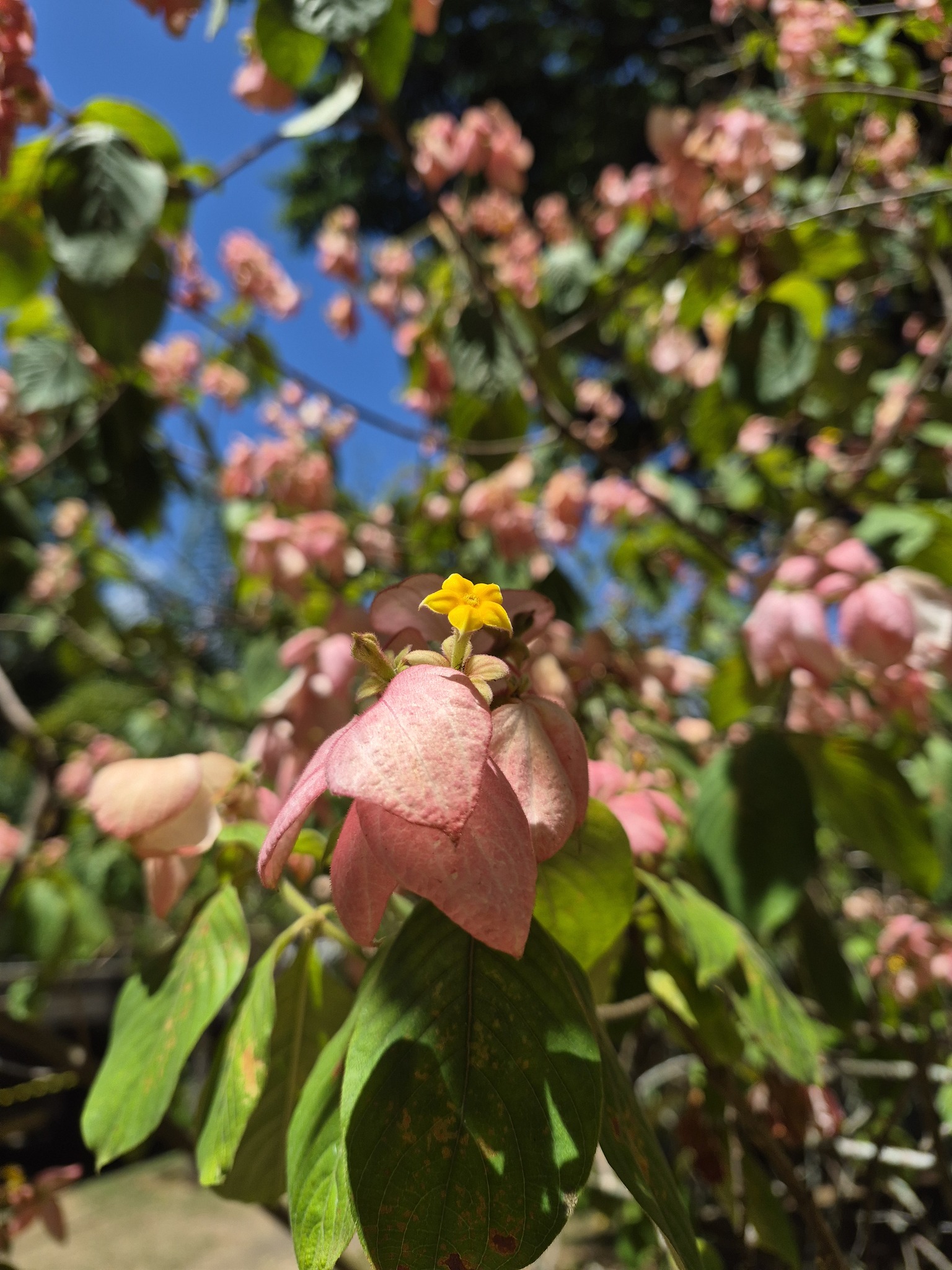
Philippine mussaenda (Mussaenda philippica) is an upright evergreen shrub native to the Philippines, producing clusters of small, star-shaped yellow flowers framed by enlarged, velvety white calyx lobes. The plant blooms continuously across warm months, creating a dense canopy of foliage and white bracts.
This tropical shrub requires warm conditions and will drop foliage if temperatures fall below 10 °C (50 °F). In temperate zones, gardeners keep it in large 40–60 L (10–15 gal) rolling containers moved indoors before the first autumn cold snap.
Key Facts
- Light: Full sun to light afternoon shade
- Water: Keep consistently moist; water when top 2.5 cm (1 in) dries
- Cold limit: Defoliates below 10 °C (50 °F); USDA zones 10–12
- Soil: Rich, acidic loam with pH 5.5–6.5
- Feeding: High-potassium fertilizer every 4 weeks in warm months
Growing Philippine Mussaenda: Garden Fit and Climate Limits
Philippine mussaenda is suited to frost-free tropical gardens or heated conservatories where year-round temperatures stay above 15 °C (59 °F). It suits growers looking for sustained summer colour in coastal or humid landscapes, provided strong wind protection is available to prevent its soft bracts from bruising.
Because it grows rapidly and spreads up to 3 m (10 ft) wide, place this shrub where it has room to expand without encroaching on paths. Outside USDA zones 10 to 12, grow it in large containers on wheels that move into a greenhouse or bright sunroom before autumn nighttime temperatures dip into single digits.
How to Identify Mussaenda philippica
You can identify Philippine mussaenda by its opposite, ovate green leaves and dense terminal cymes carrying small tubular yellow-orange corollas surrounded by enlarged, chalk-white calyx lobes. The leaves measure 8–15 cm (3–6 in) long with prominent pinnate venation and fine downy hairs on the undersides.
While the true flowers are five-lobed and measure only 1.5–2 cm (0.6–0.8 in) across, one calyx lobe per flower enlarges into an ovate, petal-like white calycophyll up to 8 cm (3.1 in) long. In the wild form, only one sepal per flower expands, whereas cultivated forms produce heads where nearly all sepals enlarge into white leaf-like clusters.
Mature Size and Growth Rate
A landscape specimen grows to a mature height of 3 to 4.5 m (10 to 15 ft) with an equal spread within five to seven years in warm ground. Under warm, wet tropical conditions, new shoots can add 60–90 cm (24–36 in) of vertical growth in a single growing season.
Container-grown specimens remain smaller, typically topping out at 1.5–2 m (5–6.6 ft) tall when restricted by a 40–50 cm (16–20 in) root ball. Annual post-bloom pruning keeps plants bushy and prevents the central framework from becoming leggy or sparse.
Best Light and Soil for Mussaenda
Philippine mussaenda requires at least six hours of direct sunlight daily to produce dense foliage and prolific white bracts. Shaded plants develop thin, weak stems with pale green leaves and fail to expand their signature white calycophylls.
The root system requires moisture-retentive, loose soil with good drainage to thrive:
- Soil pH: Acidic to neutral, strictly within 5.5 to 6.5 to prevent iron chlorosis.
- Drainage: Sand or perlite mixed into heavy clay to prevent standing water around feeder roots.
- Organic matter: A 5 cm (2 in) layer of aged compost worked into the top 20 cm (8 in) of earth before planting.
- Wind shelter: Position near a wall, fence, or windbreak to protect delicate bracts from tearing.
How to Plant Mussaenda in Ground and Pots
Plant container-grown stock in spring or early summer by digging a hole twice as wide as the root ball and equal to its depth. Settle the root collar flush with the surrounding soil grade, backfill with amended native soil, and water thoroughly to eliminate air pockets.
Follow these steps to establish a healthy plant:
- Soak the root ball in water for 15 minutes before sliding it out of the nursery pot.
- Gently untangle circular roots at the bottom of the root mass with your fingers.
- Firm the soil around the base and build a 7 cm (3 in) watering basin around the drip line.
- Spread a 5 cm (2 in) layer of pine bark mulch around the base, keeping it 10 cm (4 in) clear of the main trunk.
Watering and Feeding Routine
Water mature garden shrubs deeply whenever the top 2.5 cm (1 in) of soil feels dry to the touch, which typically equates to 25–35 mm (1–1.4 in) of water per week in summer. Potted plants dry out much faster and may require daily watering during heat waves exceeding 30 °C (86 °F).
Support continuous floral bract production with a disciplined nutrition plan:
- Apply a balanced, slow-release granular fertilizer formulated for acid-loving shrubs (such as 10-10-10 with micronutrients) once every 6 to 8 weeks from March through August.
- Supplement monthly with liquid potassium and magnesium if flower production slows.
- Apply chelated iron drench if new leaves display bright yellow tissue between green veins.
- Cease all fertilizer applications by late September to prevent tender late growth vulnerable to autumn chills.
How to Prune Mussaenda for Dense Flowering
Prune the shrub heavily in late winter or early spring just as new growth buds begin to swell. Because the plant sets flowers on current season’s wood, early structural cuts increase the number of blooming tips for the coming summer.
Maintain healthy shape and airflow by pruning systematically:
- Cut back main branches by one-third to one-half their length to maintain a dense, compact framework.
- Remove dead, broken, or crossing wood flush against parent stems.
- Pinch back new soft branch tips in late spring to trigger secondary and tertiary branching.
- Deadhead spent flower clusters back to the nearest leaf axil throughout summer to stimulate fresh buds.
Mussaenda Plant Care in Winter
Protect the plant whenever night temperatures threaten to drop below 10 °C (50 °F), as sustained cold induces severe leaf and bract drop. Even brief light frosts at 0 °C (32 °F) will kill soft branch tips down to thick woody tissue.
In non-tropical zones, transition potted shrubs indoors using these winter precautions:
- Bring containers inside before outdoor temperatures drop below 12 °C (54 °F) at night.
- Place near an unobstructed south-facing window or beneath an LED grow light running 12 hours daily.
- Cut watering frequency in half, allowing the top 5 cm (2 in) of potting mix to dry between waterings.
- Maintain room humidity above 50% using a cool-mist humidifier; avoid placement near heating vents.
Troubleshooting Common Pests and Growing Problems
Foliar yellowing and sap-sucking insects represent the primary challenges when growing this species outside its native Philippine rainforest habitat. Inspect the undersides of leaves weekly, especially during dry spells when spider mites proliferate.
Identify common symptoms with these solutions:
- Interveinal chlorosis: High soil pH causing iron deficiency; drench soil with chelated iron and incorporate sulfur pellets.
- Whiteflies and mealybugs: White waxy deposits or flying insects under leaves; spray thoroughly with insecticidal soap or horticultural neem oil every 7 days.
- Sudden defoliation: Root chill or cold drafts below 10 °C (50 °F); move container to a warm, draft-free room.
- Root rot: Brown, mushy stems from waterlogged soil; reduce watering and repot into fresh mix containing coarse perlite.
Year-Round Maintenance for Philippine Mussaenda
| Spring | Prune back main branches by one-third in late winter or early spring before buds break. Apply a slow-release acidic shrub fertilizer and resume regular watering as active shoot growth emerges. |
|---|---|
| Summer | Water deeply twice weekly during dry weather, ensuring containers do not dry out completely. Apply monthly liquid potassium feed and pinch soft branch tips once in June to encourage dense lateral blooming. |
| Autumn | Cease high-nitrogen fertilizer applications by September. Move container plants indoors before nighttime temperatures drop below 12 °C (54 °F), placing them in a warm, sunny room. |
| Winter | Keep indoor plants at 16–24 °C (61–75 °F) in maximum bright light. Reduce watering so the top 5 cm (2 in) of soil dries out, and run a room humidifier to prevent dry-air leaf drop. |
Diagnosing Common Mussaenda Problems
| What you see | Likely cause | What to do |
|---|---|---|
| Yellow leaves with green veins on new growth | Iron deficiency from high soil pH above 6.8 | Drench roots with chelated iron and amend soil with agricultural sulfur to lower pH to 6.0. |
| Sudden leaf drop across entire branches | Exposure to temperatures below 10 °C (50 °F) or cold indoor drafts | Move the plant into a warm location above 16 °C (61 °F) away from exterior doors and air conditioners. |
| Sticky leaves covered in black soot | Sooty mold growing on honeydew secreted by aphids or scale insects | Wipe foliage clean with warm water and spray the undersides of leaves with insecticidal soap. |
| Browning, crisping tips on white bracts | Low air humidity or severe drought stress during hot winds | Water deeply at the base and run a cool-mist humidifier or install a windbreak screen. |
| Abundant foliage with few or no white bracts | Insufficient direct sunlight or excessive nitrogen fertilizer | Relocate to a site receiving at least six hours of direct sun and switch to a high-potassium bloom fertilizer. |
Popular Philippine Mussaenda Cultivars
- ‘Doña Aurora’ – all five calyx lobes enlarged, pure white, dense habit
- ‘Doña Alicia’ – soft rose-pink bracts, hybrid lineage
- ‘Queen Sirikit’ – pale pink flushed bracts with reddish margins
- ‘Doña Luz’ – deep rose-pink calycophylls, compact shrub habit
- ‘Rosea’ – pale pinkish-white bracts, vigorous growth rate
Landscape Uses and Companion Species
Philippine mussaenda functions well as a tall privacy hedge, mixed border accent, or specimen lawn shrub in frost-free climates. Its white bracts contrast against dark green foliage plants and bright tropical bloomers.
Combine this species with plants that share similar moisture and acidic soil preferences:
- Chinese hibiscus (Hibiscus rosa-sinensis) provides vivid red blooms alongside the white bracts.
- Scarlet mussaenda (Mussaenda erythrophylla) adds bold crimson bracts with identical cultural requirements.
- Ti plant (Cordyline fruticosa) contributes deep burgundy or variegated foliage for texture contrast.
- Yellow bell (Tecoma stans) delivers bright yellow tubular flowers and comparable drought tolerance once established.
- Golden trumpet (Allamanda cathartica) creates an evergreen flowering backdrop along fence lines.
Frequently Asked Questions
How to care for mussaenda plant in containers?
Plant in a 40–50 cm (16–20 in) pot with drainage holes using a peat-based, free-draining potting mix with pH 5.5–6.5. Water when the top 2.5 cm (1 in) dries, keep the pot in full sun, and bring it indoors before temperatures dip below 12 °C (54 °F).
How to propagate mussaenda from cuttings?
Take 10–15 cm (4–6 in) semi-hardwood stem cuttings in late spring, dip the basal cut into rooting hormone powder, and stick them into moist perlite-peat mix. Enclose the pot in a clear plastic bag or humidity dome at 24–28 °C (75–82 °F); roots establish within 4 to 6 weeks.
What is the difference between Mussaenda philippica and Mussaenda erythrophylla?
Philippine mussaenda (Mussaenda philippica) naturally produces white or creamy bracts and upright, woody stems. Red mussaenda (Mussaenda erythrophylla), native to tropical Africa, produces bright scarlet red bracts and has a more scrambling, vine-like growth habit.
Why is my mussaenda dropping its leaves in autumn?
Foliage drop occurs when air temperatures decline below 10 °C (50 °F) or when daylight drops sharply. Move potted plants into a bright, heated room above 16 °C (61 °F) and water sparingly until fresh spring growth emerges.
Is Philippine mussaenda safe for cats and dogs?
Philippine mussaenda is non-toxic to cats, dogs, and horses, with no known systemic poisons in its stems, leaves, or bracts. Ingestion of rough fibrous plant matter may cause minor, temporary stomach upset in pets.
Information about traditional or historical uses is provided for educational interest only and is not medical advice. Do not use any plant to treat a condition without speaking to a qualified professional.
Sources & Verification
Taxonomy and distribution are checked against the databases below. Care guidance is written for cultivated species only and reviewed by our editor. How We Build Plant Profiles →