
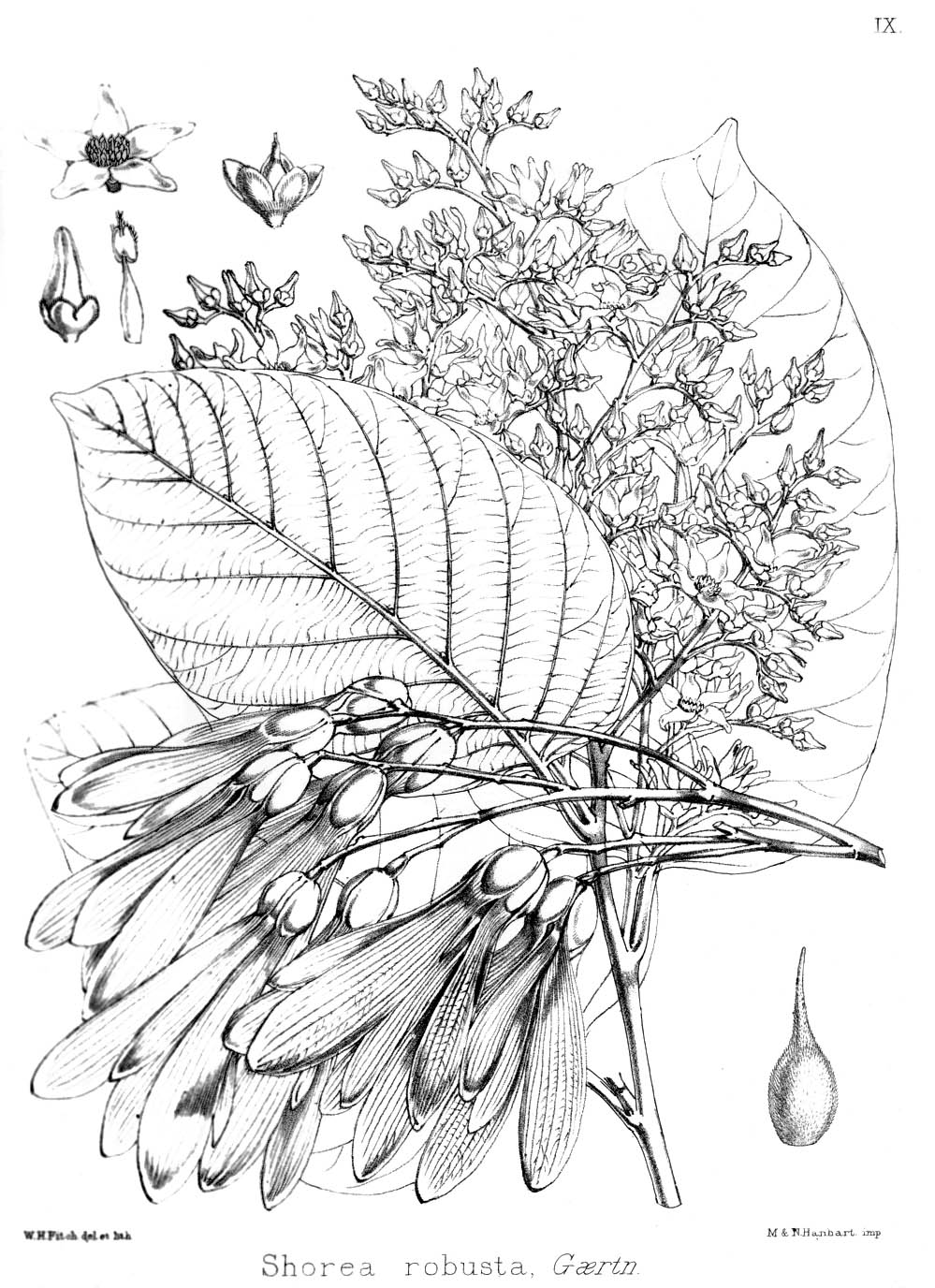
The Sal tree is a large, slow-growing hardwood native to the Indian subcontinent and the Himalayan foothills, belonging to the species Shorea robusta. It dominates forest ecosystems across India, Nepal, and Bangladesh, where it can reach heights of 35 m (115 ft).
While often confused with the Peepal tree (Ficus religiosa), the Sal tree is a member of the dipterocarp family and produces distinct winged fruits. It provides essential timber and resin but requires specific monsoonal conditions to thrive in its native range.
Key Facts
- Water: High during monsoon, drought-tolerant once established
- Growth Rate: Slow, reaching maturity over 80-100 years
- Sun: Full sun required for canopy development
- Soil: Deep, well-drained sandy loam
- Hardiness: Tropical and subtropical (USDA zones 10-12)
Is the Sal Tree Right for Your Landscape?
Growing a Sal tree requires large open spaces and a climate that mimics the seasonal monsoons of South Asia. It is not suitable for small residential gardens due to its massive mature size and deep taproot system that can interfere with underground utilities.
You should only plant this species if you can provide a permanent site where it can grow for a century or more. It is best suited for large estates, public parks, or reforestation projects in tropical and subtropical regions where frost is rare.
Identifying the Sal Tree
You can identify the Sal tree by its ovate-oblong leaves that measure 10-25 cm (4-10 in) long and its distinctively fissured bark. The leaves are leathery with a cordate or rounded base and a short, pointed tip, appearing in a glossy green color.
The bark on young trees is smooth and greyish, but it develops deep longitudinal fissures and a reddish-brown hue as the tree ages. In early spring, the tree produces small, yellowish-white flowers in terminal or axillary racemose panicles.
Mature Size and Canopy Shape
Mature Sal trees typically reach heights of 30 to 35 metres (100 to 115 feet) with a trunk diameter of up to 2 metres (6.5 feet). In forest conditions, the tree develops a long, straight, cylindrical bole with a narrow crown.
When grown in open spaces, the canopy becomes more spreading and globular, providing dense shade. The growth rate is slow to moderate, with saplings typically gaining 1 m (3 ft) of height per year during their first decade under ideal conditions.
Best Site and Soil for Planting
This species thrives in deep, moist, well-drained sandy loam with a slightly acidic pH between 5.0 and 6.5. It avoids areas with high water tables or heavy clay that restricts root respiration.
Choose a site in full sun, as Shorea robusta is a light-demander that will become stunted or spindly in the shade of other trees. It is particularly successful on gentle slopes where water drains away naturally during heavy monsoon rains.
Planting and Establishing Shorea robusta
Plant Sal seeds immediately after harvest because they lose viability within 7 to 10 days of falling from the tree. These seeds are recalcitrant, meaning they cannot be dried or stored for long periods without dying.
- Sow seeds 1 cm (0.4 in) deep in a nursery bed or permanent site.
- Space multiple trees at least 8-10 m (26-33 ft) apart to allow for canopy spread.
- Keep the soil consistently moist but not saturated during the germination phase.
- Provide light bamboo shielding for saplings during their first summer to prevent leaf scorch.
Watering and Care Requirements
Young trees need regular watering during the first three dry seasons until their deep taproot system is fully established. Once the tree reaches 5 m (16 ft) in height, it becomes significantly more drought-tolerant.
In its native range, the tree relies on the heavy rainfall of the monsoon season. If you are growing it in a region with a prolonged dry season, provide deep supplemental watering once every two weeks to prevent premature leaf drop.
Pruning and Managing Growth
Pruning should focus on removing lower branches to encourage a straight, clear bole if the tree is being grown for timber or structural form. If you are managing a mature specimen, hiring a professional tree service is recommended due to the extreme height of the canopy.
Conduct major structural work during the winter dormancy period to minimize sap loss and stress. Naturally, Shorea robusta is a self-pruning species in forest settings, but isolated trees may require thinning of crossing branches to improve air circulation.
Common Pests and Diagnosis
The most significant threat is the Sal heartwood borer (Hoplocerambyx spinicornis), a beetle that can devastate even healthy mature trees. If you notice large exit holes or wood dust at the base, consult a tree service specialist immediately.
- Sal Heartwood Borer: Look for resin flow and wood dust on the bark.
- Leaf Defoliators: Caterpillars may strip leaves in early summer; usually non-fatal.
- Polyporus Shoreae: A fungus causing root rot in waterlogged soils; ensure drainage.
- Iron Chlorosis: Yellowing leaves with green veins indicate soil pH is too high.
Winter Survival and Temperature Limits
Sal trees are sensitive to temperatures below 0 °C (32 °F) and can suffer severe dieback or death during prolonged frosts. They are best suited for USDA zones 10 through 12.
In areas with a distinct dry winter, the tree is deciduous, dropping its leaves in February or March to conserve moisture. New foliage typically emerges in April, accompanied by the flowering season, provided the soil remains slightly moist.
Traditional and Modern Uses
The Sal tree is primarily used for heavy construction timber, railway sleepers, and boat building due to its high resin content and durability. The wood is significantly harder than teak (Tectona grandis) and resistant to termite attacks.
The tree produces an aromatic resin known as ‘dammar’ or ‘ral’, which is traditionally used as an incense and for caulking boats. The seeds contain a fat known as Sal butter, which is used in the chocolate industry as a cocoa butter substitute and in traditional skin care.
Year-Round Care for Sal Trees
| Spring | Monitor for yellowish-white flowers and new leaf emergence. This is the primary time to watch for leaf-eating caterpillars. |
|---|---|
| Summer | Provide deep watering for young saplings before the monsoon begins. Check for signs of heartwood borer activity like resin seepage. |
| Autumn | Collect winged seeds for immediate sowing, as they lose viability in less than 10 days. Reduce supplemental watering as rains taper off. |
| Winter | Prune dead or damaged wood while the tree is dormant. In dry regions, expect leaf drop; do not overwater during this period. |
Sal Tree Health and Diagnosis
| What you see | Likely cause | What to do |
|---|---|---|
| Yellowing leaves with green veins | High soil pH (Iron chlorosis) | Apply chelated iron and mulch with acidic organic matter. |
| Large holes in trunk with wood dust | Sal heartwood borer | Remove and burn infested wood to prevent the spread to healthy trees. |
| Premature leaf drop in summer | Extreme drought stress | Increase deep watering frequency to reach the deep taproot system. |
Frequently Asked Questions
Is the Sal tree evergreen or deciduous?
The Sal tree is semi-deciduous, meaning it drops its leaves for a short period (February to April) in dry regions but may remain evergreen in wetter Himalayan valleys.
How long does a Sal tree take to grow?
It is a slow-growing species that typically takes 80 to 100 years to reach a size suitable for timber harvesting, though it can live for several centuries.
Is Sal tree and Peepal tree the same?
No, the Sal tree (Shorea robusta) and Peepal (Ficus religiosa) are different; Sal has ovate leaves and winged seeds, while Peepal is a fig with heart-shaped leaves and a long tail-like tip.
What is the Sal tree special for?
The Sal tree is famous for its exceptionally hard timber, its aromatic resin used in incense, and its sacred status in several South Asian religions.
Can I grow a Sal tree in a pot?
No, the Sal tree develops a massive taproot very early in its life, which will quickly become stunted or coiled in a container, leading to the tree's death.
Information about traditional or historical uses is provided for educational interest only and is not medical advice. Do not use any plant to treat a condition without speaking to a qualified professional.
Sources & Verification
Taxonomy and distribution are checked against the databases below. Care guidance is written for cultivated species only and reviewed by our editor. How We Build Plant Profiles →