
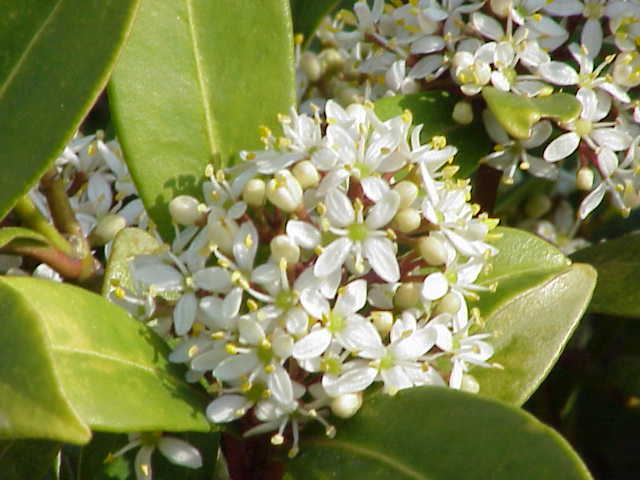
Japanese skimmia (Skimmia japonica) is a slow-growing evergreen shrub native to woodland understoreys across Japan, China, and Taiwan. It belongs to the citrus family Rutaceae and produces aromatic foliage alongside winter-persistent flower buds.
This acid-loving shrub requires partial to full shade, suffering foliage scorch and severe yellowing when exposed to full direct sun. Female plants produce bright red berries only when planted alongside a male pollinator.
Key Facts
- Height: 1–1.5 m (3.3–5 ft)
- Light: Partial shade to full shade
- Soil pH: 5.0–6.5 (acidic to neutral)
- Hardiness: USDA zones 6 to 8
- Toxicity: Mildly toxic to humans and dogs if ingested
Growing Japanese Skimmia in Woodland and Shade Borders
Japanese skimmia performs best in sheltered, shaded garden beds where soil remains damp and rich in organic matter. Its dense canopy of dark green leaves provides structure in sheltered north- or east-facing borders under tall trees. Because it tolerates urban pollution and heavy shade, it functions well in courtyard beds where light-demanding shrubs fail.
Planting requires damp soil with free drainage. Waterlogging rots the root system within weeks during cold winter weather. Gardens with alkaline chalk soils require planting in containers filled with ericaceous compost rather than directly in ground soil.
What Japanese Skimmia Looks Like
Japanese skimmia forms a mounded evergreen shrub reaching 1–1.5 m (3.3–5 ft) tall and wide after 10 to 15 years. The alternate, leathery leaves measure 7–12 cm (2.8–4.7 in) long, displaying a deep glossy green upper surface with lighter undersides that release a spicy citrus aroma when bruised.
Pink to dark red flower buds form in late autumn and persist through winter at the branch tips. In mid to late spring, these open into star-shaped white or creamy-pink flowers measuring 6 mm (0.24 in) across. Fertilized female cultivars produce round red berries measuring 8–10 mm (0.31–0.39 in) in autumn that linger into winter.
- Foliage: Evergreen, lanceolate leaves, 7–12 cm (2.8–4.7 in) long.
- Buds & Flowers: Reddish winter buds opening to fragrant white 4-petaled spring flowers.
- Fruit: Glossy red spherical drupes on female plants from October to February.
Japanese Skimmia Size and Growth Rate
Japanese skimmia grows at a slow rate of 10–15 cm (4–6 in) per year, taking over a decade to reach maximum height. Dwarf cultivars such as ‘Rubella’ stay around 75 cm (30 in) tall, whereas wild varieties in low-light woodland can slowly reach up to 2 m (6.6 ft).
Its slow habit makes frequent pruning unnecessary. You can easily maintain planted specimens within tight borders, patio containers, or low hedges next to common box (Buxus sempervirens) without risk of rapid overgrowth.
Where to Plant Japanese Skimmia
Position Japanese skimmia in dappled sunlight or full shade with protection from direct afternoon sun. Strong sunlight breaks down leaf chlorophyll, turning green foliage pale, yellow, or bleached brown.
The root system requires an acidic to neutral soil pH between 5.0 and 6.5. Alkaline soils inhibit iron absorption, triggering severe interveinal chlorosis across the foliage. Select a site protected from harsh, drying winter winds to prevent leaf scorching alongside companions like English holly (Ilex aquifolium).
- Sun Exposure: North- or east-facing borders; partial to full shade.
- Soil Type: Humus-rich, moist, free-draining acidic soil.
- Wind Protection: Shelter from dry freezing winter gusts.
How to Plant Japanese Skimmia
Plant Japanese skimmia in autumn or early spring when soil temperatures stay above 7 °C (45 °F). Dig a hole twice as wide as the root ball and equal in depth, ensuring the root flare sits level with the surrounding soil level.
Incorporate leaf mould or pine bark compost into heavy clay soils to loosen structure and boost acidity. Apply a 5 cm (2 in) mulch layer of bark chippings around the root zone, keeping mulch 3 cm (1.2 in) away from the main stems.
- Timing: September to October or March to April.
- Spacing: Space plants 90–120 cm (35–47 in) apart for continuous borders.
- Container Mix: Use 80% ericaceous compost blended with 20% coarse perlite or grit.
Japanese Skimmia Care and Maintenance
Water established plants during dry periods to maintain consistent soil moisture without saturation. Young shrubs require 10–15 litres (2.6–4 gal) of water weekly during their first summer season in the ground.
Apply a slow-release ericaceous fertilizer in early spring at a rate of 35 g/m² (1 oz/sq yd). Use rainwater or acidified water for container plants, as tap water containing high lime levels steadily raises compost pH and causes yellow leaves.
How to Prune Japanese Skimmia
Prune Japanese skimmia in late spring immediately after flowering ends to shape the shrub without removing winter flower buds. Cut back stray branches by 5–10 cm (2–4 in) using clean secateurs, trimming back to a healthy leaf node.
Avoid heavy hard pruning into old bare wood, as re-growth from old timber is unreliable and slow. Remove dead, damaged, or crossing branches in April before new growth expands.
- Sanitation: Clean secateur blades with 70% isopropyl alcohol before pruning.
- Timing: April or May, straight after blooms fade.
- Technique: Selective tip-pruning rather than shearing.
Japanese Skimmia Leaf Yellowing and Pests
Yellowing foliage on Japanese skimmia usually indicates lime-induced chlorosis or overexposure to sunlight. Check soil pH with a test kit and top-dress with sequestered iron if leaves turn yellow while veins stay green.
Watch for horse chestnut scale (Pulvinaria regalis) and spider mites under dry summer conditions. Scale insects leave white woolly egg masses on stems, while red spider mites cause fine stippling on leaf surfaces under warm, low-humidity conditions.
- Chlorosis: Treat with iron chelates and ericaceous feed.
- Scale Insects: Spray with horticultural oil in early spring.
- Spider Mites: Increase moisture around foliage and hose down leaf undersides.
Japanese Skimmia Hardiness and Winter Care
Japanese skimmia is fully hardy down to -15 °C (5 °F), corresponding to USDA hardiness zones 6 through 8. Extended cold periods below this threshold damage tender branch tips and evergreen foliage.
Protect potted specimens during severe frosts by wrapping containers in bubble wrap to prevent root freezing. Ensure garden soils do not remain waterlogged during winter months, as cold wet roots cause winter dieback.
Berries, Toxicity, and Male vs Female Plants
Japanese skimmia is a dioecious species requiring one male plant for every six female plants to achieve berry fertilization. Male cultivars produce larger, more fragrant flower clusters but no fruit, while females produce red berries following pollination.
All plant parts contain skimmianine alkaloids, making the foliage and red berries mildly toxic to humans, dogs, and cats if eaten. Ingesting foliage causes nausea, stomach cramps, and vomiting, though wild birds safely consume the mature berries during winter months.
Frequently Asked Questions
Is Japanese skimmia evergreen?
Yes, Japanese skimmia is a fully evergreen shrub that retains dark green foliage year-round across USDA zones 6 to 8.
Is Japanese skimmia poisonous to dogs?
Yes, Japanese skimmia contains skimmianine alkaloids that cause vomiting, diarrhea, and drooling in dogs if leaves or berries are ingested.
Is Japanese skimmia deer resistant?
Yes, Japanese skimmia is considered deer resistant due to the bitter alkaloids and aromatic essential oils present in its leathery foliage.
How do you prune Japanese skimmia?
Prune Japanese skimmia in late spring right after flowering by lightly cutting stems back to strong leaf buds with clean secateurs.
Is Japanese skimmia invasive?
No, Japanese skimmia is not invasive in North America or Europe; it expands slowly by 10–15 cm (4–6 in) annually and does not spread aggressively by runners or self-seeding.
How to propagate Japanese skimmia?
Propagate Japanese skimmia by taking 7–10 cm (3–4 in) semi-ripe stem cuttings in late summer, dipping them in rooting hormone, and keeping them in humid cold frames.
Sources & Verification
Taxonomy and distribution are checked against the databases below. Care guidance is written for cultivated species only and reviewed by our editor. How We Build Plant Profiles →
- Royal Horticultural Society (RHS)rhs.org.uk
- Missouri Botanical Gardenmissouribotanicalgarden.org
- NC State University Extensionplants.ces.ncsu.edu
- ASPCA Animal Poison Controlaspca.org
- GBIF — Global Biodiversity Information Facilitytaxonomy, synonyms, occurrence records
- Plants of the World Online (Kew)accepted name, native range
- Wikipediageneral reference