
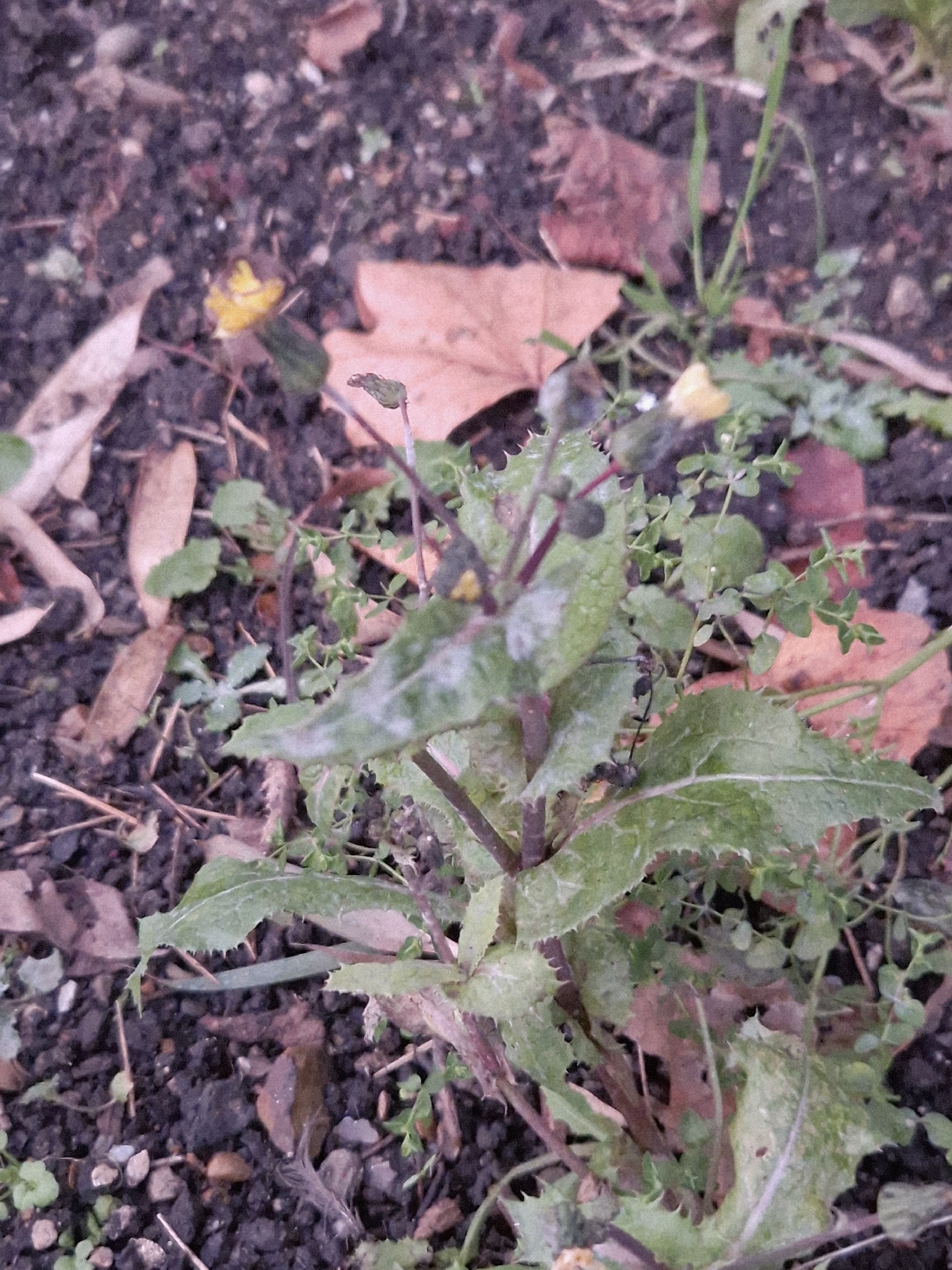
Prickly sow-thistle (Sonchus asper) is an upright annual or overwintering biennial herb in the daisy family, native across Eurasia and North Africa but established worldwide in disturbed soils. It is distinguished by glossy green leaves with stiff, spiny margins and curved basal auricles that clasp the stem tightly.
While often treated as an aggressive agricultural weed, its bitter spring leaves have a long history of human foraging. The plant can produce up to 25,000 windborne seeds per specimen, allowing it to colonise disturbed borders within weeks.
Key Facts
- Plant type: annual or overwintering biennial herb
- Native origin: Europe, North Africa, and temperate Asia
- Height: 30–150 cm (12–60 in) tall
- Flowers: bright yellow ray florets from late spring to autumn
- Sap: exudes thick, white latex when broken
Encountering Prickly Sow-Thistle in Gardens and Fields
Prickly sow-thistle behaves as an opportunistic pioneer plant that establishes rapidly anywhere topsoil has been turned or vegetation stripped back. It thrives under high nitrogen conditions, meaning vegetable patches, compost heaps, and disturbed field edges are the primary places you will spot its spiny rosettes.
Because it germinates across a broad thermal window from 5 to 35 °C (41–95 °F), new seedlings can appear in both early spring and late autumn. If left to bolt, the hollow central stem shoots upward rapidly, taking moisture and nutrients from adjacent cultivated crops.
Prickly Sow-Thistle Identification: Leaves, Stems, and Flowers
You can identify prickly sow-thistle by examining its glossy leaf texture and rounded, stem-clasping basal lobes. The plant forms a basal rosette before sending up a ribbed, hollow flowering stalk that reaches 30–150 cm (12–60 in) in height.
Key diagnostic features to look for on a mature specimen include:
- Foliage: dark green, waxy, unlobed or pinnatifid leaves with sharply spinose-dentate margins that feel stiff to the touch.
- Auricles: curved, rounded lobes at the leaf base that clasp the stem closely.
- Stems: smooth, greenish to reddish-purple stalks containing bitter white latex sap.
- Inflorescence: corymbose clusters of yellow, ligulate flower heads measuring 1.5–2.5 cm (0.6–1.0 in) across.
- Fruit: flattened brown achenes topped with a silky white pappus for wind dispersal.
Habitat and Distribution of Rough Milk Thistle
Rough milk thistle has colonised all inhabited continents, showing strong affinity for ruderal habitats and agricultural ecosystems. While indigenous to the Mediterranean Basin, temperate Europe, and Central Asia, international commerce helped spread its achenes globally during the nineteenth and twentieth centuries.
The species occupies diverse environments where bare soil allows rapid root development:
- Arable cropland, particularly brassica, potato, and cereal plantings
- Roadside verges, railway ballast, and urban demolition grounds
- Pasture margins and livestock paddocks with compacted earth
- Riverbanks and gravel bars with seasonal sediment disturbance
Ecological Value and Wildlife Interactions
The flower heads provide a readily accessible nectar and pollen source for hoverflies, solitary bees, and generalist pollinators from June through October. The broad, flat ray florets allow short-tongued insects that cannot reach the nectar of tubular blossoms to feed freely.
Small seed-eating birds, particularly the European goldfinch (Carduelis carduelis), systematically strip the ripening achenes from late summer seed heads. Additionally, the leaves host larvae of polyphagous moths and leaf-mining flies in the genus Phytomyza, making the weed a quiet contributor to local food webs despite its unruly reputation.
Weed Control and Agricultural Impact
Eradicating prickly sow-thistle requires severing the central taproot below the crown before the yellow flower heads shed seed. Because a single plant can release up to 25,000 seeds that travel miles on gentle breezes, prompt intervention prevents long-term seed bank accumulation.
Effective management strategies in garden beds and farm plots include:
- Hand pulling: wear leather gloves to protect fingers from spiny leaf margins, and pull when soil is moist to extract the entire 15–30 cm (6–12 in) taproot.
- Mulching: maintain an 8 cm (3 in) layer of coarse organic mulch to block light triggers required for achene germination.
- Mowing: cut bolting plants down before petals emerge, though monitor for low-growing secondary shoots that often regenerate from the severed base.
Foraging History and Traditional Uses
Humans have harvested young foliage of the sow-thistle family as a cooked pot herb or bitter green for thousands of years. Early Roman foragers collected tender basal leaves in early spring, boiling them with olive oil to reduce bitterness before spines hardened.
In historic herbal traditions across southern Europe, the cooling milky latex was traditionally used in folk poultices applied to minor cutaneous irritations and skin abrasions. While older stems become unpalatably fibrous and acrid, modern wild-food foragers occasionally simmer young spring shoots as a substitute for wild spinach or chicory.
Distinguishing Prickly Sow-Thistle from Look-Alikes
Prickly sow-thistle is most often confused with common sow-thistle (Sonchus oleraceus), which features dull, matte leaves and sharply triangular, pointed basal lobes rather than rounded, curling auricles. It is also mistaken for prickly lettuce (Lactuca serriola), which carries a distinctive line of stiff prickles along the underside of the main leaf midrib where prickly sow-thistle remains smooth.
Gardeners researching milk thistles also encounter several other prickly Asteraceae:
- Milk thistle (Silybum marianum): often sought as “cardo mariano,” this robust biennial bears prominent white marbled leaf veins and large, solitary purple flower heads wrapped in vicious spines.
- Cardoon (Cynara cardunculus): an enormous Mediterranean perennial with grey-green, deeply incised leaves and large violet artichoke-like heads.
- Dandelion (Taraxacum officinale): produces single yellow flower heads on hollow, leafless scapes originating strictly from a basal rosette.
Frequently Asked Questions
Is prickly sow-thistle edible?
Yes, the young leaves and tender shoots are edible before the plant bolts and develops tough spines. They have a bitter flavour similar to chicory and are usually boiled or sautéed in olive oil.
How does prickly sow-thistle differ from cardo mariano?
Cardo mariano refers to milk thistle (Silybum marianum), which produces large purple blossoms and leaves with striking white marbling. Prickly sow-thistle produces small yellow flower heads and uniformly green foliage.
Is Sonchus asper toxic to dogs or livestock?
Prickly sow-thistle is considered non-toxic to domestic pets and grazing livestock. In fact, pigs and rabbits readily consume the foliage, which is the historical origin of the common name sow-thistle.
Why is prickly sow-thistle so hard to pull out by hand?
The plant anchors itself with a strong, deep vertical taproot that can reach 30 cm (12 in) into compacted subsoil. Stems frequently snap off at the soil line if pulled without loosening the ground first, allowing the root crown to re-sprout.
How can you tell prickly sow-thistle from wild lettuce?
Inspect the underside of the leaf midrib: wild prickly lettuce (Lactuca serriola) has a single distinct row of stiff spines running along the central vein, while the leaf midrib of prickly sow-thistle is completely smooth underneath.
Information about traditional or historical uses is provided for educational interest only and is not medical advice. Do not use any plant to treat a condition without speaking to a qualified professional.
Sources & Verification
Taxonomy and distribution are checked against the databases below. Care guidance is written for cultivated species only and reviewed by our editor. How We Build Plant Profiles →
