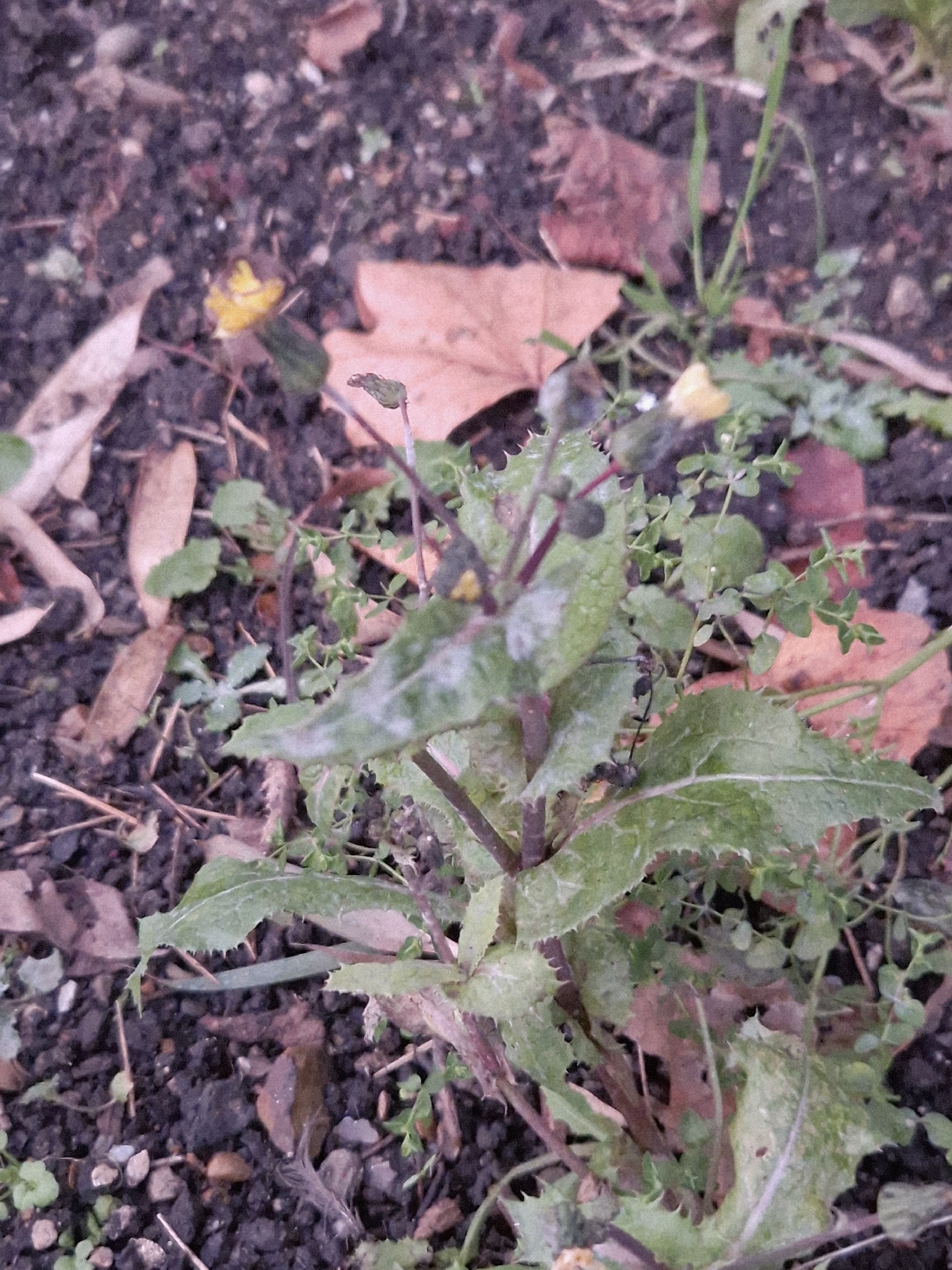
Corn sow thistle (Sonchus arvensis) is an erect, perennial herbaceous plant in the daisy family (Asteraceae), native to temperate Eurasia and naturalised throughout North America. It is recognised by its milky white sap, prickly-margined dandelion-like leaves, and golden-yellow flowerheads that open in the morning sun.
Unlike annual sow-thistles, this species spreads aggressively through brittle, creeping horizontal roots that quickly produce new aerial shoots whenever broken by cultivation equipment.
Key Facts
- Family: Asteraceae (sunflower or daisy family)
- Life cycle: deep-rooted creeping perennial
- Native range: Europe, western Asia, and northern Africa
- Root depth: underground root systems penetrate up to 2 m (6.5 ft)
- Edibility: young foliage and bitter leaves are cooked or eaten raw
- Flowering period: July through October
Encountering Corn Sow Thistle in the Wild
You will encounter corn sow thistle primarily as an aggressive coloniser of arable fields, roadsides, ditch banks, and neglected garden plots. Its persistence stems from horizontal underground root stocks that can store large amounts of carbohydrates throughout winter dormancy.
A single severed root fragment measuring only 1 cm (0.4 in) can generate a healthy new aerial shoot within weeks. Gardeners and land managers often encounter patches expanding outward in dense clonal rings that outcompete neighbouring vegetation for light and soil moisture.
How to Identify Sonchus arvensis
Identify corn sow thistle by its 3 to 5 cm (1.2 to 2 in) wide golden-yellow terminal flowerheads clustered at the top of stout, hollow stems. All vegetative tissues produce a sticky, milky white latex immediately when broken.
Key diagnostic features include:
- Stems: hollow, ribbed, glaucous green, reaching 60 to 150 cm (2 to 5 ft) in height, often coated in coarse yellowish gland-tipped hairs near the top.
- Leaves: alternate, clasping the stem with rounded basal auricles; lower leaves are deeply pinnatifid with spiny-toothed edges, measuring 10 to 35 cm (4 to 14 in) long.
- Flowerheads: dense heads of ligulate florets surrounded by involucral bracts densely covered with yellow-tipped glandular hairs.
- Seeds: ribbed, dark brown achenes measuring 2.5 to 3.5 mm (0.1 in), tipped with a fluffy white pappus of fine bristles.
Habitat and Distribution
Corn sow thistle thrives in deep, moist, nitrogen-rich soils with full sunlight exposure. While native to Europe and temperate Asia, human commerce introduced it worldwide as an agricultural contaminant in seed grain.
The plant demonstrates broad ecological tolerance across temperate regions, growing comfortably in heavy clay soils, riverbanks, reclaimed industrial land, and railway ballast. Cold winter temperatures do not kill the creeping root network, allowing the species to persist into subarctic agricultural belts across Canada and Scandinavia.
Ecological Value and Wildlife Interactions
Corn sow thistle flowers provide large quantities of pollen and nectar to over 40 species of native solitary bees, hoverflies, and butterflies during midsummer. The abundant late-season composite flowerheads supply essential forage when many springtime meadow blossoms have set seed.
Goldfinches and other small passerine birds feed heavily on the nutrient-dense achenes in late autumn. However, grazing livestock such as sheep, cattle, and swine consume the bitter foliage readily, giving the genus its historic common name.
Agricultural Weed Status and Management
In commercial crop production, corn sow thistle can cause crop yield losses exceeding 30% in cereal grains and oilseed crops when left uncontrolled. Tillage operations often worsen infestations by slicing horizontal root chains into dozens of viable regenerative segments.
Effective eradication in wild or managed borders requires specific physical strategies:
- Exhausting root carbohydrate reserves through repeated mechanical severance at the 4-leaf stage every 21 days.
- Applying heavy sheet mulches over small patches for a minimum of 18 consecutive months.
- Preventing seed production by cutting flowering heads before ray florets wither into fluffy white seed tufts.
Traditional Medicinal and Edible Uses
The young basal leaves of corn sow thistle are collected in early spring before bitter compounds accumulate, and eaten raw in salads or boiled as potherbs. In historical European herbalism and traditional Indonesian medicine, the dried leaves—termed Sonchus arvensis folium—were traditionally used as a diuretic and for managing urinary discomfort.
The plant contains flavonoids, cichoriin, and phenolic acids that give mature leaves a sharp, astringent flavour. While historically simmered into cleansing teas or applied as poultices on swollen joints, modern culinary usage remains limited to foraging tender, young spring greens.
Distinguishing Corn Sow Thistle from Similar Species
Corn sow thistle is distinguished from annual sowthistles primarily by its creeping perennial root system and glandular flowerheads. Annual and biennial relatives snap off cleanly at the root collar when pulled, whereas Sonchus arvensis snaps along brittle subterranean runners.
Look-alike species include:
- Common sowthistle (Sonchus oleraceus): an annual with pointed leaf auricles and distinctly smaller flowerheads under 2.5 cm (1 in) across, usually hairless.
- Prickly sowthistle (Sonchus asper): an annual displaying stiff, glossy leaves with strongly rounded, curled basal auricles and sharply prickly margins.
- Creeping thistle (Cirsium arvense): a perennial sharing similar horizontal root networks, but bearing sharp spines and pale purple to pinkish flowerheads instead of yellow.
Frequently Asked Questions
Is corn sow thistle edible?
Yes, young spring leaves are edible raw in salads or boiled as greens before flowering stems emerge. Once flowering begins in summer, the foliage develops a bitter, astringent latex.
What is Sonchus arvensis folium?
Sonchus arvensis folium is the pharmaceutical name for dried corn sow thistle leaves, traditionally used in herbal preparations as a mild diuretic.
What plant family does Sonchus arvensis belong to?
Corn sow thistle belongs to the family Asteraceae, also known as the daisy, sunflower, or composite family.
How does corn sow thistle spread across farmland?
The plant spreads via airborne wind-dispersed seeds equipped with a feathery pappus, as well as brittle horizontal creeping roots that generate new stems from severed fragments.
Is corn sow thistle toxic to grazing animals?
No, it is non-toxic to livestock, and sheep, cattle, and pigs graze the foliage without ill effects.
Information about traditional or historical uses is provided for educational interest only and is not medical advice. Do not use any plant to treat a condition without speaking to a qualified professional.
Sources & Verification
Taxonomy and distribution are checked against the databases below. Care guidance is written for cultivated species only and reviewed by our editor. How We Build Plant Profiles →